



KAIST Develops AI-Based Gene Transcription Factor Prediction System
 Published2021.01.01 10:05
Predicting transcription factors that regulate the copying process
Development of 'DeeptiFactor' for rapid protein sequence analysis
A joint research team led by Professor Sang-Yeop Lee of the Department of Chemical and Biomolecular Engineering at the Korea Advanced Institute of Science and Technology (KAIST) and Professor Bernhard Palsson of the Department of Biomolecular Engineering at the University of California, San Diego (UCSD) announced on the 29th that they have developed a 'DeepTFactor' system that uses AI to predict transcription factors that control gene transcription (the process of copying genetic information).
Analyzing gene transcription mediated by transcription factors can help us understand how organisms respond to genetic or environmental changes to control gene expression. In this sense, identifying an organism's transcription factors is the first step toward analyzing its transcriptional regulatory system.
Until now, to find new transcription factors, we have analyzed homology (similar properties) with already known transcription factors or used data-based approaches such as machine learning.
To utilize existing machine learning models, it is necessary to rely on specialized knowledge of the problem to be solved, such as calculating the physicochemical properties of molecules or analyzing the homology of biological sequences, to identify features to use as input values for the model.
Deep learning has recently been utilized in various fields of biology because it can inherently learn potential features for problem solving. However, in the case of prediction systems using deep learning, the inference process cannot be directly confirmed due to the complex calculations within the system.
.jpg)
[Image = KAIST]
DeeptiFactor, developed by the joint research team, utilizes three parallel convolutional neural networks (CNNs) to predict transcription factors from protein sequences. Using DeeptiFactor, the joint research team predicted 332 transcription factors in Escherichia coli and identified the genome-wide binding sites of three of them, validating DeeptiFactor's performance.
Furthermore, the joint research team used a saliency map-based deep learning model interpretation methodology to understand DeeptiFactor's inference process. This methodology confirmed that, although information about the DNA binding region of transcription factors is not explicitly provided during DeeptiFactor's learning process, it implicitly learns this information and utilizes it for prediction.
Professor Lee Sang-yeop said, “Using DeeptiFactor, we can quickly analyze newly discovered protein sequences and numerous protein sequences that have not yet been characterized,” and “This will be utilized as a basic technology for analyzing the electronic regulatory networks of organisms.”
Meanwhile, this study was conducted with support from the Ministry of Science and ICT's Climate Change Response Technology Development Project's System Metabolic Engineering for Biorefinery Source Technology Development Project. Additionally, it was published on December 28th in the international academic journal Proceedings of the National Academy of Sciences of the United States of America (PNAS) under the title 'DeepTFactor: A deep learning-based tool for the prediction of transcription factors.'
Comments
Related news
.jpg)
'Perfect Logistics Automation' Built by Adding Deep Learning to Machine Vision
Cognex has announced applications of its Insight Vision System, a deep learning-based machine vision solution used in packaging inspection automation, and image-based barcode readers. The Insight Vision System is a deep learning-based machine vision solution that integrates advanced automation technology into manufacturing, enabling companies to perform packaging inspection more efficiently. Cognex's combination of machine vision, deep learning, barcode reading, and barcode verification technologies ensures that primary and secondary packaging are properly sealed throughout the manufacturing and distribution process, correctly assembled without tampering, and ultimately free of defects. Consequently, unnecessary rework can be reduced and product recalls can be prevented.
2020.11.11by 김동우 기자
Xilinx Provides Deep Learning Models for AI Medical Device Development
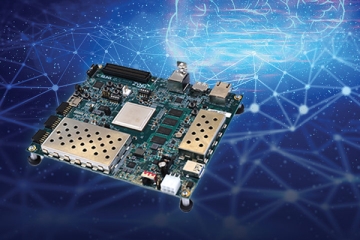
Recent demand in the medical field is increasing for AI-based solutions that rapidly process and analyze patient data collection. The COVID-19 pandemic, where healthcare provider fatigue accumulation has become a problem, is accelerating this trend. As demand for telemedicine is also growing, devices capable of AI processing at the edge are being required. In response, Xilinx has collaborated with Spline.ai to release a medical X-ray classification deep learning model that functions perfectly on AWS and an FPGA-based Zynq UltraScale Healthcare AI Starter Kit.
2020.11.17by 이수민 기자
.jpg)
How to develop AI models optimized for embedded systems?
Digitalization is accelerating across nearly all industries, and many companies are stepping up efforts to adopt AI. However, AI knowledge and experience among industry experts who will implement these initiatives remain insufficient. MathWorks is focusing on reducing the time and effort engineers spend developing AI models through MATLAB and other solutions with enhanced interoperability with deep learning frameworks.
2020.12.20by 이수민 기자
[e4ds Tech Day 2026 ⑨] Sim Sang-gyu, Autocrypt CTO: "In the Physical AI Era, Automotive Security Must Extend Beyond the Vehicle"
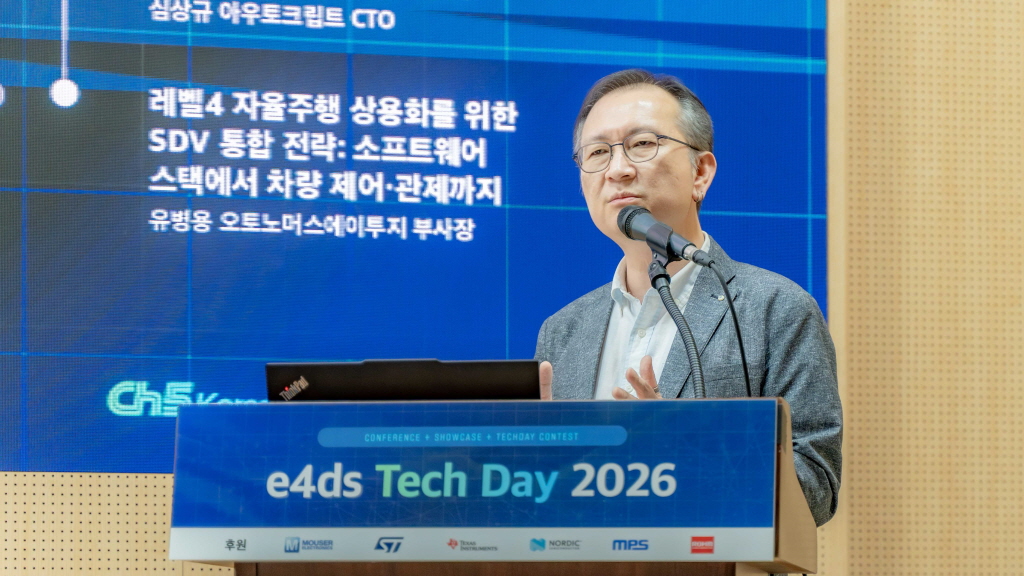
At e4ds Tech Day 2026, Sim Sang-gyu, CTO of Autocrypt, explained automotive cybersecurity strategies in the era of Physical AI and SDV (Software-Defined Vehicle). Automobiles are evolving as part of an ecosystem connected to AI, cloud, chargers, IoT, and robots, and he emphasized that the scope of security must expand beyond the vehicle interior to the entire connected environment. In particular, AI model tampering, adversarial attacks, OTA updates, and EV charger hacking were identified as major threats. He explained that response measures require zero trust, AI model integrity protection, intrusion detection, Security by Design and Default, and full lifecycle security management, and that proactive security system establishment beyond regulatory compliance is critical for securing future mobility competitiveness.
2026.10.12by 배종인 기자
NVIDIA to Invest $1 Billion in U.S. Science Over Next Five Years
NVIDIA has announced plans to invest $1 billion over the next five years to strengthen U.S. scientific and technological competitiveness. The company will enhance cutting-edge artificial intelligence research and development capabilities in key areas including quantum computing, healthcare, and energy security, while expanding support for higher education research institutions and cloud service providers. NVIDIA is participating as a major industry partner in the White House Office of Science and Technology Policy's Genesis Mission, and is promoting supercomputer construction in collaboration with national laboratories including Argonne and Los Alamos.
2026.10.12by 배종인 기자











