



Is the Odd Generation Mobile Technology Cruel? "6G Project Takes First Steps"
 Published2021.01.08 15:15
Investing 200 billion won over five years to secure high-risk 6G technology.
Supporting the creation of 6G standard patents and fostering specialized talent
Securing leadership in the global mobile communications market requires securing advanced technologies and standards. Recently, major global economies, including the US, China, and Europe, have entered a race to secure leadership in 6G, the next technology after 5G.
The Ministry of Science and ICT announced that it will pursue a project to develop core 6G technologies to secure leadership in future mobile communication networks and to respond to non-face-to-face and digital transformation.
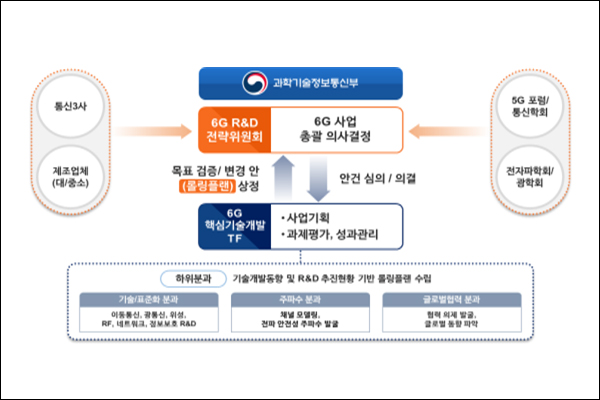
The 6G core technology development project passed a preliminary feasibility study in April 2020, with a total budget of KRW 200 billion for five years from 2021 to 2025. Subsequently, at the 12th Science and Technology Ministerial Meeting, the 'Future Mobile Communications R&D Promotion Strategy to Lead the 6G Era' was confirmed and announced, and the business announcement was implemented from December 18, 2020.
Through this project, the Ministry of Science and ICT plans to prioritize technological development in challenging and leading fields where it is difficult for the private sector to actively invest, such as the development of low-orbit satellite communication technology.
In 2021, a total of KRW 16.4 billion will be provided to 11 sub-projects, including KRW 10.8 billion in the ultra-performance and ultra-wideband field, KRW 2.3 billion in the ultra-space field, and KRW 3.3 billion in the ultra-precision and ultra-intelligence field, focusing on nine strategic technologies in five key areas.
The nine strategic technologies in the five key areas of focus are: ▲Ultra-performance (△Tbps-class wireless communication technology, △Tbps-class optical communication infrastructure technology), ▲Ultra-band (△THz-band RF core technology, △THz frequency development and safety evaluation technology), ▲Ultra-space (△3D space mobile communication technology, △3D space satellite communication technology), ▲Ultra-precision (△End-to-end ultra-precision network core technology), ▲Ultra-intelligence (△Intelligent wireless access technology, △Intelligent 6G mobile core network technology).
However, the strategic technology for internalizing 6G security in the ultra-reliable field will be supported through the 'Information Protection Core Source Technology Development Project (total of 7.5 billion won over 4 years)'.
◇ 6G commercialization will take hold after pilot services begin in 2026.
Based on the standard patent strategy map developed in cooperation with the Korean Intellectual Property Office, the Ministry of Science and ICT plans to apply the "IP-R&D" method, which analyzes patents around the world from the early stages of R&D and avoids or invalidates patents of foreign companies, to provide package support for R&D funds and standard patent acquisition strategies to companies and institutions.
In addition, a university-centered 6G Research Center (6G Re) was established to strengthen basic 6G research and cultivate specialized talents.We select a research center and provide support for up to 5 years to establish a research foundation.
Beginning in March 2021, we plan to establish and operate a "6G R&D Strategy Committee" to listen to the voices of industry and experts and share, verify, and coordinate the goals, progress, and achievements of the entire business.
Starting in 2026, when technological development is completed, a 6G upgrade pilot project will be launched to apply pre-commercial 6G technology to five major 5G+ services (smart city, smart factory, digital healthcare, realistic content, and autonomous vehicles), and support will be provided to ensure that the technologies developed through this project are established as services.
The business announcement will be held for about a month from Friday, December 18, 2020 to Monday, February 1, 2021, and detailed information can be found on the websites of the Ministry of Science and ICT and the National IT Industry Promotion Agency .
As the Ministry of Science and ICT explains, securing leadership in mobile communications technology requires advanced technological development and rapid adoption of standards. However, smooth 5G service delivery is still lacking, and both millimeter wave (mmWave) 5G SA services, which can be considered true 5G, and 5G MEC services for enterprises are still in the development stage.
There is a common belief in the industry that odd-numbered generation (1, 3) mobile communication technology is complemented by even-numbered generation (2, 4) technology.
Looking at the policies of companies and organizations, it seems highly likely that 5G will be completed by 6G. While technological development is important, providing services that resonate with consumers is also urgent. The time before 5G becomes a so-called "black history" is running out. Now is the time when the will and effort to improve services from those involved are urgently needed.
Comments
Related news
Investing 200 billion won in R&D over five years to secure leadership in 6G mobile communications technology.
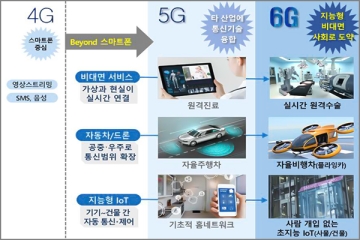
A 6G mobile communications technology R&D promotion strategy has been announced. With 6G commercialization expected to occur 10 years from now, the government will pursue three strategies: securing next-generation technology leadership, securing standards and patents, and establishing research and industrial foundations. This two-phase strategy will focus on technology development through 2025 and commercialization through 2028.
2020.08.07by 이수민 기자

Why is 6G commercialization being promoted when 5G has not yet taken hold?
Perspectives on 5G are not favorable. This is because its ultra-high-speed, ultra-low-latency, and ultra-connectivity characteristics have failed to deliver their intended performance even after more than a year since commercialization. 6G is a next-generation mobile communication technology that complements 5G with characteristics of ultra-performance, ultra-broadband, ultra-precision, ultra-spatial, ultra-intelligence, and ultra-reliability. With the Ministry of Science and ICT announcing plans to advance 6G R&D projects, we examined the differences between 5G and 6G.
2020.08.11by 이수민 기자
[Webinar Key Q&A] True 5G Depends on Millimeter Waves
5G signifies more than just next-generation mobile communications. For at least the next decade, 5G will lead wireless standards. To establish the foundation for a network that will operate for 10 years, we must anticipate what will happen going forward and prepare accordingly. The 5G plans of major countries already include not only the sub-6GHz band infrastructure that has been partially built, but also millimeter-wave band infrastructure deployment. Therefore, securing relevant technological capabilities will have a significant impact on future corporate competitiveness.
2020.11.09by 이수민 기자
European Patent Applications Surpass 200,000 for the First Time… South Korea Maintains 5th Place, Led by Batteries and Telecommunications
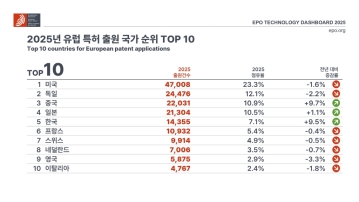
According to the European Patent Office (EPO)'s 'Technology Dashboard 2025', European patent applications last year reached 201,974, surpassing 200,000 for the first time. Korean companies and inventors filed 14,355 applications, representing a 9.5% increase from the previous year and maintaining 5th place by country. Battery, digital communication, and semiconductor technologies led the growth, with Samsung ranking as the top EPO applicant for the second consecutive year and LG reaching 3rd place. The presence of major domestic cities such as Seoul, Suwon, and Yongin was also confirmed. It was also revealed that Korea's European patent strategy is expanding beyond individual technologies to span the entire industry.
2026.03.24by 명세환 기자
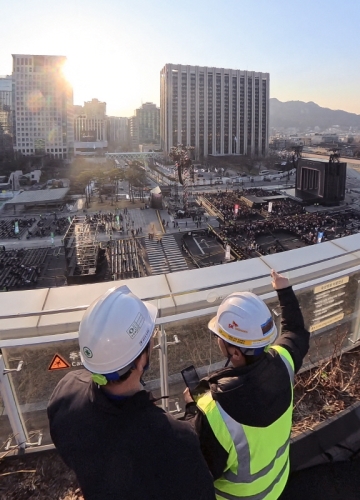
SK Telecom First Applies AI-Based Network Operations at Gwanghwamun K-Pop Concert
SK Telecom announced that it applied an AI-based network operation system for the first time at a large-scale K-pop concert held in the Gwanghwamun area of Seoul on March 21st, managing communication quality throughout the event. Mobile data usage during the three hours before and after the concert reached 12.15TB, approximately doubling compared to the same time slot the previous weekend. SK Telecom monitored traffic using the AI system 'A-One' in five-minute and 50-meter units to respond to potential overload situations, while also operating temporary communication facilities and on-site personnel in parallel. This case is interpreted as confirmation of the practical applicability of AI-based autonomous network operation in an environment where demand from dense events and foreign users increases simultaneously.
2026.03.23by 명세환 기자











