


The 1.6 trillion won Digital New Deal broke ground in 2020. What's the progress?
 Published2021.01.15 21:30
Non-ICT companies' participation in digital transformation increased by 85%.
Follow-up projects are being implemented across all ministries, with a scale of 7.6 trillion won.
The Digital New Deal is a project to overcome the economic downturn and unemployment caused by the COVID-19 pandemic, investing 44.8 trillion won in government funds by 2025. On the 15th, the Ministry of Science and ICT announced the progress and changes to projects under its jurisdiction that began in 2020, among the Digital New Deal projects jointly promoted by relevant ministries.

[Image = Ministry of Science and ICT]
Since the announcement of the Korean New Deal plan in July, the Ministry of Science and ICT has invested approximately 1.6 trillion won in the Digital New Deal and implemented 81 projects. A total of 12,486 domestic companies and institutions have participated, with small and medium-sized enterprises (SMEs) (10,843 companies) accounting for the largest proportion (86.8%) of the total.
The construction of the Data Dam, a core project of the Digital New Deal, strengthened the ecosystem across the entire data cycle of "collection-processing-utilization" and served as a foundation for the growth of new industries based on DNA (Data, Network, AI). Last year, many domestic existing software (SW) and system integration (SI) companies participated in the project.
Compared to 2019, the number of AI voucher suppliers (220 → 553 companies) and data voucher suppliers (393 → 765 companies) increased in 2020, and the number of 'crowd sourcing' platform companies for data processing also increased by approximately 2.6 times (15 → 39 companies).
Non-ICT companies' participation in digital transformation also increased by 85%. Among companies participating in the 2020 AI, data, and cloud voucher program, participation from non-ICT sectors such as education, beauty, distribution, healthcare, manufacturing, and fashion increased by 85% compared to 2019 (from 2,024 cases (62%) in 2019 to 3,751 cases (75.7%) in 2020).
The number of digital job seekers directly participating in the Digital New Deal project is 49,157. Furthermore, approximately 14,000 digital talents for the post-COVID-19 era have been produced through eight AI graduate schools, four AI convergence research centers, 40 software-focused universities, one innovation academy, and five ICT innovation squares.
In addition, 1,000 'digital learning centers' were operated in 17 metropolitan and 215 basic local governments across the country, supporting the improvement of digital capabilities necessary for non-face-to-face social and economic activities for 213,000 digitally vulnerable people, including the elderly and the disabled.
We also continued to improve laws and regulations. Over the past year, we eased 13 regulations through the ICT Regulatory Sandbox, and in October, we introduced a digital service contract system, leading to the signing of contracts worth 50 billion won across 21 businesses. In December, the public electronic signature system (public certificate) was abolished, and a roadmap for reorganizing laws, systems, and regulations in preparation for the AI era and ethical standards were established.
◇ We are working to strengthen AI capabilities and discover convergence services.
The Ministry of Science and ICT announced, “According to a survey by Oxford Insights in the UK, our government received a high evaluation, ranking 7th out of 172 countries in the ‘Government AI Readiness Index’ (26th in 2019).”
In April, the Electronics and Telecommunications Research Institute (ETRI) and SK Telecom developed "AB9," an AI semiconductor suitable for high-performance servers. AB9 delivers 40 TFLOPS (40 trillion operations per second) of performance while consuming only 15-40 watts of power.
In September, we began developing innovative AI-based services in collaboration with relevant ministries to improve convenience in seven areas that are closely related to the lives of citizens and have significant economic ripple effects: ① prognosis and prediction of new infectious diseases, ② medical image interpretation and treatment, ③ rapid response to national safety, ④ coast guard and mine detection, ⑤ interpretation of illegal counterfeit goods, ⑥ quality control of regional specialized industries, and ⑦ energy efficiency of industrial complexes.
In a verification lab that can safely process and learn from large amounts of data, 55 companies are currently developing services using data such as △500,000 medical images (X-rays, MRIs, etc.) and △500,000 images of illegally copied products. The 2020 results will be applied to a medical imaging interpretation solution for the Gyeok-o-ji Military Hospital in 2021, and to a prognosis prediction solution for COVID-19 base hospitals.
In October, the government established the "AI Semiconductor Industry Development Strategy" to foster AI semiconductors as a second DRAM, and launched a KRW 1 trillion R&D project to secure the highest level of semiconductor technology by 2029.
◇ Support for 5G MEC, VR/AR, precision medicine, and cyber defense industries
The Ministry of Science and ICT has discovered seven 5G convergence service activation models based on MEC (Mobile Edge Computing) by region (△Safety and quarantine (Incheon International Airport), △Distance education (Gwangju Office of Education), △Road management (Gwangju Metropolitan City), △Quarantine and education (Gyeonggi Province), △Healthcare (Jeju Special Self-Governing Province), △Smart industrial complex (Gumi City, Ulsan Metropolitan City, Ansan City), △Environmental management (Jeonju City)) and has proactively applied them to major public sectors.
We also invested in the development of next-generation immersive content for virtual reality (VR) and augmented reality (AR) to foster the growth of the virtual convergence economy. We supported the production of approximately 70 VR/AR content for manufacturing processes, opened the "K-Reality Studio" (May), and established a Virtual Convergence Economy Development Strategy (December) to expand the domestic VR/AR industry. In 2020, domestic VR/AR production (estimated at KRW 803.2 billion) increased by KRW 751.8 billion year-on-year.
With the participation of 26 medical institutions and 22 ICT companies, research and development of AI-based disease diagnosis, prediction, and treatment support software, "Doctor Answer 1.0," has been completed, and is currently undergoing clinical trials and being introduced at 38 hospitals in Korea. In addition, we are pursuing overseas expansion, including cross-validation through hospitals under the Saudi Arabian Ministry of Defense and Health (July) and registering international trademarks in the US and EU (December).
We also implemented measures to address cyber threats stemming from the expansion of remote services, such as distance learning and work. First, we provided information security consulting (to 775 companies) and customized information security solutions to improve the security of small and medium-sized enterprises (SMEs). We also established "Security Living Labs" in five specialized convergence industry regions (Wonju, Gunsan, Ansan, Anyang, and Busan) to ensure a safe production environment for manufacturers. Furthermore, to strengthen information security for all citizens, we provided 16,300 remote security inspection services ("My PC Caretaker"), including services for vulnerable groups such as welfare centers.
◇ The private sector's digital transformation continues.
In the AI field, the 'AI One Team', which includes KT, Hyundai Heavy Industries, LG Electronics, LG Uplus, Korea Investment & Securities, Dongwon, KAIST, Hanyang University, and ETRI, and the 'AI R&D Council', which includes SK Telecom, Samsung Electronics, and Kakao, are cooperating on related research and development and human resource development.
In the semiconductor sector, since September, development companies (Furiosa AI, Nextchip, etc.), demand companies (Hanwha Techwin, Hyundai Mobis, etc.), sponsors (Samsung Electronics, SK Hynix, etc.), and cooperative organizations (Nanoinfrastructure Council, Korea Semiconductor Industry Association, etc.) have been focusing on developing competitive AI semiconductors, centered around the 'Next-Generation Intelligent Semiconductor Business Unit.'
In the 5G sector, the three mobile carriers announced a three-year investment plan totaling 25.7 trillion won (July) to build a 5G network, a data superhighway, and are also developing innovative services such as autonomous driving, finance, and healthcare based on 5G MEC. Major internet companies such as Naver and Kakao are also expanding their data centers and expanding their investments in the DNA field.
Small and medium-sized enterprises (SMEs) and startups also achieved success in various fields. Big data specialist Vibe Company achieved a 27% share of the domestic big data analysis service market and successfully listed on KOSDAQ (October). Medical information technology specialist EasyCareTech developed an electronic medical record (EMR) solution, becoming the first Asia-Pacific company to achieve sixth place in the global EMR market share.
'Motion2AI' developed an AI-based cargo recognition automation system through processing structural data within a logistics warehouse, and concluded an introduction contract after verifying its effectiveness in improving logistics site productivity.
Minister of Science and ICT Choi Ki-young said, “2020 is the year that laid the cornerstone for the digital transformation,” and added, “We will review the progress and challenges of the 7.6 trillion won worth of digital new deal projects that will be jointly promoted by all ministries in the future through the existing joint digital new deal team of related ministries, while striving to ensure that the public can feel the tangible results.”
Comments
Related news

The Ministry of Science and ICT is launching a "collaboration support project" for ICT startups.
The Ministry of Science and ICT will actively pursue the ICT Future Market Optimization Collaborative Technology Development Project, which supports D.N.A sector ICT startups in strengthening market-demand-tailored technological capabilities and growth into high-growth companies. The ministry will conduct a project announcement for 31 days from January 6 (Wednesday) to February 5 (Friday), and plans to select supported companies in June following evaluation.
2021.01.05by 이수민 기자
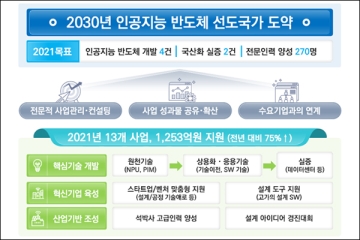
Four AI semiconductors will be developed this year and two will be commercialized
AI semiconductors are high-performance, low-power system semiconductors specialized for AI implementation such as learning and inference. The Ministry of Science and ICT will launch full-scale support projects for AI semiconductors as a follow-up measure to the 'AI Semiconductor Development Strategy' announced in October 2020 in conjunction with related government departments. The scale of this year's support projects, into which a total of 125.3 billion won will be invested across 13 projects, has increased by approximately 75% compared to last year (9 projects, 71.8 billion won).
2021.01.13by 이수민 기자
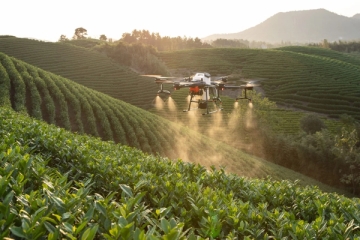
Smart Farm R&D Division Launches: "Recruiting Research Teams Begins in February"
The Smart Farm Research and Development Consortium, jointly established by the Ministry of Science and ICT, the Ministry of Agriculture, Food and Rural Affairs, and the Rural Development Administration, has launched. The consortium, established as a non-profit public interest foundation, operates and manages the smart farm multi-ministry package innovation technology development project, into which a total of 386.7 billion won will be invested from 2021 to 2027. Professor Cho Sung-in from the Department of Biosystems Engineering at Seoul National University was appointed as the head of the consortium.
2021.01.13by 명세환 기자
Camera for Both Humans and Machines: ST BrightSense 5MP Dual Shutter Image Sensor
Video consumed by humans and imagery analyzed by machines impose different requirements on the sensor in terms of shutter method and wavelength band. Until now, sensors had to be separated or supplemented with companion chips and high-performance processors, and this cost and complexity became a bottleneck in vision system design. The ST BrightSense next-generation 5MP image sensor (VD5943, VD1943, VB5943, VB1943) with 2.25 µm pixels supports both global and rolling shutters, and through on-chip staggered HDR (up to 100 dB), on-chip RGB-IR separation and 5MP NIR smart upscaling, and frame-by-frame context switching, absorbs both requirements internally at the sensor level. This white paper describes the rationale, choices, trade-offs, and results of each design decision based on presentation slides and technical Q&A, and specifies application boundaries. The product is scheduled for mass production in February 2026, and evaluation and sampling are currently available.
2026.10.13by 편집부
AI-based Universal Robots Automation Solution
In manufacturing environments where declining labor populations overlap with frequent production item changes, existing programming-based robot automation requires reconfiguration from weeks to several months each time product models change. This white paper takes this flexibility gap as its starting point and synthesizes, based on webinar presentation materials and technical Q&A, what collaborative robots gain and forfeit compared to industrial robots, why process automation is transitioning from rule-based to learning-based (4th generation) approaches, and how Universal Robots' hardware, software, and partner ecosystem implement this. Additionally, it clarifies the application boundaries and limitations, including that AI Accelerator is still at the development kit stage.
2026.10.13by 편집부











