



Design of electronic systems requiring multiple voltage domains
 Published2021.01.18 11:55
Different voltage domains must be properly controlled
High-reliability power-up/down sequences become increasingly important
Today's electronic applications do not require just a single power supply voltage, such as 5 V or 3.3 V. It is not uncommon to require as many as 10, 20, or even more voltages.
Furthermore, the same voltage may need to be generated in different domains. The same two voltages may need to be provided for analog loads and digital loads. This separation has the advantage of preventing mutual interference and providing energy to different loads at different times.
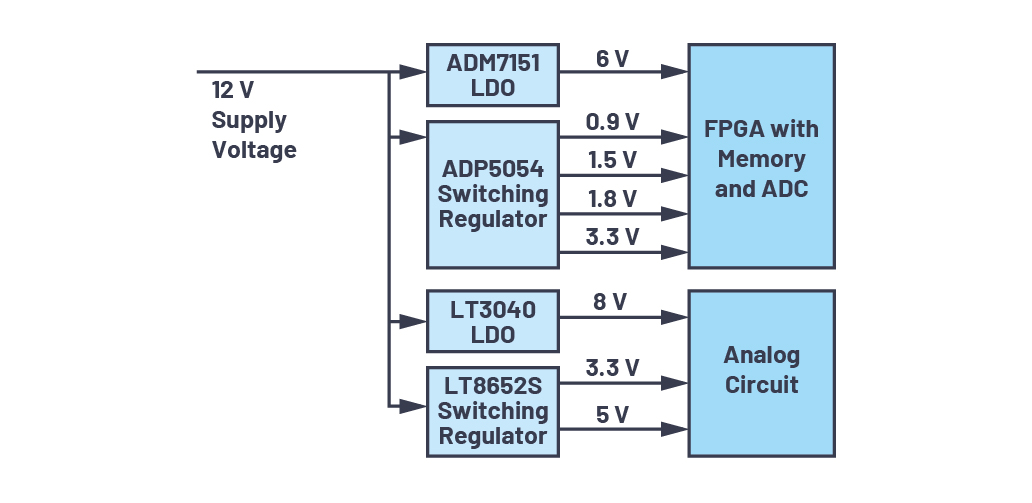
Figure 1 is a system block diagram that requires multiple voltage domains. These voltages are generated using individual switching regulators and linear regulators. The selection of each voltage converter can vary depending on the required conversion efficiency, the voltage to be generated, and the current consumed by the load. Therefore, each voltage converter design can vary significantly.
The delay time required for each voltage to reach the desired level may vary from converter to converter. Failure to properly control the ramping of different voltage domains can result in functional problems and damage to the system. A reliable power-up sequence is required to ensure that each voltage reaches the desired value at the desired time. A specific power-down sequence may also be required during shutdown.
In systems that use multiple power supply voltages, it is also important to monitor the different voltages. In systems that use two voltage domains, this is simple, but when using multiple voltages, the task becomes much more complex. For this reason, many sequencer devices include a supervisory or voltage monitoring function.
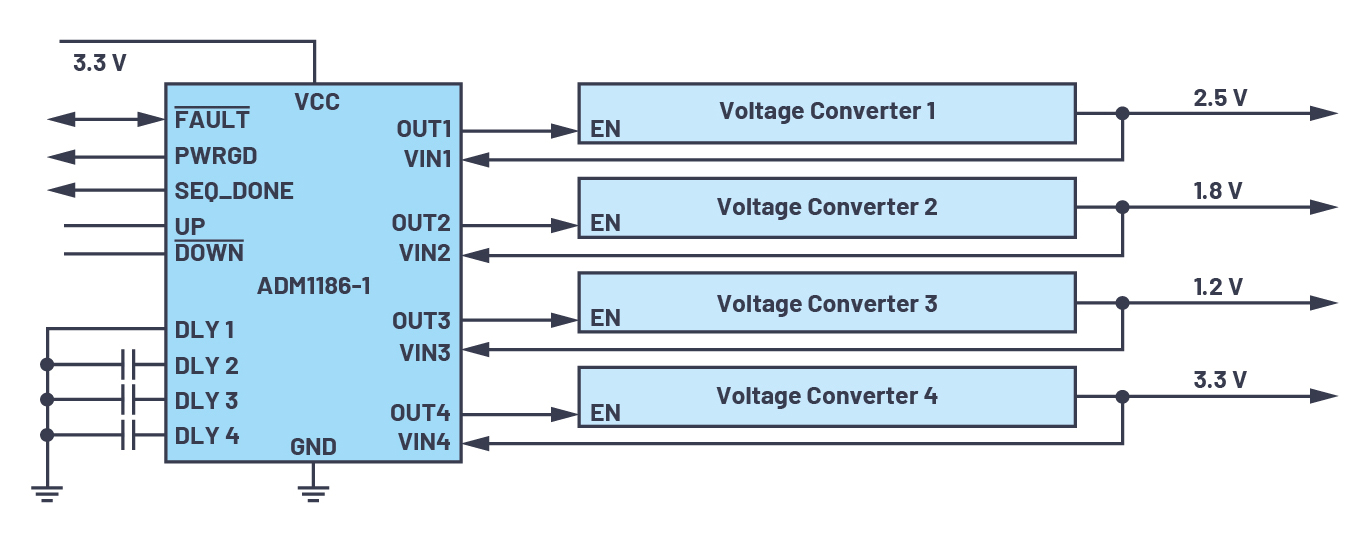
ADM1186-1 Analog Sequencer [Figure 2 = ADI]
Figure 2 shows the ADM1186-1 analog sequencer IC. This device can control and monitor four voltage domains. The voltages can be powered up and down by controlling the enable (on/off) pin of the voltage converter, and the turn-on time of the voltage converter can be adjusted by delaying it using a small capacitor.
The output voltage can also be monitored via the monitoring pin. Once all voltages have been built up, the sequencer circuit generates a power-good signal.
Analog sequencing solutions such as the ADM1186-1 are easy to use. The device supports all the functions required for systems that use multiple voltages. Its design is simpler than that of a digital sequencer, and therefore requires less digital monitoring functions. This means that there is no need for PMBus or similar protocols.
Figure 1 The system uses eight voltage domains. So how do you implement sequencing and monitoring in a system that uses more than four voltage domains? In this case, you can combine multiple ADM1186-1 circuits. The ADM1186-1 sequencer can connect any number of products.
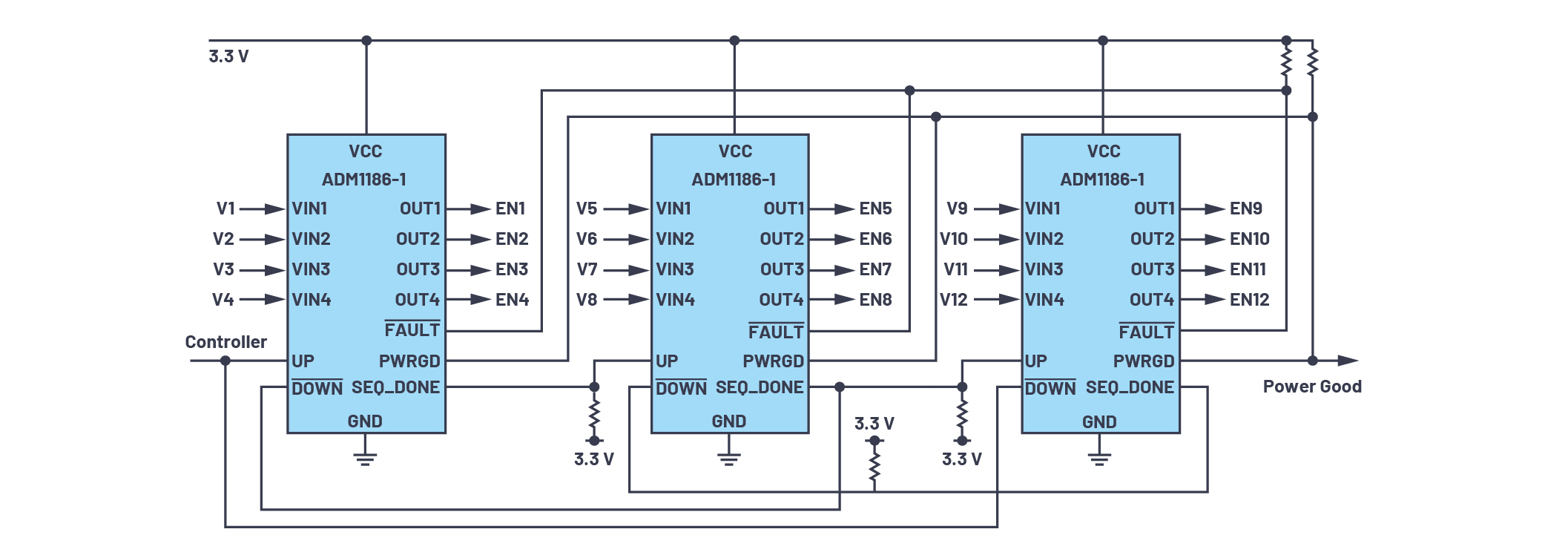
Power-up and power-down sequencing can be implemented [Figure 3 = ADI]
There are many examples of sequencing types that combine individual sequencers in the market. However, what makes the ADM1186-1 different from them is that it can fully support sequencing during power-up as well as power-down in connected applications, as shown in Figure 3.
Competitive solutions only allow multiple sequencer ICs to be connected and their individual voltages to be raised in a controlled manner, but do not support power-down sequencing in this daisy-chain configuration. Reliable power-up and power-down sequencing is critical for modern systems. The ADM1186-1 provides flexible implementation of this type of sequencing, reducing development effort.
Meanwhile, ADI provides various information on sequencing (△ Overview of Analog Sequencers △ Overview of Digital Sequencers △ Understanding Power System Management △ Power Sequencing to Prevent System Damage ).
This article is a summary of the article titled “A Reliable Power-Up and Power-Down Sequence” by Frederik Dostal, Power Management FAE at Analog Devices.
Comments
Related news
ST Announces 300mA 60V Synchronous DC/DC Buck Converter L7983
ST has launched the L7983, a compact 3V to 60V 300mA synchronous DC/DC buck converter that meets the requirements of noise-sensitive applications with flexible dynamic mode selection capability and maximizes efficiency under light loads. The L7983 controls the low-side power MOSFET to provide a low-noise mode with constant switching frequency and a low-consumption mode.
2020.12.13by 강정규 기자
Mouser to Offer ADI Medical Multimode Sensor Front Ends
Mouser supplies ADI's ADPD4100 and ADPD4101 multimode sensor front ends. Both front ends feature eight input channels with multiple operating modes suitable for a variety of sensor measurements. They provide flexible input multiplexing to support both single-ended and differential sensor measurements.
2021.01.10by 이수민 기자

Extending drone flight range depends on optimizing hydrogen fuel cell power delivery network (PDN).
Hydrogen fuel cell technology is enhancing the utility of drones. Doosan Mobility Innovation (DMI) has completed demonstration of the DS30 drone equipped with the DP30 power pack, a hydrogen fuel cell, and is now expanding its lineup. To manufacture drones capable of flights exceeding two hours, DMI adopted Vicor's modular regulators, achieving miniaturization, weight reduction, and efficiency optimization of the power system.
2021.01.12by 이수민 기자

Intel Unveils Next-Generation 'Core Ultra Series 3' and vPro Platform for Enterprise PCs
Intel has officially unveiled the "Intel Core Ultra Series 3" for next-generation enterprise PCs and the latest vPro platform, addressing a wide range of demands from enterprise notebooks to high-performance workstations.
2026.03.26by 배종인 기자
ROHM Launches ESD Protection Diode Compatible with High-Speed Interfaces of 10Gbps or Higher
Semiconductor specialist ROHM has developed the 'RESDxVx series' of ESD (electrostatic discharge) protection diodes capable of responding to next-generation high-speed data communication environments exceeding 10Gbps, simultaneously enhancing both signal quality maintenance required in high-speed interfaces and IC protection performance.
2026.03.26by 배종인 기자











