


"Standing on its own now?" KT launches 5G Standalone Mode pilot service
 Published2021.01.28 11:05
Launch of 5G SA Pilot Service for Employees
SA mode without LTE, the start of true 5G
5G is classified into Non-Standalone (NSA) and Standalone (SA) modes depending on the service method. 5G NSA requires interoperability between the 5G and LTE networks, as it uses the 5G network for data and the LTE network for signals required for data processing. On the other hand, 5G SA does not require interoperability with the LTE network because it utilizes the 5G network for both data and signals.
KT announced on the 27th that it has launched a 5G Standalone (SA) pilot service on its commercial network. 5G SA can support true 5G characteristics, such as reduced battery consumption, lower latency, enhanced communication reliability and security, and large-scale device connectivity. Currently, all three major domestic mobile carriers are offering 5G Non-Standalone (NSA) services.

Checking the quality of the 5G SA network [Photo=KT]
Since last year, KT has been preparing a test environment on its commercial network to provide 5G SA services, and has been conducting network function tests and customer (B2C) service quality verification. KT tests communication quality by applying its proprietary patented technology to 'Evolved Packet System Fallback' technology.
After testing, it is expected that 5G network-based voice services (Voice over New Radio; VoNR) will be implemented to replace current LTE network-based voice services (VoLTE).
KT's 5G SA pilot service is scheduled to take place at major KT office buildings and in urban areas with the direct participation of employees. As a final quality check procedure prior to the official 5G SA service, KT plans to provide 5G SA services to its 5G subscribers once the pilot service is successfully completed.
Comments
Related news

The three major mobile carriers' 2021 blueprints prioritize AI and platforms over 5G and infrastructure.
Last year, the three telecom companies secured a significant number of high-priced 5G subscribers and recorded modest revenue growth in the telecommunications sector, while in the B2B segment, they achieved notable results in AI solutions and IDC business driven by accelerated digitalization. However, the core business of the three companies is not delivering returns commensurate with their investments. In response, the heads of the three telecom companies emphasized moving beyond telecommunications in their New Year's addresses and expressed their aspirations for transformation into comprehensive ICT companies.
2021.01.05by 이수민 기자
Is the Odd Generation Mobile Technology Cruel? "6G Project Takes First Steps"
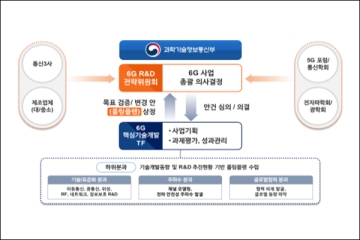
Securing leadership in the global mobile communications market requires advanced technology and standards preemption. Recently, major countries around the world including the United States, China, and Europe have entered into competition to preempt 6G, the technology following 5G. The Ministry of Science and ICT announced that it will pursue a 6G core technology development project to secure leadership in future mobile communication networks and to respond to the shift toward contactless and digital environments.
2021.01.08by 이수민 기자

Samsung Electronics Receives CC International Security Certification for 5G Mobile Communications Equipment
Samsung Electronics has obtained Common Criteria (CC) certification for 5G mobile communication equipment. CC certification is based on the ISO 15408 international standard that evaluates the security of IT products. It can be obtained by verifying compliance with common evaluation items among security assessment standards managed by various countries worldwide.
2021.01.22by 이수민 기자
European Patent Applications Surpass 200,000 for the First Time… South Korea Maintains 5th Place, Led by Batteries and Telecommunications
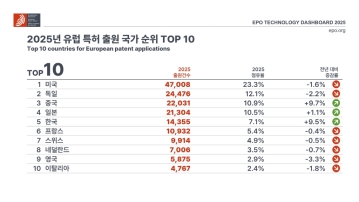
According to the European Patent Office (EPO)'s 'Technology Dashboard 2025', European patent applications last year reached 201,974, surpassing 200,000 for the first time. Korean companies and inventors filed 14,355 applications, representing a 9.5% increase from the previous year and maintaining 5th place by country. Battery, digital communication, and semiconductor technologies led the growth, with Samsung ranking as the top EPO applicant for the second consecutive year and LG reaching 3rd place. The presence of major domestic cities such as Seoul, Suwon, and Yongin was also confirmed. It was also revealed that Korea's European patent strategy is expanding beyond individual technologies to span the entire industry.
2026.03.24by 명세환 기자

SK Telecom First Applies AI-Based Network Operations at Gwanghwamun K-Pop Concert
SK Telecom announced that it applied an AI-based network operation system for the first time at a large-scale K-pop concert held in the Gwanghwamun area of Seoul on March 21st, managing communication quality throughout the event. Mobile data usage during the three hours before and after the concert reached 12.15TB, approximately doubling compared to the same time slot the previous weekend. SK Telecom monitored traffic using the AI system 'A-One' in five-minute and 50-meter units to respond to potential overload situations, while also operating temporary communication facilities and on-site personnel in parallel. This case is interpreted as confirmation of the practical applicability of AI-based autonomous network operation in an environment where demand from dense events and foreign users increases simultaneously.
2026.03.23by 명세환 기자











