


"Gaining Energy from Static Electricity" Saenggiwon Develops TENG Amplifier
 Published2021.02.05 15:45
The power of the bioelectric generator increases to 5,000V
Development of original technology for micro sawtooth type amplifier
By utilizing the principle of frictional electricity generated in everyday life, such as when wearing winter clothes or touching objects, LED bulbs can be lit and high-voltage plasma can be created without an external power source. To do this, a separate energy conversion device called a 'Triboelectric Nanogenerator (TENG)' is required.
On the 4th, the Korea Institute of Industrial Technology (KITECH), together with Korea University of Technology and Education and Sungkyunkwan University, developed a source technology to maximize triboelectric output by making the electrode structure of a TENG into a micro-serrated shape and utilizing the discharge characteristics of the electrode.
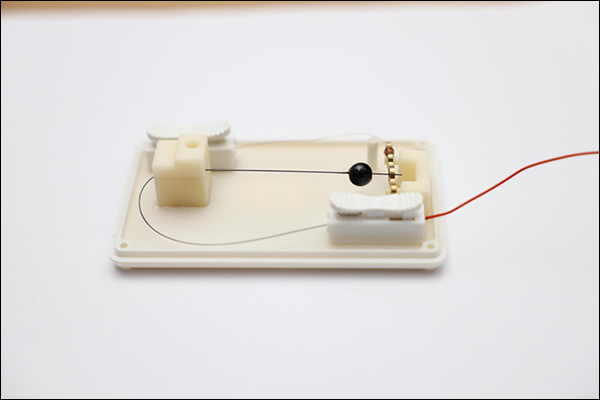
TENG converts the kinetic energy generated at the contact surface when two different materials rub against each other into electrical energy. It has a voltage output hundreds of times higher than other energy harvesting methods that electrify heat or pressure, and has been actively researched since it was first introduced to the academic world in 2012.
This time, the technology developed by Saenggiwon focused on ‘electrode structural changes’ that had not been paid attention to in previous studies, and implemented high voltages of over 5,000 V. This output is 2 to 3 times higher than similar studies that stayed at the 2,000 V level.
A joint research team consisting of Dr. Cho Han-cheol of the Precision Machine Process Control Research Group at Saenggiwon, Professor Park Jin-hyung of Korea University of Technology and Education, Professor Kim Sang-woo of Sungkyunkwan University, and Dr. Kim Ji-hye came up with the idea while contemplating recycling 'aluminum wool', a byproduct generated when machining aluminum plates.
The edge of the aluminum wool is made up of a continuous structure of micrometer (㎛) sized sawtooth shapes, and when an electrode approaches the vicinity, a spark discharge effect occurs as if a lightning rod is struck by lightning. As a result of confirming this through finite element analysis, it was confirmed that the sharper the electrode shape, the easier the spark discharge is and the output is also maximized.
Based on this, the research team created a micro-saw-shaped electrode that can maximize output in any type of TENG, and independently designed and manufactured an amplifier that allows spark discharge to occur continuously. The fabricated amplifier was shown to be effective in inducing a voltage output approximately 25 times greater and a current increase of 120 times greater than before amplification.
This was verified through a fluorescent emission experiment of a Crookes tube that visualizes a high voltage state of 5,000 V and a phenomenon in which plasma is continuously generated in a vacuum.
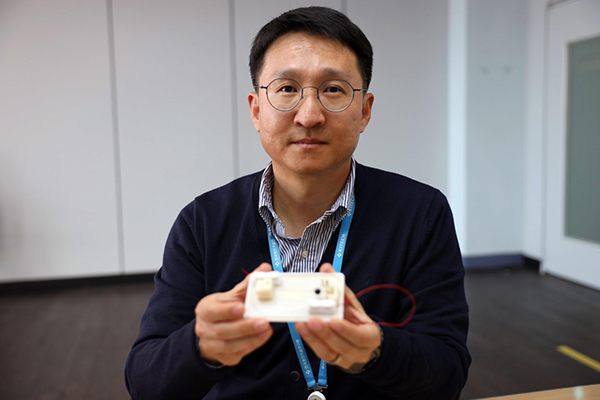
Dr. Cho Han-cheol of Saenggiwon said, “TENG is a future technology that can be used semi-permanently because it is safe from electric shock due to its high voltage and low current characteristics and can be self-charged.” He continued, “Once commercialized, it is expected to be used in various real-life fields, from lighting up dark alleyways and hiking trails using the kinetic and frictional energy of pedestrians to removing viruses and bacteria in the air using high-voltage plasma.”
Meanwhile, this study was conducted with the support of the New and Basic Research and Nano Future Materials Source Technology Development Project hosted by the National Research Foundation of Korea. In addition, a paper covering the research process was published in November 2020 in the renowned energy journal 'Advanced Energy Materials (Impact Factor: 25.245)'.
Comments
Related news
.jpg)
Hyundai Motor and LS Motors to Develop 95kW Hydrogen Fuel Cell Power Generation System
Hyundai Motor and LS Electric have formed a partnership to expand the supply of eco-friendly energy and achieve an early realization of a hydrogen society. Hyundai Motor and LS Electric have signed a Memorandum of Understanding covering mutual cooperation in the development and supply of hydrogen fuel cell power generation systems.
2020.12.08by 명세환 기자
Chemical Research Institute Discovery of First Photo-Avalanche Nanoparticles That Will Increase Solar Cell Efficiency
The Korea Chemical Research Institute has discovered an optical avalanche phenomenon in which shooting a small amount of light energy onto nanomaterials triggers a chain amplification reaction of light within the material, resulting in the emission of a large amount of light energy, as well as the nanoparticles (ANP) that cause this phenomenon. ANP has significant potential for application in next-generation biomedical technology, IoT technology, and renewable energy technology.
2021.01.16by 이수민 기자
.jpg)
Design of electronic systems requiring multiple voltage domains
Modern electronic devices do not require a single power supply voltage. It is not uncommon for examples requiring more than 20 different voltages. Separating voltages offers the advantage of preventing mutual interference and enabling power delivery to various loads at different times. To ensure that each voltage reaches the desired value at the desired time, a reliable power-up sequence is required. Additionally, a specific power-down sequence may be necessary during shutdown.
2021.01.18by 이수민 기자

Intel Unveils Next-Generation 'Core Ultra Series 3' and vPro Platform for Enterprise PCs
Intel has officially unveiled the "Intel Core Ultra Series 3" for next-generation enterprise PCs and the latest vPro platform, addressing a wide range of demands from enterprise notebooks to high-performance workstations.
2026.03.26by 배종인 기자

ROHM Launches ESD Protection Diode Compatible with High-Speed Interfaces of 10Gbps or Higher
Semiconductor specialist ROHM has developed the 'RESDxVx series' of ESD (electrostatic discharge) protection diodes capable of responding to next-generation high-speed data communication environments exceeding 10Gbps, simultaneously enhancing both signal quality maintenance required in high-speed interfaces and IC protection performance.
2026.03.26by 배종인 기자











