


The restructuring smartphone market: "Capture the mid- to low-priced and 5G markets."
 Published2021.02.08 17:35
BBK surges despite Huawei phone shipments plummeting 41%
Samsung Electronics and Apple Launch Full-Scale 5G Competition
The global smartphone market has been in turmoil since the beginning of the new year.
LG Electronics' withdrawal from the smartphone business, the growing risk to Huawei due to US sanctions, the advancement of Chinese companies affiliated with BBK, including Oppo, Vivo, and Realme, and the 5G smartphone competition between Samsung Electronics and Apple are emerging as hot topics.
◇ LG Electronics' MC Division seeks to end its long history of glory and shame.
On the morning of January 20th, several media outlets reported that LG Electronics was considering restructuring its Mobile Communications (MC) division, which oversees its smartphone business. In the afternoon, LG Electronics CEO Kwon Bong-seok acknowledged the possibility of a sale, stating, "We are reviewing the direction of our business operations with all options open."
In the early to mid-2000s, LG Electronics stood out in the mobile phone market with feature phones such as the 'Chocolate Phone,' 'Shine Phone,' and 'Prada Phone.' However, it entered the smartphone market relatively late compared to competitors such as Samsung Electronics and has remained at a disadvantage to this day.
LG Electronics' MC division recorded operating losses for 23 consecutive quarters from the second quarter of 2015 to the fourth quarter of 2020, and the accumulated operating loss is estimated to have reached 5 trillion won by the end of 2020. Despite its continued deficit streak, LG Electronics focused on self-rescue measures in 2019, including suspending domestic production, relocating its factory to Vietnam, and increasing the ratio of original design manufacturing (ODM) products. The company also focused on improving its business structure and reducing costs.
However, LG failed to establish a presence in the premium market, overshadowed by Apple and Samsung Electronics, and struggled in the mid- to low-end market, falling behind Chinese rivals like Huawei and Xiaomi. Last year, LG attempted to revamp its lineup with the introduction of the so-called mass premium phone, the "LG Velvet," and introduced new form factors like the "LG Wing," a dual-screen phone in a T-shape, but the market response was lukewarm.
.jpg)
Analysis suggests that a rollable phone has been unveiled. [Photo = LG Electronics]
LG Electronics plans to release the 'LG Rollable' phone, which was briefly unveiled at CES 2021, as early as the first quarter of this year or at the latest in the first half of the year, but the development of other strategic phones after that is observed to be unclear.
Various scenarios have emerged in the market, including a spin-off sale of LG Electronics' MC division, a drastic reduction in operations, and a merger with other divisions. Currently, it is understood that companies such as Google in the US, Volkswagen in Germany, and VinSmart in Vietnam have expressed interest in acquisition.
Huawei smartphone shipments plummet 41%, but BBK surges.
According to Counterpoint Research, Huawei's global smartphone shipments in the fourth quarter of 2020 were 33 million units, a 41% decrease from the same period last year, and its market share was only 8%.
Huawei fell from the world's number one to sixth place, falling behind Samsung Electronics, Apple, and Chinese competitors Xiaomi, Oppo, and Vivo. It is analyzed that the US sanctions have caused a major blow to Korea, as not only has the use of the Android OS been banned, but it has also made it impossible to purchase semiconductors produced with US technology.
Last November, Huawei sold its mid- to low-priced smartphone brand Honor to Shenzhen-based Zhixin New Information Technology, a move aimed at restructuring its business and focusing on recovering its smartphone business.
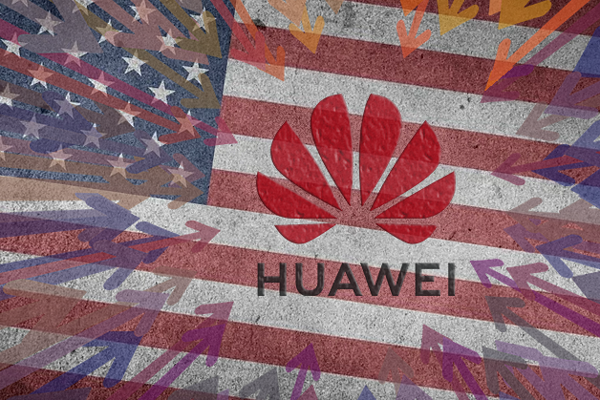
It plummeted from first to sixth place in the world. [Image = e4ds News]
There have been reports that Huawei is considering selling its premium smartphone brands, the 'P' series and 'Mate' series, but Huawei has denied this.
Meanwhile, the 2020 shipments of three smartphone companies under the Chinese BBK Group, including Oppo, Vivo, and Realme, surpassed Samsung Electronics (255.7 million units) by 262.7 million units.
Oppo and Vivo have laid the foundation for growth by targeting niche markets in China's provincial cities. Since then, Oppo has pursued a dual strategy of targeting the mid-to-low-end market for women, while Vivo has targeted the premium market for men, and this has led to the success we see today.
The three companies are expected to rapidly improve their technological capabilities, such as by preemptively adopting display-integrated fingerprint recognition and under-display cameras that place the front camera below the screen, and to quickly catch up with Samsung Electronics and Apple in the premium market.
Samsung Electronics and Apple fiercely compete for first place in the 5G smartphone market.
In the 2020 global smartphone market, Samsung Electronics maintained its lead with 255.7 million units shipped and a 19% market share. However, Apple's fierce pursuit in the second half of the year narrowed its lead. Samsung Electronics' overall smartphone shipments decreased 14% from 2019 (296.9 million units), resulting in a market share of just 19%. Apple, on the other hand, saw a 3% increase, resulting in a 15% market share. The gap between the two companies is now a mere 4 percentage points.
The battle for leadership is intensifying as competition from Chinese companies in the mid- to low-end market and Apple's launch and success of its 5G smartphone threaten Samsung Electronics' top spot. iPhone sales in the first quarter of fiscal year 2021 (October-December 2020) reached $65.6 billion (approximately 73 trillion won), up 17% from the same period last year, accounting for 59% of Apple's total revenue and the highest ever.
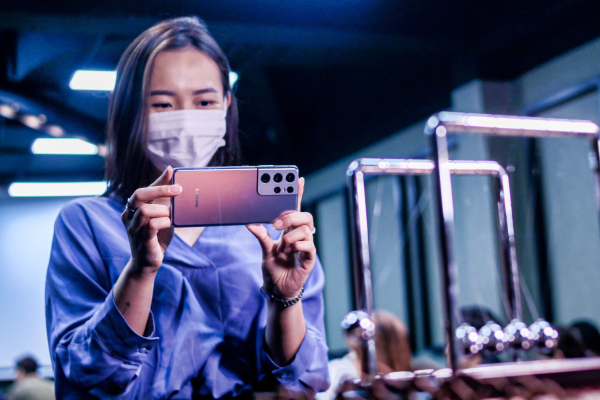
A local reporter is experiencing the product [Photo = Samsung Electronics]
In January of this year, Samsung Electronics launched the Galaxy S21 series about a month early in 60 countries around the world, including North America, Europe, Southeast Asia, and India, including Korea, to compete with the iPhone 12 series. Furthermore, the company plans to strengthen its Galaxy Z Flip lineup, targeting the premium market with a budget-friendly foldable phone and increasing its market share with mid- to low-priced 5G smartphones.
Apple is also expected to aggressively expand its market share in the 5G market, leveraging the impact of the iPhone 12 series, and join the form factor revolution by developing foldable prototypes.
◇ The two-party system has resumed, and BBK must be on high alert.
With LG Electronics' exit becoming visible and Samsung Electronics and Apple solidifying their dominance in the global smartphone market, companies like Oppo, Vivo, and Realme are developing strategies to fill the void left by Huawei in China, the largest smartphone market.
Now, Samsung Electronics is the only domestic smartphone manufacturer left. As the company has maintained its leading position so far based on aggressive launches of low- to mid-priced products and its dominance in the Indian and Latin American markets, efforts are needed to maintain its leadership position.
As Chinese companies rapidly expand their influence by leveraging their large domestic market and competitive pricing, it is time to thoroughly prepare for future competition, including diversifying 5G lineups, offering mid- to low-priced products with premium performance, high-performance cameras, and leading the way in foldable technology.
Comments 27
27 Comments:
Related news
Samsung Electronics Launches Galaxy Device Location Service
'SmartThings Find' can be used immediately upon completing a simple registration process by accessing the 'SmartThings' app. Devices whose location can be confirmed with 'SmartThings Find' include Galaxy smartphones and tablets, smartwatches, and earbuds (left and right individually). Currently, smartphones and tablets with Android 8 operating system or higher are supported, smartwatches with Tizen 5.5 operating system or higher are supported, and for earbuds, 'Galaxy Buds Plus' and 'Galaxy Buds Live' are applicable.
2020.10.30by 김동우 기자
Even 5G technology can't break through the US's Huawei encirclement: "Biden will continue."
Multiple European countries are refusing to adopt Huawei's 5G equipment and joining the United States in its countermeasures against Huawei and, more broadly, China. Last September, the United States announced severe sanctions that fundamentally block semiconductor supplies to Huawei, citing reasons such as preventing China's acquisition of competitive advantages in advanced sectors and protecting domestic security. The Biden administration, which will succeed the Trump administration, is expected to maintain this policy direction.
2020.11.09by 이수민 기자
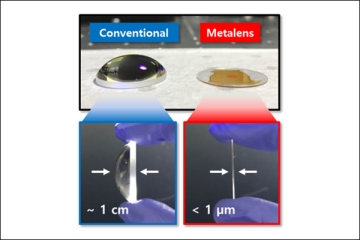
"No Catuktu Smartphone Coming Soon": Ultra-thin Metalens Released
Smartphone cameras use compound lenses consisting of 8 to 9 refracting lenses to reduce image distortion. However, it is difficult to reduce the thickness of compound lenses, which causes cameras to protrude from the rear of smartphones. A research team led by Professor Noh Jun-seok at POSTECH, in collaboration with Professor Lee Heon's research team at Korea University and Master Han Seung-hoon's Imaging Device Lab at Samsung Electronics' Advanced Technology Institute, has developed an infrared metalens that is 10,000 times thinner than conventional refracting lenses while maintaining their performance, along with mass production technology for this metalens.
2021.01.04by 이수민 기자
ESP32 Development Environment Selection and GPS Application Implementation
The ESP32 is a microcontroller that integrates Wi-Fi, Bluetooth, 12-bit ADC, capacitive touch, PWM, DAC, and UART in a single SoC. However, the abundance of features does not by itself solve the designer's problems. The real challenges lie in selecting the appropriate development environment, determining which pins can be used and which must be avoided, and converting raw data from modules into usable information. This document addresses ESP32 peripheral constraints (ADC2 and Wi-Fi coexistence limitation, UART1 occupancy, ADC non-linear regions), the trade-offs between Arduino IDE and ESP-IDF, and the process from connecting NEO-6M/NEO-M8N GPS modules to UART2, parsing NMEA sentences, and visualizing routes in Google Earth, all organized based on documented references.
2026.10.12by 편집부
MIPI CSI-2, DSI-2, C-PHY, D-PHY Test Solution Technical White Paper
The MIPI interface adopts a burst mode that transitions between low-power (LP) and high-speed (HS) states for low-power consumption, and in return, strict timing rules are imposed on state transitions. Additionally, the high-speed section operates as a packet-based protocol with headers, ECC, and CRC, so verification engineers must handle waveforms and protocols simultaneously. Traditional configurations combining general-purpose oscilloscopes and AWGs reveal limitations in setup complexity, measurement uncertainty, and lack of reproducibility when faced with these requirements. This white paper, based on webinar materials, organizes the structure of this problem and describes how the SV5C-DPTXCPTX generator for receiver testing and SV5C-DPRXCPRX analyzer for transmitter testing integrate state transition testing, stressed eye testing, and protocol analysis into a single bench, along with their application boundaries.
2026.10.12by 편집부












세계적인 거대 공룡인 노키아도 혁신의 선두였지만, 무너졌었고, 그외 수 많은 휴대폰 기업들이 쓸쓸하게 시장에서 사라졌습니다. LG전자의 퇴장을 보면, 어느 회사도 안전할 수 없다는 것을 보여줍니다. 그만큼 휴대폰사업이란 것이 쉬운 사업이 아니라는 것이겠죠. 지금 애플, 삼성이 선전하고 있지만, 그들도 조그마한 방향의 실수등이 미래에 어떤 영향이 있을 것인지 모를 일입니다. 중국기업도 중저가 폰의 시장 활성화등으로 점유율을 올려가고 있으나, 신기술과 혁신 없이는 여전히 도태될 위험을 있어 보입니다. 한때 함께 했던 초콜핏폰 LG의 좋은 시절이 마냥 그리워지는 하루이네요.
LG전자의 MC사업철수가 예상되는 상황에서 뚜렷한 경쟁자가 없는 삼성전자의 혁신이 과연 앞으로도 가능할지 모르겠네요.
삼성전자 스마트폰이 기술력과 우수성으로 세계시장에서 영향력을 더 키우면 좋겠습니다.더불어 LG 스마트폰의 외국 합작이나 제품 정책을 변경하여 이 위기를 잘 극복하였으면 좋겠습니다.향후 가전,건강,차량 등 모든 기기와 스마트폰 연동을 통해 LG가 한차례 도약하는 계기가 되었으면 합니다.
삼성전자 시장 점유율은 19%, 애플은 15%입니다 5G 스마트폰 시장에서 선의의 경쟁을 통해서 1위에 도달하면 좋겠습니다^^
스마트폰 시장이 재편되고 있습니다. 중저가 5G 시장을 리드하기를 응원합니다. 화이팅!!!
재미있는 내용 감사합니다
삼성, LG 대한민국 대표 기업으로 글로벌 시장에서 더욱 빛나길 바랍니다
LG전자가 모바일 폰 사업을 접는 것은 매우 아쉽네요. 여러 혁신기술들을 먼저 선보였으나 시장과 트렌드를 살짝 비켜난 느낌입니다. 하지만 그런 혁신 노력이 시장을 요동치게 만드는것은 분명하고, 경쟁력을 키우는 하나의 방법이라고 생각합니다.
기술적 변화에 대해 고객들과의 소통 방안을 모색해야 한다고 봅니다.
좋은 정보와 내용 감사드립니다~
항상 변화에 능동적으로 대처할수 있는 유연성을 지니고 있어야 함을 일깨워 주는군요~
소용돌이 변화속에서도 큰 도약을! 기대해봅니다.
5G를 활용한 다양한 서비스 제공
Apple vs 삼성의 국내 2파전, global하게는 Apple vs 샤오미의 2파전 양상인가요..
피쳐폰에서 스마트폰으로 변화에 적응하지 못해 퇴출 당한 업체들 처럼 스마트폰 그 다음을 미리 대비해야 될거라 생각합니다. 가성비라 칭하고 그능을 딸리고 가격은 어중간한 포지션은 더이상 먹히지 않습니다. 확실한 기능에 확실히 저렴한 가격 아니면 애플과 같은 완전히 차별화된 정치성을 구축해야 될것 같습니다.
최신폰의 경우 카메라 성능을 주 차별점으로 하고 있으나 비대면 서비스를 차별화 포인트로 가져가면 좋을것으로 생각합니다.
5G시장을 선도해나길 응원합니다!
삼성전자 화이팅
휴대폰 시장은 혁신의 연속입니다. 시간이 지날수록 비용이 낮아지고 혁신은 커지기에 더욱더 경쟁이 가속화 되고 있습니다. 집중이 더욱 필요한..
신규 외국 메이커들의 대거 투입으로 인하여 더욱더 큰 변화와 소용돌이가 예상됩니다. 만전을 기해야..
더욱더 큰 시장이 다가올거라 예상되기에 흥미진진하고 기대가 됩니다. 화이팅!!
LG전자의 퇴장으로,, 앞으로 삼성vs애플 구도가 흥미진진 합니다!
좋은 관점의 기사 감사드립니다. 한국 휴대폰 기업의 역사적인 흐름의 기사가 있으면 잼있을 듯 합니다.
LG전자의 스마트폰사업 철수등 앞으로 많은 변화가 일어날듯하네요
베트남 스마트폰 업체을 글로벌 진출
애플은 자동차 업계와 자율주행 관련 논의 기사가 있으나 삼성이나 다른 회사의 자율주행 협업 또는 전략은?
중국 업체들의 5G 라인업 다변화 대처 방안