



Chairman Jin Dae-je: "National preparation for semiconductor hegemony is essential."
 Published2021.03.30 14:52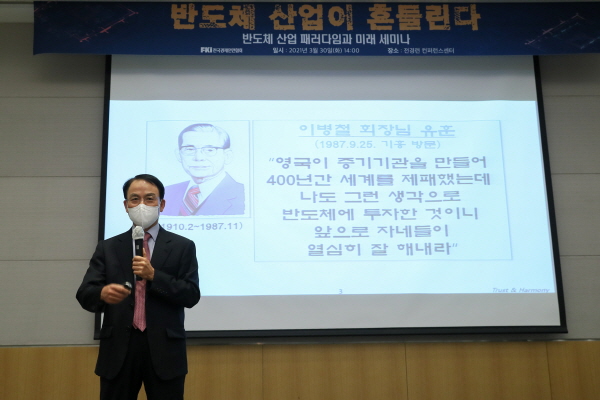
Intensifying foundry competition has led to tight semiconductor supply relative to demand for a considerable period.
It has been suggested that the supply of semiconductors will remain tight for a considerable period of time, and that a national countermeasure is needed to prepare for the semiconductor hegemony battle.
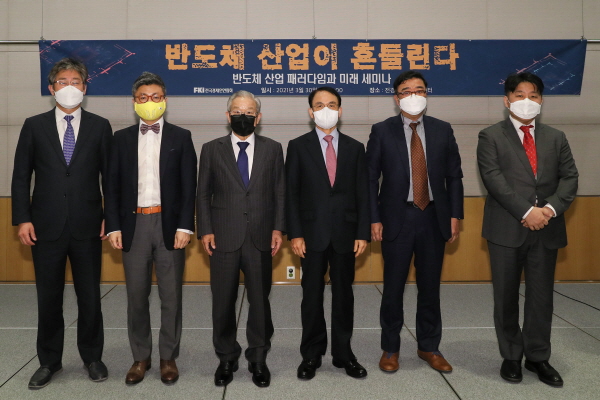
The Federation of Korean Industries (FKI) held a seminar on the 30th at the FKI Conference Center under the theme, “The Semiconductor Industry is Shaking: The Semiconductor Industry Paradigm and Future.”
Jin Dae-je, CEO of Skylake Investment, who gave the keynote speech at this seminar, stated that semiconductor supply is not keeping up with demand, and that demand for semiconductors is skyrocketing due to the Fourth Industrial Revolution, 5G, AI, and big data.
In addition, he mentioned that it would be difficult to increase production immediately if demand surges, as the investment in a 5-7nm advanced fab would cost 10 trillion won, and that the company is cautious about increasing semiconductor production.
In addition, regarding automotive semiconductors, which have recently become an issue, the semiconductor industry stated that it is a field with no profit, and since it takes 1-2 years to guarantee durability, it will take at least 6 months to resolve the shortage of automotive semiconductors.
In addition, it is expected that the supply of semiconductors will be tight compared to the demand for a considerable period of time due to China's sluggish semiconductor performance and the US's semiconductor sanctions against China.
CEO Jin Dae-je said, “Just before the late Chairman Lee Byung-chul of Samsung Group passed away, we said, ‘Conquer the world with semiconductors developed independently using our own technology.’”He said, “I am reminded of the words you said,” and added, “We can only achieve semiconductor hegemony by creating a policy environment that can foster semiconductor technology talent and encourage the motivation of leading companies.”
Next, Noh Geun-chang, head of the research center at Hyundai Motor Securities, who gave a presentation on “Semiconductor Industry Trends and Development Direction,” said, “New risks have emerged due to intensifying competition and disasters in the foundry sector, where Korean semiconductor companies have recently been concentrating their investment resources,” and “We must pay attention to the movements of major governments to foster their own semiconductor industries.”
Center Director Noh Geun-chang predicted that while the U.S. has had short-term success in containing China through trade sanctions, in the medium to long term, the U.S. will likely restructure its semiconductor industry, which is heavily reliant on fabless (semiconductor design) companies, and promote investment in U.S. production facilities and strengthen manufacturing competitiveness.
To foster its domestic semiconductor industry, the United States plans to provide tax credits of up to 40% of investment costs by 2024 and provide $22.8 billion in support for semiconductor infrastructure and R&D.
Furthermore, China announced "Made in China 2025" in 2015 and set a goal of achieving 70% self-sufficiency in semiconductors by 2025, and has continued to invest accordingly. However, according to market research firm IC Insight, China's semiconductor self-sufficiency rate stood at a mere 15.7% as of 2019. Despite US sanctions, China is pursuing large-scale M&As and expanding domestic semiconductor production with a "hiding one's strengths while cultivating one's potential" strategy, building on its past success in LCD development.
European countries, including Germany, France, Italy, and the Netherlands, have agreed to invest up to 50 billion euros to reduce their dependence on Asian foundries. It is known that 20-40% of the investment amount for semiconductor companies will be paid in the form of subsidies.
Center Director Noh Geun-chang predicted that the shortage of automotive semiconductors will ease after July of this year as Taiwanese foundry companies, such as TSMC, increase production of automotive semiconductors by restructuring their production lines at the request of governments around the world.
The general discussion continued with a discussion on 'Response measures for the future of semiconductors in Korea' chaired by Kang Seong-cheol, a senior research fellow at the Korea Semiconductor and Display Technology Society.
Semiconductor experts agreed that while Korea possesses the world's best memory semiconductor technology, its competitiveness in the non-memory sector is weak, and that the country must break free from the complacency that came with its success in memory semiconductors.
Ahn Ki-hyun, executive director of the Korea Semiconductor Industry Association, said, “Due to the recent semiconductor shortage, major countries are doing their best to attract semiconductor manufacturing facilities by establishing various incentive programs,” adding, “The U.S., Europe, and Japan are pursuing supply chain stabilization by expanding manufacturing facilities within their countries, China is aiming to become a semiconductor powerhouse through large-scale investment, and Taiwan is further enhancing its international status through the world’s best system semiconductor manufacturing technology.”
He also stated, "If our country quickly and effectively builds semiconductor manufacturing facilities and the public and private sectors cooperate to expand the role of system semiconductors in the electronics industry supply chain, we will see positive results."
Hong Dae-soon, director of the Global Strategy and Policy Research Institute, said, “The U.S. launched the semiconductor manufacturing technology research group ‘Sematech’ in 1987, and thanks to investments from the government and major corporations such as Intel, today’s Qualcomm was able to be born. Taiwan also was able to grow global companies such as TSMC and UMC thanks to support through the ‘Industrial Technology Research Institute (ITRI)’ established in 1973. He mentioned that "there was".
He continued, “The semiconductor industry is facing competition not only between companies but also between countries, so the government and companies must put their lives on the line.”

Comments
Related news
Fab equipment boom returns, with double-digit growth expected through 2022.
SEMI stated that as demand for electronic products surges due to the widespread adoption of non-face-to-face trends following COVID-19, investment in fab equipment is expected to continue increasing. According to the latest fab outlook report, global semiconductor industry fab equipment investment grew 16% in 2020, and is projected to rise 15.5% in 2021 and 12% in 2022.
2021.03.22by 이수민 기자
Will the ongoing semiconductor supply and demand instability change the foundry landscape?
The shortage of automotive semiconductors stems from major automotive semiconductor manufacturers' failed demand forecasts, who anticipated reduced automobile sales due to the COVID-19 pandemic, as well as the rapidly advancing electrification of vehicles and enhanced autonomous driving capabilities. The automotive semiconductor shortage shows signs of extending to broader semiconductor shortages across the entire manufacturing sector. In response, the EU, the United States, and other regions are accelerating efforts to reclaim semiconductor manufacturing capabilities that have become dependent on Taiwan and South Korea.
2021.03.27by 이수민 기자
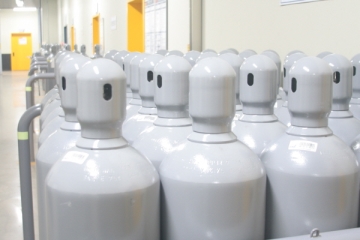
Tight supply of diborane (B2H6), semiconductor material supply instability
The supply of diborane (B2H6) is tightening, intensifying concerns over semiconductor material supply instability. Should diborane supply instability materialize, it is expected to impact semiconductor production. According to the semiconductor industry, major diborane distributors are experiencing tight supply conditions. Diborane is a key gas used in semiconductor and photovoltaic doping processes, serving as an in-situ doping material in various semiconductor blanket and deposition processes. While arsine and phosphine are primarily used in n-type semiconductors, diborane is increasingly used in p-type semiconductors.
2021.03.30by 배종인 기자
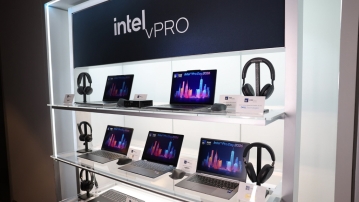
Intel Unveils Next-Generation 'Core Ultra Series 3' and vPro Platform for Enterprise PCs
Intel has officially unveiled the "Intel Core Ultra Series 3" for next-generation enterprise PCs and the latest vPro platform, addressing a wide range of demands from enterprise notebooks to high-performance workstations.
2026.03.26by 배종인 기자
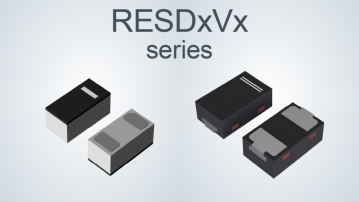
ROHM Launches ESD Protection Diode Compatible with High-Speed Interfaces of 10Gbps or Higher
Semiconductor specialist ROHM has developed the 'RESDxVx series' of ESD (electrostatic discharge) protection diodes capable of responding to next-generation high-speed data communication environments exceeding 10Gbps, simultaneously enhancing both signal quality maintenance required in high-speed interfaces and IC protection performance.
2026.03.26by 배종인 기자











