



Leveraging Big Data Depends on Automating Machine Learning Workflows
 Published2021.03.31 15:15
High-performance with MathWorks, MATLAB, and AutoML
Support for automated development of machine learning-based solutions
Many companies recognize the business value of big data, but lack of technical expertise and data accessibility/siloing issues prevent them from devising appropriate big data collection, storage, and processing strategies for their businesses.
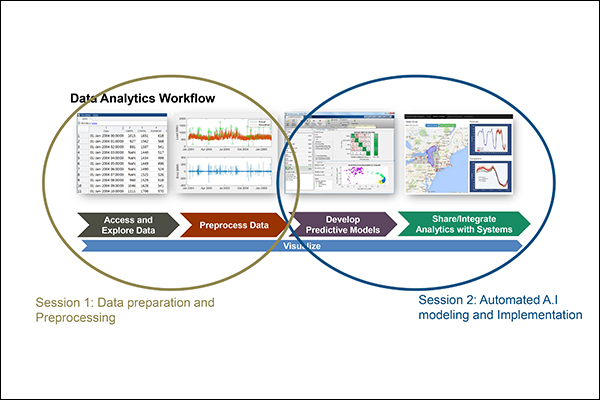
Data preparation and processing, AI modeling automation and utilization process
It's easy to do on a single platform [Image = MathWorks]
On the 18th, MathWorks Korea held a two-part online seminar titled "Data Science and Machine Learning Applications Using MATLAB." In the first lecture, MathWorks Korea Manager Seong Ho-hyeon introduced high-speed big data processing using simple functions in a parallel/distributed computing architecture and how this approach can support applications.
“MathWorks supports the simplification and automation of big data processing and data feature extraction processes,” said Vice President Seong Ho-hyeon. “Through this, it presents solutions to the problems of lack of skilled technology and low data quality, which are obstacles to utilizing big data.”
In the second lecture, MathWorks Korea's Deputy Manager, Gyu-Hwan Jang, explained the pain points of the machine learning workflow and MathWorks' automated machine learning development solution to resolve them. Vice President Jang emphasized that even users without prior knowledge or experience with domain data or algorithms can develop high-performance machine learning systems.
Below is a summary of the first and second lectures of the seminar held that day.
◇ MATLAB, Generating Training Data for Machine Learning-Based Solutions
MATLAB provides a convenient big data processing environment for experts and engineers in specific industries. First, it supports cluster and Spark/Hadoop-based distributed data processing to support streaming applications through the 'Tall function' suitable for processing big data larger than the memory capacity of the big data processing platform.
Next, we implement a cluster-based parallel processing method through a 'distributed function' that enables high-speed in-memory operations, enabling smooth execution of mathematical and matrix operations that require a large amount of computing work.
Volkswagen adopted MATLAB to build the technological foundation for providing personalized car features and services to drivers, and successfully developed an individual driver recognition algorithm based on driving habit data.
.jpg)
Developed an individual driver recognition algorithm [provided by MathWorks]
MATLAB significantly reduces the time required for processing large-scale video and image data and extracting features, which account for approximately 70-80% of AI development time. Accelerate the processing of image data of increasing scale and complexity in industries such as medical, defense, and aerospace by implementing video streaming environments, processing large-scale image segmentation, supporting parallel computing and GPUs, analyzing pixels, and detecting and tracking objects.
For text data analysis, MathWorks offers the Text Analytics Toolbox. This toolbox analyzes the sentiments contained in human language and analyzes, classifies, and summarizes data, thereby enhancing the efficiency of natural language processing.
MathWorks helps customers develop maintenance applications that predict failure time and remaining useful life (RUL) of enterprise assets by leveraging their existing IoT and streaming data.
Additionally, when rapid environmental changes make it difficult to continuously collect sufficient amounts of data, it generates virtual error data. In particular, MathWorks supports the development of highly accurate prediction models that produce results most similar to data values measured in real environments through 'Simulink', which is equipped with an automatic tuning function.
Energy technology company Baker Hughes partnered with MathWorks to develop machine learning-based, highly accurate predictive maintenance software that can easily collect, categorize, and analyze terabytes of diverse sensor data.
Lacking data on shale oil extraction pump failures, Baker Hughes developed a model that mimics how the pumps operate and developed a machine learning algorithm that derives the RUL by virtually introducing errors into the model, 10 times faster than before.
◇ AutoML, Automating Industry-Specific Machine Learning Model Development
Machine learning is a technology that allows models, which derive outputs from input data, to learn and update based on new data. Currently, it's being used in various applications, including: speech recognition, object detection, and engine life prediction, all based on nonlinear input-output structures; stock market and weather forecasting based on dynamic programming based on real-time data fluctuations; and IoT, taxi fare systems, and flight delay analysis, all based on scalable big data.
Currently, there is a growing demand in many industries, including defense, electronics, and automotive, to perform a series of machine learning development processes on a single platform. To address this, MathWorks provides a toolbox that supports the entire machine learning workflow, from data access to modeling and system deployment. It also addresses pain points that exist at each stage of the machine learning workflow.
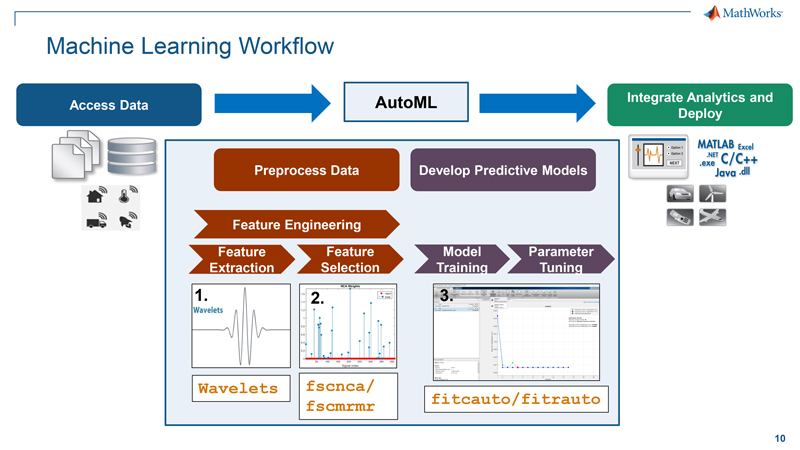
MathWorks' automated machine learning development solution, AutoML, automates the feature extraction process. Feature extraction involves generating (feature generation), selecting (feature selection), and transforming (feature transformation) key data features during data preparation so that machine learning models can learn from them.
AutoML allows for easy extraction of key features even with limited understanding of domain data. It prevents "model overfitting," which leads to suboptimal results due to modeling based on inappropriate data. It also improves "model interpretability," the interpretability of selected features, and reduces model size.
Additionally, AutoML automatically finds and recommends the optimal algorithm applicable to the characteristics of data prepared through automated machine learning model training.
Today, engineers are challenged by the sheer number of algorithms available, making it difficult to choose the right one. For example, classification and regression models often have over ten and six algorithms available, respectively. AutoML improves the efficiency and productivity of machine learning development by eliminating the time spent training individual algorithms.
Furthermore, by tuning hyperparameters, which are parameters that remain constant during training, models can be easily and quickly optimized. Furthermore, MATLAB Coder, Compiler, and Compiler SDK support code generation and deployment in C, C++, HDL, PLC, CUDA, Java, Python, and other languages for machine learning models, tailored to machine learning applications on embedded hardware and enterprise systems.
Comments
Related news
.jpg)
How to develop AI models optimized for embedded systems?
Digitalization is accelerating across nearly all industries, and many companies are stepping up efforts to adopt AI. However, AI knowledge and experience among industry experts who will implement these initiatives remain insufficient. MathWorks is focusing on reducing the time and effort engineers spend developing AI models through MATLAB and other solutions with enhanced interoperability with deep learning frameworks.
2020.12.20by 이수민 기자
Building an autonomous system that works on its own, isn't it easier?
With advances in robotics and autonomous systems technology, today's robots are capable of higher-level tasks that conventional robots could not perform. However, due to lack of specialized expertise and limited development time, there are challenges in applying advanced autonomous technology to real-world environments. MathWorks provides an ecosystem necessary for autonomous systems development and supports customers through integrated robotics AI solutions and technical services that encompass modeling, simulation, testing, and deployment.
2021.02.25by 이수민 기자
MATLAB/Simulink R2021a Announced with Enhanced Communication Verification Features
MathWorks has announced Release 2021a of its MATLAB and Simulink product families. This update adds or improves hundreds of features. In MATLAB, users can now dynamically control live scripts and add plots to live scripts without writing code. In Simulink, C code can be imported into reusable Simulink libraries to accelerate simulation speed.
2021.03.17by 이수민 기자

Korea Instrument, KOLAS Accredited Calibration Agency First to Simultaneously Acquire ISO/IEC 27,001·27,701
Korea Instrument has become the first among KOLAS accredited calibration agencies to simultaneously acquire ISO/IEC 27,001 and ISO/IEC 27,701 certifications. Through its proprietary platforms CWIZ Enterprise and CWIZ Partners, the company has embedded information security and personal data protection requirements across all business processes including customer information, equipment data, and calibration reports, with plans to continuously advance its management system through regular audits and security inspections.
2026.10.12by 배종인 기자

TeamViewer One, IT Incident Automation Workflow and Resolution Center Enhanced
TeamViewer has added IT incident automation capabilities and an advanced Resolution Center to its integrated digital workplace management platform 'TeamViewer ONE'. Recurrent service disruptions, configuration errors, and capacity shortages are automatically handled according to preset policies, and device status verification through script deployment can be managed in a unified interface, significantly reducing repetitive tasks for IT teams.
2026.10.12by 배종인 기자











