



Domestic mid-sized companies' digital transformation is 'insufficient'
 Published2021.04.05 08:17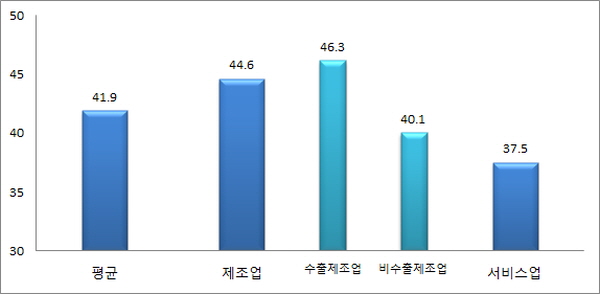
The digital transformation of domestic small and medium-sized enterprises (SMEs) appears to be inadequate. It was analyzed that focusing on digital transformation of small and medium-sized enterprises is necessary to secure sustainable competitiveness.
The Korea Federation of SMEs (Chairman Kim Ki-moon) announced on the 1st the results of a survey titled "Digital Maturity of SMEs," which examined 15 key competencies for digital transformation to understand the current state of SMEs' global digital competitiveness as digital transformation becomes the new normal worldwide due to COVID-19.
The survey results showed that domestic small and medium-sized enterprises' digital maturity was 41.9 points out of 100, indicating that they are inadequately prepared for digital transformation.
By industry, manufacturing scored 44.6 points and service industry scored 37.5 points, showing differences in digital maturity by industry.
In particular, the digital maturity of export-oriented SMEs was found to be higher at 46.3 points compared to 40.1 points for domestic SMEs, indicating that strengthening the capacity to respond to digital transformation is necessary to enhance the global competitiveness of SMEs.
The industries with the highest digital maturity included computer programs and system management (61 points) and electrical equipment and general devices (56 points), while the industries with the lowest digital maturity included warehouse and transportation (25.8 points) and video and audio-related industries (29 points).
The digital maturity of small and medium-sized enterprises (SMEs) also showed significant differences depending on corporate sales.
Manufacturing companies with sales of 10 billion won or more received 50.9 points, while those with sales of less than 3 billion won received 38.3 points. In the service industry, those with sales of 10 billion won or more received 44.9 points, while those with sales of less than 3 billion won received 32.9 points.
Additionally, the digital maturity of companies with export performance exceeding 3 billion won was 53 points, indicating that the greater the digital transformation response capacity, the higher the global competitiveness.
SMEs are requesting government support measures to strengthen their digital transformation capabilities, including consulting (49.5%) and online platform support (3%).The responses were in the following order: digital education (7.5%), AI voucher support (14.4%), and AI-related education (33.2%).
In particular, export companies were high in need of consulting support (51.5%) and online platform support (50.5%), and 43.8% of companies with exports of less than 1 billion won responded that they needed educational support.
As a result of investigating 15 core competency elements on a 5-point scale to measure digital maturity, introduction of remote work (1.42 points), innovation of production and inventory processes such as tracking systems (1.57 points), attempts to change corporate culture (1.63 points), development and utilization of new business models (1.98 points), digitalization strategy (1.99 points), securing digital experts, and digital education and training (2.04 points) scored lower than the average (2.09 points), and were identified as elements that should be prioritized when establishing government policies.
“COVID-19 has accelerated the digital transformation, making non-face-to-face interactions a daily occurrence,” said Chu Moon-gap, head of the Economic Policy Division at the Korea Federation of SMEs. “Because the coming digital transformation is inevitable, it is urgent to build the foundation for SMEs through active support in consulting and education to ensure their competitiveness in the global market.”

Comments
Related news
Nvidia invests $5 billion in Intel
NVIDIA and Intel, leaders in global AI computing technology, are now forging ahead in providing cutting-edge solutions through NVLink-based architecture integration. NVIDIA and Intel have officially announced a strategic partnership and stated that they will jointly develop customized data center and personal computing products to accelerate diverse applications and workloads ranging from hyperscale to enterprise and consumer markets, thereby laying the foundation for the next generation computing era.
2025.09.22by 배종인 기자
.jpg)
Applied Materials Launches Environmental Protection Campaign to Mark World Cleanup Day
Applied Materials Korea (CEO Park Kwang-seon) is carrying out environmental cleanup activities with employees and their families around the Dongtan Sinricheon area on the occasion of World Cleanup Day, evolving into a company that engages with the local community beyond technological innovation.
2025.09.22by 명세환 기자
.jpg)
The combination of electrical and electronic technologies like AI, semiconductors, and electric vehicles with renewable energy will determine industrial competitiveness.
Professor Lim Chun-taek from Gwangju Institute of Science and Technology (GIST) stated in his keynote speech at the '2025 e4ds Tech Day' on the 9th, "Global energy investment is already shifting from fossil fuels to renewable energy, and the trend of electrification combined with electrical and electronic technologies is changing the industrial landscape."
2025.09.12by 배종인 기자
.jpg)
"Data Center Power Demand Surges: Distributed Energy is the Solution"
The power demand of data centers is surging rapidly alongside the accelerating growth of artificial intelligence (AI), cloud, and electric vehicle industries. In particular, the global power supply and demand structure centered on the United States is undertaking a massive infrastructure reorganization to adapt to this change, and Korea is no exception in this trend. As an alternative to overcome the limitations of the existing centralized power system, distributed energy systems and smart grid technologies are gaining attention.
2025.09.02by 배종인 기자
Huawei Begins Full-Scale Training of Young Korean Global ICT Leaders
Global ICT company Huawei Korea has signed a Memorandum of Understanding (MOU) with Dongguk University, Ewha Womans University, and Hanyang University, and will jointly implement a global education program to nurture next-generation ICT leaders.
2025.08.29by 배종인 기자











