



ADI and MDA Partner to Develop Beamforming ICs for Low-Earth Orbit Satellites
 Published2021.04.08 10:30
Telesat Lightspeed LEO satellites to be adopted
Electronic steering arrays deploy beams faster than mechanical ones
Analog Devices (ADI) announced on the 8th that it is developing a beamforming integrated circuit (BFIC) for phased array antennas in collaboration with MDA. MDA's phased array antenna, equipped with the new BFIC, will be used in the Lightspeed low-Earth-orbit (LEO) satellite constellation of Canadian satellite internet service provider Telesat.
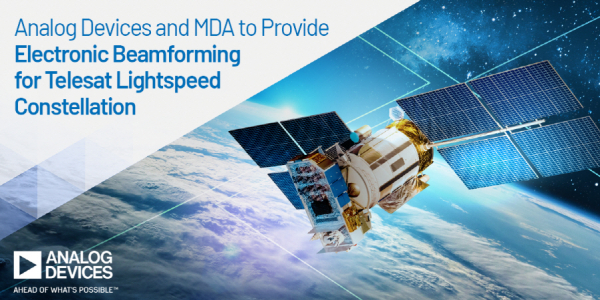
Telesat Lightspeed, consisting of 298 LEO satellites, is scheduled to launch in the second half of 2023 and plans to provide global B2B and B2G broadband connectivity services.
Unlike geostationary satellites that operate in fixed locations, LEO satellites that move across the sky must dynamically adjust their communications beams to maintain uninterrupted, high-speed connections with ground stations. The new BFIC solution operates reliably in extreme temperatures and cosmic radiation environments throughout the satellite's entire lifespan, which can be up to 10 to 12 years.
“Electronically steered array technology enables multiple beams to be steered simultaneously and rapidly repositioned at speeds that would be impossible mechanically,” said Bryan Goldstein, vice president and general manager of ADI’s Aerospace and Defense business. “It is essential for both manufacturers and operators of next-generation LEO satellite constellations.”
Comments
Related news

u-blox unveils module for simultaneous tracking of four GNSS satellite signals.
u-blox announced the M10 GNSS platform for low-power, high-performance position tracking applications. The M10 platform enhances positioning performance by supporting miniaturization of tracking applications and extending battery life. Additionally, it simultaneously tracks up to four GNSS satellites even in challenging environments such as densely packed urban canyons, delivering accurate location data.
2020.11.06by 이수민 기자
Microchip Ships Radiation-Tolerant FPGA Engineering Silicon in Progress with 'QML Class V' Certification
Microchip has commenced engineering silicon shipments for radiation-tolerant PolarFire FPGAs undergoing MIL-STD-883 Class B, QML Class Q and V certification procedures, which are reliability standards for space industry components. Engineers can now develop hardware prototypes with identical electrical and mechanical performance to what space-qualified RT PolarFire FPGAs provide for high-bandwidth satellite onboard processing systems.
2020.12.03by 강정규 기자

ADI Announces RF Platform for 5G O-RAN Equipment Optimization
ADI announced RadioBus, a wireless platform based on ASIC for O-RAN compatible 5G wireless devices. The platform integrates functions required for O-RAN compatible 5G wireless devices, including baseband ASIC, software-defined transceiver, signal processing, and power supply. Additionally, it has been designed to enable significant improvements in performance and form factor.
2021.03.26by 이수민 기자

Intel Unveils Next-Generation 'Core Ultra Series 3' and vPro Platform for Enterprise PCs
Intel has officially unveiled the "Intel Core Ultra Series 3" for next-generation enterprise PCs and the latest vPro platform, addressing a wide range of demands from enterprise notebooks to high-performance workstations.
2026.03.26by 배종인 기자

ROHM Launches ESD Protection Diode Compatible with High-Speed Interfaces of 10Gbps or Higher
Semiconductor specialist ROHM has developed the 'RESDxVx series' of ESD (electrostatic discharge) protection diodes capable of responding to next-generation high-speed data communication environments exceeding 10Gbps, simultaneously enhancing both signal quality maintenance required in high-speed interfaces and IC protection performance.
2026.03.26by 배종인 기자











