



Nvidia to Build Arm Core-Based CPUs for Data Centers
 Published2021.04.14 17:34
Reducing CPU-GPU memory bottlenecks through Arm cores
Swiss supercomputer Alps to hire in 2023
Nvidia's data center roadmap includes central processing units (CPUs) in addition to graphics processing units (GPUs) and data processing units (DPUs). Nvidia's stock price rose on news that it would enter the server CPU business in 2023, while Intel and AMD's stock prices fell.
Jensen Huang, founder and CEO of NVIDIA, unveiled a data center processor, codenamed 'Grace' CPU, in a keynote speech at the GPU Technology Conference (GTC) 2021, held online on the 12th (Pacific Standard Time).
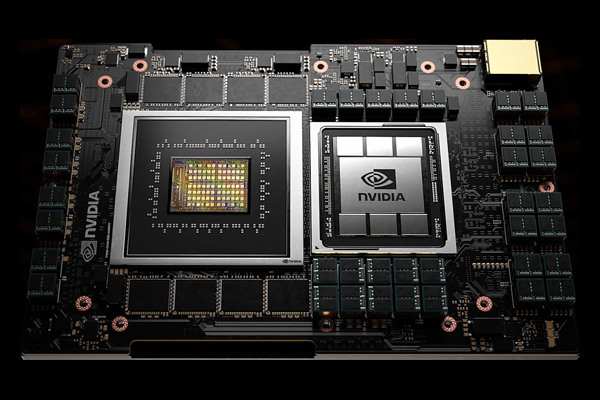
[Capture = NVIDIA GTC 2021 Keynote]
“Today’s data centers are home to a multitude of applications that require diverse system architectures,” said CEO Huang. “While the x86 server architecture that powers enterprise, hyperscale, storage, deep learning training, and inference servers can handle numerous applications, it still has limitations in processing massive amounts of data.”
“Improving the efficiency of AI models is a task for computing systems,” said CEO Hwang, adding that “NVIDIA DGX systems are also experiencing bottlenecks due to the difference in memory speed between CPUs and GPUs.” Some DGX systems consist of four Ampere GPUs, each connected to 80GB of memory at 2TB/s, and a single CPU connected to 1TB of memory at 0.2TB/s. The CPU memory capacity is three times larger than the GPU, but it is 40 times slower.
“If we package one CPU and four GPUs for AI model training, there will be a bottleneck at the PCIe interface,” said CEO Hwang. “Even if we use NVLink to solve this, the speed is not enough.” He added that x86 CPUs do not have NVLink. To overcome this, CEO Hwang announced that NVIDIA has begun developing the Grace CPU, which is suitable for accelerating large-scale data computing applications.
The purpose-built Grace CPU, named after Grace Hopper, a computer scientist and U.S. Navy admiral in the 1950s, features next-generation Arm server cores. "Designed for terabyte-accelerated computing, once commercialized, Grace will be able to deliver higher-performance systems (over 2,400 SPECint_rate) than the current highest-performance DGX system (450 SPECint_rate)," said CEO Hwang.
The Swiss National Supercomputing Centre plans to build Alps, a supercomputer powered by NVIDIA's Grace CPUs and next-generation GPUs. Alps, a 20 exaflops computer designed for weather and climate simulations, quantum chemistry, and quantum physics, will be built by HPE and is scheduled to be operational in 2023. “NVIDIA data center products have a confirmed CPU, GPU, and DPU configuration,” said CEO Hwang, adding, “We will release new chip architectures every two years, alternating between x86 and Arm platforms.”
Meanwhile, NVIDIA has decided to integrate its GPUs with Amazon Web Services (AWS)'s "Graviton2" CPU to enhance cloud gaming capabilities. Commercial products are expected to be released later this year. Furthermore, NVIDIA has partnered with Ampere Computing, Marvell, MediaTek, and others to develop a cloud computing SDK and reference system.
Comments
Related news

NVIDIA certifies five servers as AI workload-ready.
Nvidia has disclosed servers that have passed its AI workload certification program. The Nvidia certification system was introduced to accelerate AI with the latest Nvidia GPUs running on Nvidia Mellanox networks and to handle large-scale AI workloads. Through this, it helps organizations derive insights from numerous data that their existing systems have been missing.
2021.01.28by 이수민 기자
Amid GPU shortages, Nvidia announces processors for cryptocurrency mining.
Nvidia announced that the GeForce RTX 3060 GPU, launching on the 25th, will have its cryptocurrency mining hash rate limited to 50%, and that it will release a cryptocurrency mining processor (CMP) specialized for mining. The CMP has no display output, enabling improved air flow during mining operations and allowing higher-density packing.
2021.02.20by 이수민 기자
Intel Announces 3rd Generation Xeon Processors to Accelerate Data Centers
Intel has unveiled the third-generation Intel Xeon Scalable processor family with the Ice Lake codename, which accelerates 5G, AI, and cloud performance in data centers. The new Ice Lake processors achieved an average performance improvement of 46% compared to the previous-generation Cascade Lake processors in typical data center workloads.
2021.04.07by 이수민 기자

Intel Unveils Next-Generation 'Core Ultra Series 3' and vPro Platform for Enterprise PCs
Intel has officially unveiled the "Intel Core Ultra Series 3" for next-generation enterprise PCs and the latest vPro platform, addressing a wide range of demands from enterprise notebooks to high-performance workstations.
2026.03.26by 배종인 기자

ROHM Launches ESD Protection Diode Compatible with High-Speed Interfaces of 10Gbps or Higher
Semiconductor specialist ROHM has developed the 'RESDxVx series' of ESD (electrostatic discharge) protection diodes capable of responding to next-generation high-speed data communication environments exceeding 10Gbps, simultaneously enhancing both signal quality maintenance required in high-speed interfaces and IC protection performance.
2026.03.26by 배종인 기자











