



Metal 3D printing technology for rapid manufacturing of large parts has been developed.
 Published2021.04.16 15:15
Development of a favorable wire-arc 3D additive manufacturing technology
Production speed is more than twice as fast as conventional casting methods
Metal 3D printers can precisely custom-make any complex mold, reducing costs from product development to mass production. They are particularly effective for high-value-added products like parts for medium- to large-scale transportation equipment like ships and aircraft, but requiring small-batch, high-variety production.
On the 15th, the Korea Institute of Industrial Technology (KITECH) announced the development of a metal 3D printing technology that enables faster and more affordable manufacturing of medium- to large-sized parts and die-casting molds. This technology was developed as part of the Ministry of Trade, Industry and Energy's Industrial Technology Innovation Project and the institute's core "New Market Creation Support Project." Five SCI-level papers were published and four patents were filed for this project.
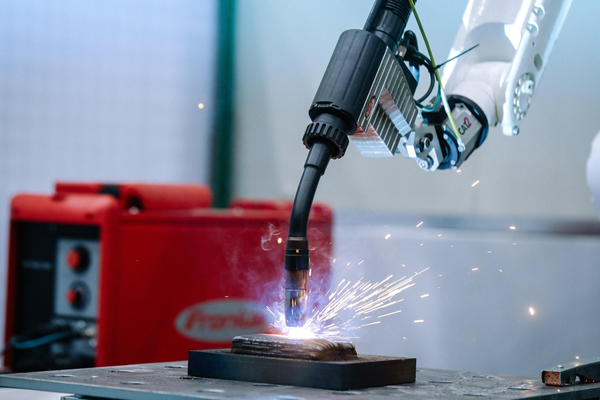
[Photo = Korea Institute of Industrial Technology]
The existing PBF (Powder Bed Fusion) 3D printing technology requires high-power laser equipment and expensive powder materials to be layered one by one over a long period of time. As a result, the larger the mold, the higher the manufacturing cost and the lower the productivity. Additionally, the price of a single large metal 3D printer is approximately 1 billion won or more, making it difficult for small and medium-sized businesses to easily introduce and operate them.
Dr. Ji Chang-wook's research team at the Advanced Forming Process Research Group at the Korea Advanced Institute of Science and Technology (KAIST) has developed a "Wire Arc (Wire+Arc) 3D additive manufacturing method" that rapidly layers metal wires using the latest push-pull welding technique. This method is similar to the Directed Energy Deposition (DED) method, but differs in that it uses a high-temperature electric arc instead of a laser as a heat source and melts wires instead of metal powder to layer them.
Furthermore, the research team integrated the welding machine, robot, and layering path-setting software into a single system and built a database of process variables, including wire material, gas flow rate, and operating temperature, to optimize the system for 3D printing. When CAD drawings of the parts and products to be manufactured are input into the system, the path-setting software selects the optimal layering path, and a welding torch attached to the robot arm melts the wire along that path, layer by layer.
This new technology can produce parts more than twice as fast as conventional casting methods. Compared to CNC (Computer Numerical Control) machining, die casting molds have manufacturing costs approximately 20% lower and material loss rates are 80% lower. Construction costs are also one-tenth that of large-scale 3D printers. By applying the 'cladding' method, a welding technique that joins dissimilar materials during the lamination process, the cooling speed and wear resistance of the mold can be improved, thereby extending the life of the mold and increasing the dimensional stability of the product.
Using this technology, the research team produced a 2-meter-tall large ship propeller in just three weeks, a process that normally takes about two months. The team also received recognition for its superior physical properties, such as strength and durability, and even received a "classification certificate," a type of certificate that certifies a ship's ability to sail overseas.
Dr. Ji Chang-wook said, “The technology we developed is a high-speed, low-cost 3D printing technology that can be easily adopted by small and medium-sized businesses,” and added, “In the future, we plan to expand the applicable materials from iron and aluminum to magnesium alloy, which is advantageous for lightweighting, and utilize it in the production of aircraft parts.”
Comments
Related news
A hydraulic, wearable-controlled robotic arm that could replace excavators at disaster sites.
The Robotics and Mechatronics Research Institute has developed a special-purpose machine for disaster response that prioritizes firefighter safety at disaster sites and enables rapid execution of difficult and complex rescue operations. The developed equipment features a pair of 6-meter-long manipulators that function as human arms, mounted on four tracked undercarriage modules. Through a wearable control device, the manipulators can be moved freely like one's own arms, allowing even untrained operators to control them intuitively.
2021.01.22by 명세환 기자
"Gaining Energy from Static Electricity" Saenggiwon Develops TENG Amplifier
High-voltage plasma can be generated without external power by utilizing the principle of triboelectricity in everyday life. For this purpose, a separate energy conversion device called a triboelectric nanogenerator (TENG) is required. KIST, in collaboration with Korea University of Technology and Education and Sungkyunkwan University, developed core technology that maximizes triboelectric output by designing the electrode structure of TENG in a micro-sawtooth shape and utilizing the discharge characteristics of the electrode.
2021.02.05by 이수민 기자
"Shortening the time to market for electronic products, 3D analysis tools are essential"
As the performance of electronic products has improved, requirements have become more complex. Meanwhile, intensified competition has shortened time-to-market deadlines. Repetitive prototype manufacturing is inevitable to waste time and resources. If product issues can be identified in advance, such waste can be significantly reduced. Dassault Systèmes' ABAQUS FEA and CST Studio Suite enable engineers to conduct structural and electromagnetic analyses virtually.
2021.03.12by 이수민 기자
Korea Instrument, KOLAS Accredited Calibration Agency First to Simultaneously Acquire ISO/IEC 27,001·27,701
Korea Instrument has become the first among KOLAS accredited calibration agencies to simultaneously acquire ISO/IEC 27,001 and ISO/IEC 27,701 certifications. Through its proprietary platforms CWIZ Enterprise and CWIZ Partners, the company has embedded information security and personal data protection requirements across all business processes including customer information, equipment data, and calibration reports, with plans to continuously advance its management system through regular audits and security inspections.
2026.10.12by 배종인 기자
TeamViewer One, IT Incident Automation Workflow and Resolution Center Enhanced
TeamViewer has added IT incident automation capabilities and an advanced Resolution Center to its integrated digital workplace management platform 'TeamViewer ONE'. Recurrent service disruptions, configuration errors, and capacity shortages are automatically handled according to preset policies, and device status verification through script deployment can be managed in a unified interface, significantly reducing repetitive tasks for IT teams.
2026.10.12by 배종인 기자











