



Continental Unveils Two Long-Range Radars to Accelerate Autonomous Driving
 Published2021.04.17 13:30
Detects and maintains performance even when mounted on the corner of a vehicle
Surround radar is under development and production is targeted for 2023.
Continental announced on the 16th that it will unveil its 6th-generation long-range radar and surround radar at the Shanghai Auto Show, which will be held in China on Wednesday, April 21st. The two radars share a software and hardware platform, reducing complexity and overall costs. This also reduces customer testing and development efforts. Performance has been improved compared to the 5th-generation radar.
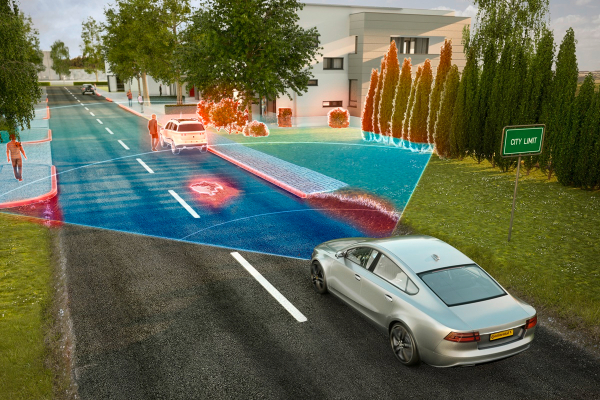
[Graphics = Continental]
The 6th-generation radar is a scalable solution, capable of detecting up to approximately 250 meters. It supports a range from a basic version that meets European NCAP requirements to a premium version that implements advanced automated functions, such as lane change. It is GSR (General Safety Regulation) compliant and can be used as a smart radar, processing data from sensors, or as a satellite radar, processing data from a central control unit, supporting a variety of vehicle architectures and types.
Continental is currently developing surround radar focused on 360-degree surrounding detection. It can detect up to a distance of about 200 meters, which officials say is longer than previous short-range radars and is expected to meet NCAP requirements for auxiliary systems.
The enhanced responsiveness of surround radar is expected to enable faster and more accurate detection of moving objects on the road. Its performance remains unaffected even when installed in difficult vehicle locations. Especially when installed on the side of a vehicle, surround radar will significantly enhance advanced driver assistance systems (ADAS) and autonomous driving performance.
To monitor a vehicle's surroundings with radar, radar must be installed at the front and rear corners of the vehicle and behind the painted bumper. However, implementation is challenging from a sensor technology perspective, as reflection and absorption effects from the bumper structure and coating can affect radar signals. Long-range radars typically installed at the front center of a vehicle are covered by a radome, a protective cover made of radio-frequency transparent plastic.
“The technology doesn’t work at the corners of the vehicle,” says Norbert Hammerschmidt, head of program management radar in Continental’s ADAS business unit, about the sixth-generation long-range radar. “We’ve implemented several patented solutions that increase the radar’s responsiveness, which allows us to achieve excellent detection reliability even when damped by painted bumpers at the corners.” He adds that the sensor is around 40 percent lighter than the fifth-generation sensor. The sixth-generation sensor measures approximately 70 × 55 × 20 millimeters.
The two new radars operate primarily at 77 GHz, but can also operate in the 77–81 GHz band. They also feature intelligent algorithms that filter out signals from other radar sensors and process only their own signals, even in complex road conditions. This is an important point as the installation rate of sensors inside and outside vehicles is gradually increasing.
Like fifth-generation sensors, sixth-generation long-range radars incorporate scalable, modular hardware and software. With a certain level of local sensor information, sensors can be integrated into different E/E architectures in the same manner. They also include automatic sensor alignment capabilities.
Production of the two new radars is scheduled to begin in 2023, and initial customer orders have already been received.

Comments
Related news
Continental Develops Xilinx FPGA-Based 4D Imaging Radar
4D imaging radar differs from conventional automotive radar that captures only velocity and azimuth by additionally utilizing distance, altitude, and relative velocity to confirm object location, thereby providing more detailed driving environment information. Accordingly, Continental announced that it has developed the 'ARS540' 4D imaging radar based on Xilinx's Zynq UltraScale+ MPSoC platform.
2020.09.24by 명세환 기자
Object recognition technology that improves autonomous driving safety, "How far has it come?"
Autonomous vehicles require sensors such as cameras, LiDAR, and radar. The object recognition AI model installed in autonomous vehicles interprets information transmitted by multiple sensors based on datasets, recognizes surrounding objects, and determines direction and driving control. Object recognition requires labeled datasets in any field, but the autonomous driving industry has not yet reached consensus on dataset labeling methods, with only basic standards having been established.
2020.12.07by 이수민 기자
The "SensePro 2" DSP, offering six times the DSP performance and twice the AI capabilities, has been released.
CEVA has launched the SensePro2 DSP product family, which performs AI and DSP tasks related to a wide range of sensors including cameras, radar, and lidar. The new product family delivers 6 to 8 times higher DSP performance than SensePro1, 2 times higher AI inference performance, and 20% higher power efficiency on the same process node.
2021.01.20by 명세환 기자

[e4ds Tech Day 2026 ⑨] Sim Sang-gyu, Autocrypt CTO: "In the Physical AI Era, Automotive Security Must Extend Beyond the Vehicle"
At e4ds Tech Day 2026, Sim Sang-gyu, CTO of Autocrypt, explained automotive cybersecurity strategies in the era of Physical AI and SDV (Software-Defined Vehicle). Automobiles are evolving as part of an ecosystem connected to AI, cloud, chargers, IoT, and robots, and he emphasized that the scope of security must expand beyond the vehicle interior to the entire connected environment. In particular, AI model tampering, adversarial attacks, OTA updates, and EV charger hacking were identified as major threats. He explained that response measures require zero trust, AI model integrity protection, intrusion detection, Security by Design and Default, and full lifecycle security management, and that proactive security system establishment beyond regulatory compliance is critical for securing future mobility competitiveness.
2026.10.12by 배종인 기자

Practical HIL Construction Strategy for Automotive and Off-Highway Controller Validation
As vehicle E/E architecture transitions to zonal structures and shifts to software-defined vehicles (SDV), the number of controllers (ECUs) requiring validation and software complexity are surging dramatically. Meanwhile, real vehicle testing cannot provide repeated verification under identical conditions and entails lead time and safety concerns. This white paper explains the principles of HIL (Hardware-in-the-Loop) validation and the structure of the NI platform composed of PXI, SLSC, and VeriStand, and through two actual implementation cases—Camera Record & Replay HIL for In-Cabin Monitoring Controller (ICMU) and Forklift Controller (VCU) HILS—describes how controller-level regression testing becomes possible. Additionally, it explicitly states application boundaries and limitations, such as lack of A2B support.
2026.10.12by 편집부











