


Maxim and iZip Develop Human Body Recognition Function for Low-Power IoT Devices
 Published2021.04.20 09:01
Adding human motion detection capabilities to low-power IoT systems
Maxim Integrated Korea announced on the 20th that it has applied its neural network MCU, 'MAX78000', to the 'Visual Wake Words (VWW)' model of Aizip, an artificial intelligence (AI) specialist company for Internet of Things (IoT) applications.
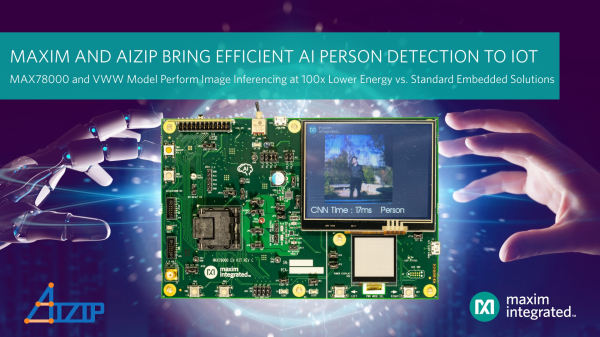
Added AI-based human recognition capabilities [Graphics = Maxim]
Low-power networks extend the operating time of battery-powered IoT systems for building energy management and human detection, such as smart security cameras. The MAX78000 low-power neural network acceleration-based MCU improves the operating time of battery-powered edge AI applications by executing AI inference using less than 1/100th the energy of existing software solutions.
The VWW network with mixed precision technology is a product of the Aizip Intelligent Vision Deep Neural Network (AIV DNN) series for image and video applications. It was developed using Aizip's own design automation tool and has achieved over 85% human recognition accuracy.
The combination of a low-power MCU system-on-chip (SoC) and a high-efficiency AI model enables human recognition with 0.7 mJ of energy per inference, 100 times lower than existing software and IoT human recognition solutions. It also enables 13 million inferences on a single AA/LR6 battery. Extreme model compression enables accurate smart vision with a low-cost AI-accelerated MCU with limited memory and an affordable image sensor.
“iZip has leveraged their per-layer quantization capabilities to reduce storage weight and implement a compact, energy-efficient model for human recognition,” said Robert Muchsel, senior research engineer at Maxim Integrated, who designed the MAX78000 MCU. “We look forward to working with iZip on other projects in the future.”
Comments
Related news
Processing massive IoT data requires a robust algorithm system.
With the advancement of IoT technology, enterprises and organizations can now collect large volumes of data in real-time compared to before. However, rapidly processing data continuously transmitted by tens to millions of IoT nodes is not straightforward. Organizations must establish automated decision-making processes to implement high efficiency and rapid response. Adopting systems powered by machine learning algorithms is one method to realize this.
2021.03.25by 이수민 기자
Simultaneously implementing enhanced security and TCO optimization in IIoT solutions.
IIoT applications are evolving from reliable IoT systems to security-enhanced IoT systems. Security-enhanced IoT solutions consist of numerous individual components, including hardware and software, as well as IoT cloud services. Selecting appropriate hardware can reduce BOM and lower component costs. Proper security infrastructure does not incur significant costs over time and provides the scalability required for growth.
2021.03.28by 이수민 기자
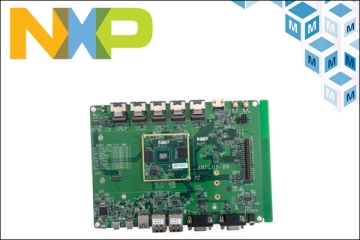
Mouser Launches Evaluation Kit for NXP IoT Processor with NPU
Mouser supplies NXP's i.MX 8M Plus evaluation kit. This kit provides a complete evaluation platform for the i.MX 8M Plus embedded multi-core heterogeneous application processor. The i.MX 8M Plus processor is the first in the i.MX product family to feature a dedicated NPU for advanced machine learning inference at the edge of IoT and IIoT applications.
2021.04.14by 강정규 기자
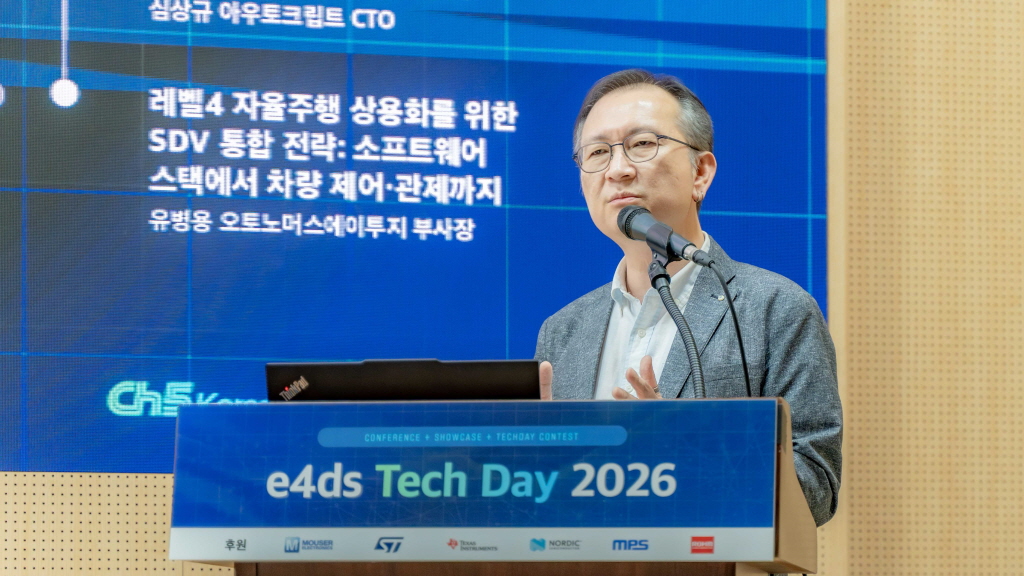
[e4ds Tech Day 2026 ⑨] Sim Sang-gyu, Autocrypt CTO: "In the Physical AI Era, Automotive Security Must Extend Beyond the Vehicle"
At e4ds Tech Day 2026, Sim Sang-gyu, CTO of Autocrypt, explained automotive cybersecurity strategies in the era of Physical AI and SDV (Software-Defined Vehicle). Automobiles are evolving as part of an ecosystem connected to AI, cloud, chargers, IoT, and robots, and he emphasized that the scope of security must expand beyond the vehicle interior to the entire connected environment. In particular, AI model tampering, adversarial attacks, OTA updates, and EV charger hacking were identified as major threats. He explained that response measures require zero trust, AI model integrity protection, intrusion detection, Security by Design and Default, and full lifecycle security management, and that proactive security system establishment beyond regulatory compliance is critical for securing future mobility competitiveness.
2026.10.12by 배종인 기자
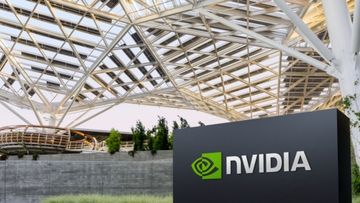
NVIDIA to Invest $1 Billion in U.S. Science Over Next Five Years
NVIDIA has announced plans to invest $1 billion over the next five years to strengthen U.S. scientific and technological competitiveness. The company will enhance cutting-edge artificial intelligence research and development capabilities in key areas including quantum computing, healthcare, and energy security, while expanding support for higher education research institutions and cloud service providers. NVIDIA is participating as a major industry partner in the White House Office of Science and Technology Policy's Genesis Mission, and is promoting supercomputer construction in collaboration with national laboratories including Argonne and Los Alamos.
2026.10.12by 배종인 기자











