



2020 Semiconductor 184 Companies Sales 268 Trillion... 9% Increase YoY
 Published2021.04.20 16:10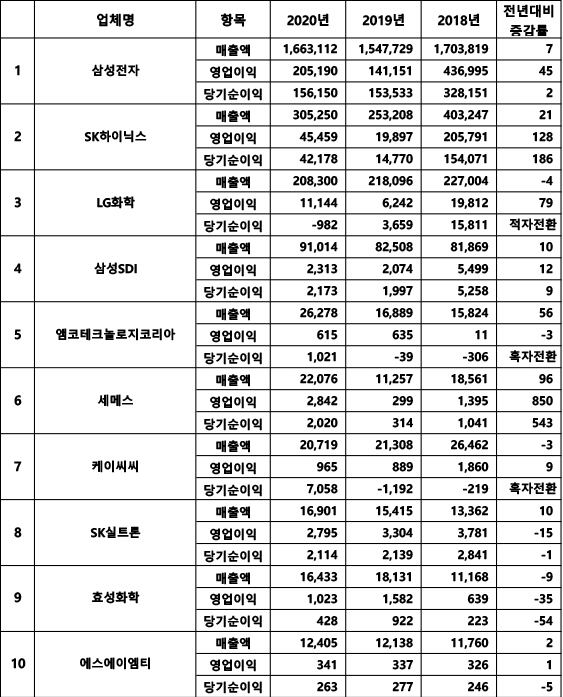
(The full text of all 184 articles can be downloaded here )
Operating profit up 50% due to increase in domestic demand and exports despite Corona and price decline
2021 DRAM supply shortage, increased equipment orders, semiconductor industry boom
In 2020, the business performance of 184 semiconductor companies showed a remarkable increase in operating profit by 50%, with domestic sales and exports increasing despite COVID-19 and the decline in memory semiconductor prices.
According to our analysis of public data, the sales of 184 domestic semiconductor companies in 2020 increased 9% year-on-year to KRW 267.998 trillion based on standalone financial statements. Operating profit increased 50% year-on-year to KRW 30.534 trillion, and net profit for the period increased 24% year-on-year to KRW 23.2114 trillion.
In 2020, the semiconductor market saw an 8.2% increase in exports compared to 2019 despite the impact of COVID-19.
DRAM and NAND flash prices also showed stability, and demand gradually recovered in the second half of the year compared to the first half.
In particular, due to the rapid transition to a non-face-to-face society caused by COVID-19, demand for data centers has increased.
There was an adjustment in production volume due to the spread of COVID-19 in the first half of the year, but overall production increased compared to 2019 due to increased demand in the second half.
In the second half of the year, imports of special-purpose semiconductors, such as automotive semiconductors and some communications semiconductors, increased, and demand for semiconductors also increased.
When analyzing the performance of major semiconductor companies individually, Samsung Electronics and SK Hynix took the top 1 and 2 places.
Samsung Electronics recorded sales of KRW 166.3112 trillion in 2020, up 7% year-on-year, and operating profit of KRW 20.519 trillion, up 45% year-on-year. Net income for the period was KRW 15.615 trillion.
Among them, Samsung Electronics DS division business performance recorded sales of 103 trillion won and operating profit of 21.1 trillion won. In the global market, DRAM, NAND, DDI, and OLED products are leading the market with the highest market share.
Memory maintained its competitive edge as the number one company even in situations of significant market fluctuations, and led the semiconductor business performance. In addition, we are preparing for the future by strengthening our next-generation technology leadership, such as establishing the EUV process mass production system for the first time in the DRAM industry and accelerating the transition to 6th generation V-NAND.
As the market expands due to increased demand for non-face-to-face services, the foundry has expanded its customer base from mobile to HPC (High Performance Computing). In addition, it is securing cutting-edge process competitiveness by expanding production capacity and operating EUV-only production lines.
System LSI is securing the SoC (System on Chip) customer base by enhancing product competitiveness and strengthening the 5G lineup. Image sensors are leading the high-pixel trend by expanding 0.7um (micrometer) fine pixels and 100 million pixel products, and are continuing solid growth by maintaining the top market share in China.
SK Hynix recorded sales of KRW 30.525 trillion based on standalone financial statements, up 21% year-on-year, and operating profit of KRW 4.5459 trillion, up 128% year-on-year. Net income for the period was KRW 4.2178 trillion, up 186% year-on-year.
Last year, SK Hynix steadily mass-produced its main products, including 10nm-class 3rd generation DRAM (1Z nano) and 128-layer NAND, and expanded its server market share based on quality competitiveness.
In 2021, SK Hynix plans to actively build a foundation for future growth, including smoothly proceeding with the acquisition of Intel's NAND business division and fully operating the new M16 fab.
Based on the standalone financial statements, Semes recorded sales of KRW 2.2076 trillion, up 96% year-on-year, and operating profit of KRW 284.2 billion, up 850% year-on-year. Net income for the period was KRW 202 billion, up 543% year-on-year.
Based on standalone financial statements, SK Siltron recorded sales of KRW 1.6901 trillion, up 10% year-on-year, while operating profit decreased by 15% year-on-year to KRW 279.5 billion. Net income was 211.4 billion won, down 1% from the previous year.
Based on standalone financial statements, Wonik IPS recorded sales of KRW 1.908 trillion, up 63% year-on-year, and operating profit of KRW 140.4 billion, up 247% year-on-year. Net income for the period was KRW 165.7 billion, up 37% year-on-year.
Based on standalone financial statements, DB HiTek recorded sales of KRW 935.9 billion, up 16% year-on-year, and operating profit of KRW 239.2 billion, up 32% year-on-year. Net income for the period was KRW 165.7 billion, up 37% year-on-year.
Applied Materials Korea recorded sales of KRW 797.9 billion based on standalone financial statements, up 16% year-on-year, and operating profit of KRW 110.1 billion, up 61% year-on-year. Net income for the period was KRW 76.7 billion, up 30% year-on-year.
Dongjin Semichem recorded sales of KRW 680 billion based on its standalone financial statements, up 4% year-on-year, and operating profit of KRW 84 billion, up 12% year-on-year. Net income for the period was KRW 64.2 billion, up 44% year-on-year.
Air Products Korea recorded sales of KRW 635.1 billion based on standalone financial statements, up 7% year-on-year, and operating profit of KRW 177.1 billion, up 9% year-on-year. Net income for the period was KRW 139.3 billion, up 13% year-on-year.
SK Materials recorded sales of KRW 520.1 billion based on standalone financial statements, up 14% year-on-year, while operating profit decreased by 8% year-on-year to KRW 91.2 billion. Net income for the period decreased by 15% year-on-year to KRW 57.4 billion.
Based on its standalone financial statements, Solbrain recorded sales of KRW 453.4 billion, operating profit of KRW 96.7 billion, and net profit of KRW 60.3 billion.
Based on standalone financial statements, KC Tech recorded sales of KRW 319.9 billion, up 21% year-on-year, and operating profit of KRW 56.1 billion, up 14% year-on-year. Net income increased 16% year-on-year to KRW 42.6 billion.
Wonik Materials recorded sales of KRW 268.6 billion based on standalone financial statements, up 21% year-on-year, and operating profit of KRW 47.8 billion, up 30% year-on-year. Net income for the period increased 30% year-on-year to KRW 33.7 billion.
■ Memory supply shortage forecast for 2021, equipment orders for capacity expansion also likely to increase significantly
According to semiconductor market experts, the DRAM fixed price in the second quarter of 2020 is expected to rise by 20% for PCs and servers and 10% for mobile, and if the production and shipment volumes are calculated and inventory is forecasted, the DRAM industry is expected to experience a severe supply shortage in the second quarter of 2021.
Additionally, NAND fixed prices are expected to rise starting in the second quarter of 2021.
Smartphones have been driving semiconductor demand since COVID-19, and PC demand is also greatly exceeding expectations due to the demand for remote work.
The transition to DDR5 is expected to begin in earnest as Intel CPUs are expected to support DDR5 starting in 2021. Experts predict that DDR5 will form a price premium over DDR4, and that this will lead to increased demand and supply constraints, which will lead to improved profitability for DRAM companies such as Samsung Electronics and SK Hynix.
It is reported that EUV will be introduced in DRAM starting with the 1Anm (estimated 14nm) process, following non-volatile memory. Samsung Electronics is known to have already mass-produced chips using EUV in 1Xnm or 1Znm, sampled them to customers, and received certification. EUV equipment is monopolized by ASML, and if a request is made to purchase EUV equipment after a DRAM supply shortage occurs, it is analyzed that it will inevitably take longer than usual to increase capacity.
Samsung Electronics is applying Single Stack for mass production of 128-layer (V6) 3D NAND, while Toshiba is selecting Double Stack for 92-layer, SK Hynix for 72-layer, and Micron for 64-layer. Samsung Electronics is also expected to select Double Stack for V7, the process after 128-layer, and in this case, supply constraints are inevitable due to increased process number and process difficulty. In addition, an increase in the usage of related materials is also expected.
Samsung Electronics is currently placing equipment orders worth 30K/month for DRAM and 30K/month for NAND in the first quarter of 2021, and the global expansion requirements for 2022 are estimated at 100K/month for DRAM and 150K/month for NAND.
Experts predict that from the second quarter of 2021 to the first quarter of 2022, memory semiconductor CAPEX will reach an all-time high for approximately one year, and that additional capacity expansion will be required due to supply constraints such as DRAM DDR5 and NAND Double Stack.
In addition, the recent shortage of non-memory memory supplies is likely to lead to a strong build-up of memory inventory until the third quarter of 2021, which is expected to be a positive year for the domestic semiconductor industry.

Comments
Related news
.jpg)
e4ds: 2021 Semiconductor Outlook and Next-Generation Technology
e4ds news will hold the 'e4ds Semiconductor Technology Conference 2021 Spring' online starting at 9:30 a.m. on April 28th. The conference will provide forecasts for the 2021 semiconductor market and examine the current state of next-generation semiconductor development. e4ds news will hold the 'e4ds Semiconductor Technology Conference 2021 Spring' online starting at 9:30 a.m. on April 28th. The conference will provide forecasts for the 2021 semiconductor market and examine the current state of next-generation semiconductor development.
2021.04.15by 배종인 기자
.jpg)
AMEC Begins Full-Scale 5nm Etching Equipment Production Line
AMEC's 5nm etching equipment recently completed testing and has been put into full-scale production lines, according to reports. AMEC Chairman In Zuyao recently announced that AMEC's plasma etching equipment has been deployed and is being used in the production lines of global leading-edge semiconductor manufacturers. The global leading-edge semiconductor manufacturer mentioned by Chairman In Zuyao is estimated to be TSMC.
2021.04.16by 배종인 기자
Wonik Materials: "Record-Best Performance in 2021 and 2022"
Onewick Materials is expected to achieve record-high performance in 2021 and 2022 due to increased material input quantities related to capacity expansion in response to growing difficulty levels in semiconductor memory processes.
2021.04.19by 배종인 기자

Intel Unveils Next-Generation 'Core Ultra Series 3' and vPro Platform for Enterprise PCs
Intel has officially unveiled the "Intel Core Ultra Series 3" for next-generation enterprise PCs and the latest vPro platform, addressing a wide range of demands from enterprise notebooks to high-performance workstations.
2026.03.26by 배종인 기자

ROHM Launches ESD Protection Diode Compatible with High-Speed Interfaces of 10Gbps or Higher
Semiconductor specialist ROHM has developed the 'RESDxVx series' of ESD (electrostatic discharge) protection diodes capable of responding to next-generation high-speed data communication environments exceeding 10Gbps, simultaneously enhancing both signal quality maintenance required in high-speed interfaces and IC protection performance.
2026.03.26by 배종인 기자











