



Xilinx Unveils FPGA-Based System-on-Mount (SOM) for Edge Vision Acceleration
 Published2021.04.21 11:59
K26 SOM delivers 1.4 TOPS of performance for vision AI.
Vitis, App Store, KV260 kit, etc.
Xilinx today launched its Kria™ portfolio of small form-factor, production-ready embedded boards for rapid deployment in edge applications. Kria is an adaptable System on Module (SOM) that comes with a complete software stack and pre-built, production-grade accelerated applications.
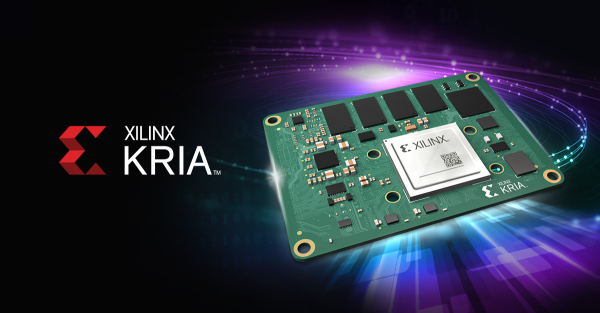
The Kria SOM allows development to begin at a later point in the design cycle than with a chip-down design approach, reducing build times by up to nine months.
The first Kria product, the K26 SOM, is designed for vision AI applications in smart cities and smart factories. It is based on the Zynq® UltraScale+™ MPSoC, featuring a quad-core Arm® Cortex™ A53 processor, over 250,000 logic cells, and an H.264/265 video codec. It has 4GB of DDR4 memory and 245 IOs, making it suitable for almost any sensor or interface.
With 1.4 TOPS of AI computing, the K26 enables developers to develop vision AI applications that deliver up to 3x better performance with lower power consumption and lower latency than GPU-based SOMs in key smart vision applications such as security, transportation, city cameras, retail analytics, machine vision, and vision-guided robotics.
◇ Development assistance with the Vitis platform and Xilinx App Store
Xilinx supports the Vitis™ unified software development platform and libraries, eliminating the need for software developers to design for FPGA hardware. Vitis provides a development environment familiar to software developers, including TensorFlow, Pytorch, Caffe frameworks, C, C++, OpenCL™, and Python programming languages. Developers can integrate custom AI models and application code, optionally modifying only the vision pipeline.
Additionally, Xilinx has launched an embedded app store for edge applications. The Xilinx App Store offers a wide range of apps from Xilinx and its ecosystem partners for the Alveo™ catalog for data centers and the Cria SOM. These free, open-source accelerated applications for Xilinx products range from smart camera tracking and facial recognition to natural language processing using smart vision.
The Kria SOM supports standard Yocto-based PetaLinux, allowing embedded developers to customize and optimize it. Additionally, Xilinx plans to collaborate with Canonical to support Ubuntu Linux, which is expected to enhance convenience for AI developers and ensure interoperability with existing applications.
◇ Starter Kit Launched for K26-Based Vision Application Development
Alongside the announcement of the Kria SOM, the Kria KV260 Vision AI Starter Kit was also unveiled. The KV260 kit is designed to support vision-accelerated applications available on the Xilinx App Store.
Even without prior knowledge of FPGAs or FPGA tools, you can be up and running in less than an hour. Pricing starts at $199. Customers looking to move to actual deployment can upgrade to the commercial ($250) and industrial ($350) K26 production SOMs.
The Kria K26 SOM and KV260 Vision AI Starter Kit are available immediately from Xilinx and its distributors worldwide. The KV260 Vision Kit is available immediately with the commercial K26 shipping in May 2021 and the industrial-grade K26 shipping this summer. Ubuntu Linux support for the K26 is expected to be available in July 2021.
Additionally, Xilinx provides accelerated applications and design services, as well as how-to videos and training courses for hobbyist designers, manufacturers, and commercial developers to help shorten the K26 design cycle.
Meanwhile, according to QYR Electronics Research Center, the SOM market is expected to grow at an annual rate of approximately 11% and reach a market size of $2.3 billion in 2025.
Comments
Related news
.jpg)
Lattice Unveils Embedded Vision and Firmware Security Enhancement Stack
Lattice Semiconductor has unveiled the "Lattice mVision 2.0" solution stack for low-power embedded vision systems and "Lattice Sentry 2.0" for server security system control. mVision 2.0 supports the "Lattice Propel" design environment, which accelerates embedded processor-based application development on FPGAs, while Sentry 2.0 includes a secure enclave IP block that implements 384-bit encryption.
2021.03.04by 이수민 기자

Microchip begins mass production of FPGAs certified for automotive and defense applications.
Microchip has begun shipping PolarFire FPGA devices that have achieved AEC-Q100 T2 grade and military temperature grade certification. Unlike other SRAM-based FPGAs, PolarFire FPGA operates without a fan and, in some cases, without a heatsink, simplifying system thermal design.
2021.03.05by 명세환 기자

Xilinx Expands 16nm FPGA Product Family to Support Edge Computing
Xilinx has expanded its cost-effective Ultrascale+ portfolio to support ultra-compact, high-performance edge computing. The Artix and Zynq Ultrascale+ devices, which are 70% smaller than conventional chip scale packages, are hardware-adaptive products based on 16nm technology and are offered with TSMC's InFO packaging technology that mounts the chip directly on the wafer.
2021.03.19by 이수민 기자

Intel Unveils Next-Generation 'Core Ultra Series 3' and vPro Platform for Enterprise PCs
Intel has officially unveiled the "Intel Core Ultra Series 3" for next-generation enterprise PCs and the latest vPro platform, addressing a wide range of demands from enterprise notebooks to high-performance workstations.
2026.03.26by 배종인 기자

ROHM Launches ESD Protection Diode Compatible with High-Speed Interfaces of 10Gbps or Higher
Semiconductor specialist ROHM has developed the 'RESDxVx series' of ESD (electrostatic discharge) protection diodes capable of responding to next-generation high-speed data communication environments exceeding 10Gbps, simultaneously enhancing both signal quality maintenance required in high-speed interfaces and IC protection performance.
2026.03.26by 배종인 기자











