


The FIDO Alliance Develops Onboarding Technology Standards for IoT Security
 Published2021.04.22 10:19
FIDO Device Onboarding Protocol Globally Released
Improving Security for Industrial/Commercial IoT Applications
On the 21st, the FIDO Alliance globally released the FIDO Device Onboard (FDO) protocol. The FDO protocol enables devices to be easily and securely integrated into cloud and on-premise management platforms.
Through the FDO protocol, the FIDO Alliance helps address the security, cost, and complexity challenges associated with large-scale deployments in IoT environments. FDO reinforces the core vision of the FIDO Alliance, which brings together more than 250 of the world's most influential and innovative companies and government agencies to eliminate data breaches and support safe online experiences.
IDC predicts that the IoT market will continue its double-digit annual growth rate, surpassing $1 trillion by 2022. Despite this anticipated growth, a recent survey of vendors and enterprise users found that a majority of companies are concerned about infrastructure breaches.
Of the 170 IoT leaders who participated in the survey, 85% said security concerns remain a major obstacle to IoT adoption. Sixty-four percent of respondents cited IoT security as their top short-term priority. This figure surpasses edge computing (55%), AI/machine learning (50%), and 5G deployment (28%).
This FDO specification for IoT was developed to address IoT security issues during onboarding, similar to how the FIDO authentication standard is used to prevent data breaches. The FDO IoT specification is freely implementable for industrial and commercial applications.
◇ Supports fast and secure IoT device onboarding.
FIDO is an automated onboarding protocol for IoT devices. It utilizes asymmetric public key cryptography to provide a fast and secure way to onboard all IoT devices.
The FDO protocol eliminates the need for installation costs. The highly automated FDO process can be performed quickly and efficiently, regardless of user experience.
Additionally, you can decide which cloud platform to onboard devices to at the point of installation, as opposed to manufacturing them yourself. By onboarding a single device stock-keeping unit (SKU) across all platforms, you can significantly simplify your device supply chain.
Security is also a strength. Because the FDO protocol utilizes an "untrusted installer" approach, installers do not need sensitive infrastructure or access control information to add devices to the network.
Meanwhile, this FDO technology standard was jointly developed by Qualcomm, Amazon, Google, and Microsoft, which are members of the FIDO Alliance IoT technology division.
Comments
Related news
.jpg)
Mature IoT platform technologies lead digital transformation of daily life and work
An increasing number of companies are leveraging internet connectivity to enhance their product functionality, create previously non-existent services, and diversify their business models. IT companies took the first steps in this direction, and manufacturing enterprises are now actively following suit. At the center of this trend is the IoT platform. An IoT platform is a technology that supports the development and operation of diverse services by connecting various sensors and terminal devices.
2021.03.22by 이수민 기자

Simultaneously implementing enhanced security and TCO optimization in IIoT solutions.
IIoT applications are evolving from reliable IoT systems to security-enhanced IoT systems. Security-enhanced IoT solutions consist of numerous individual components, including hardware and software, as well as IoT cloud services. Selecting appropriate hardware can reduce BOM and lower component costs. Proper security infrastructure does not incur significant costs over time and provides the scalability required for growth.
2021.03.28by 이수민 기자
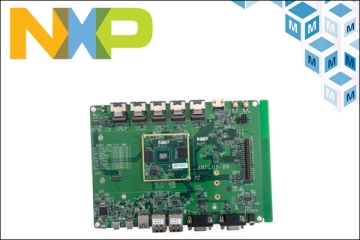
Mouser Launches Evaluation Kit for NXP IoT Processor with NPU
Mouser supplies NXP's i.MX 8M Plus evaluation kit. This kit provides a complete evaluation platform for the i.MX 8M Plus embedded multi-core heterogeneous application processor. The i.MX 8M Plus processor is the first in the i.MX product family to feature a dedicated NPU for advanced machine learning inference at the edge of IoT and IIoT applications.
2021.04.14by 강정규 기자
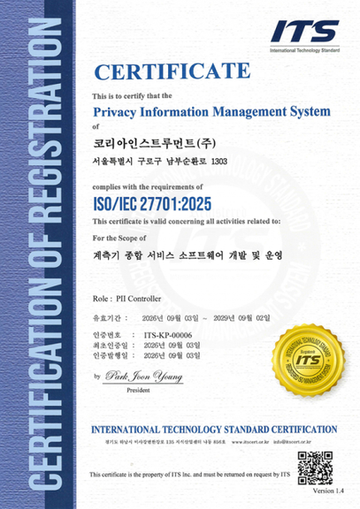
Korea Instrument, KOLAS Accredited Calibration Agency First to Simultaneously Acquire ISO/IEC 27,001·27,701
Korea Instrument has become the first among KOLAS accredited calibration agencies to simultaneously acquire ISO/IEC 27,001 and ISO/IEC 27,701 certifications. Through its proprietary platforms CWIZ Enterprise and CWIZ Partners, the company has embedded information security and personal data protection requirements across all business processes including customer information, equipment data, and calibration reports, with plans to continuously advance its management system through regular audits and security inspections.
2026.10.12by 배종인 기자

TeamViewer One, IT Incident Automation Workflow and Resolution Center Enhanced
TeamViewer has added IT incident automation capabilities and an advanced Resolution Center to its integrated digital workplace management platform 'TeamViewer ONE'. Recurrent service disruptions, configuration errors, and capacity shortages are automatically handled according to preset policies, and device status verification through script deployment can be managed in a unified interface, significantly reducing repetitive tasks for IT teams.
2026.10.12by 배종인 기자











