



Infineon Announces AEC-Q103 Qualified MEMS Microphones
 Published2021.04.27 14:50
130dB SPL AOP guaranteed, audio capture even in noisy environments
Infineon Technologies AG announced today the availability of the XENSIV™ 'IM67D130A' MEMS microphone, which meets the automotive quality requirements of AEC-Q103-003. It is available in the PG-LLGA-5-4 package and is available for order now.
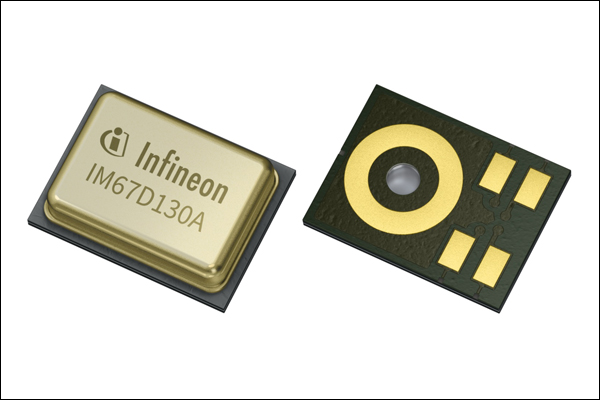
With an operating temperature range of -40°C to +105°C, it's ideal for harsh automotive environments. A high acoustic overload point (AOP) of 130dB SPL ensures distortion-free audio capture in noisy environments, making it suitable for use both inside and outside the car.
It is suitable for hands-free systems, emergency communication systems (eCall), in-vehicle communication, and active noise cancellation (ANC). It is also suitable for external applications such as sirens and road condition detection, and can be used as a supplementary sensor for ADAS or predictive maintenance.
A high signal-to-noise ratio (SNR) of 67 dB and low distortion provide optimal voice quality and speech recognition for speech recognition-based applications. High sensitivity matching allows for beamforming algorithms optimized for multi-microphone arrays.
Comments
Related news
Minimizing Machine Downtime with MEMS Accelerometers
Preventive maintenance is increasingly being recognized as important across all fields using machinery and equipment to minimize the risk of downtime. This is accomplished through detection and analysis of vibration patterns in mechanical equipment. MEMS sensors have higher resolution than piezoelectric sensors and exhibit superior drift and sensitivity characteristics. They also offer excellent SNR and can detect low-frequency vibrations close to DC levels.
2020.12.19by 이수민 기자
Infineon supplies MEMS-type microphones to replace ECM
Noise canceling headphone designers consider AOP, SNR, power consumption, package size, and whether to select ECM or MEMS type before adopting a microphone. Infineon has unveiled the XENSIV IM73A135, an analog MEMS microphone that replaces ECM.
2021.01.09by 이수민 기자
ST-Ocumented Joins Hands in Commercializing MEMS Mirror-Based 'LBS'
STMicroelectronics has agreed to collaborate with Ocumented, a MEMS mirror-specialized startup, in the fields of augmented reality (AR) and 3D sensing. According to the agreement, both companies will develop technologies and products utilizing MEMS mirror-based laser beam scanning (LBS) solutions. ST will invest significant MEMS design and manufacturing resources. Ocumented will industrialize its patented Bubble MEMS technology for implementing vacuum-sealed MEMS micro mirrors and will pursue mass production.
2021.04.12by 이수민 기자

Intel Unveils Next-Generation 'Core Ultra Series 3' and vPro Platform for Enterprise PCs
Intel has officially unveiled the "Intel Core Ultra Series 3" for next-generation enterprise PCs and the latest vPro platform, addressing a wide range of demands from enterprise notebooks to high-performance workstations.
2026.03.26by 배종인 기자

ROHM Launches ESD Protection Diode Compatible with High-Speed Interfaces of 10Gbps or Higher
Semiconductor specialist ROHM has developed the 'RESDxVx series' of ESD (electrostatic discharge) protection diodes capable of responding to next-generation high-speed data communication environments exceeding 10Gbps, simultaneously enhancing both signal quality maintenance required in high-speed interfaces and IC protection performance.
2026.03.26by 배종인 기자











