



The Ministry of Science and ICT and the National Institute of Agricultural Sciences (NIA) are exploring 5G MEC convergence service models.
 Published2021.04.29 09:01
Commercialization of open MEC-based technology and
Promoting Korean 5G and MEC standards
The Ministry of Science and ICT and the National Intelligence Service (NIA) are launching the 2021 "5G Convergence Service Discovery and Public Leadership Application" project as part of the Digital New Deal.

[Image = Pixabay]
This project, which aims to build various convergence service models utilizing 5G based on Mobile Edge Computing (MEC) in the public sector and to vitalize the 5G industry ecosystem, will have a total budget of KRW 120 billion invested from 2020 to 2022.
Last year, service models in seven areas (safety and quarantine, remote education, road management, quarantine and education, health management, intelligent industrial complex, and environment) were established and are currently in operation. Demanders are considering expanding the scale of service models for non-face-to-face safety and quarantine, smart industrial complexes, etc.
This year, we will spend 40 billion won to build a MEC-based convergence service model, commercialize open MEC-based technologies to revitalize upstream and downstream industries, and standardize 5G and mobile edge computing.
The construction of a six-field MEC-based convergence service model is led by KT (defense, smart campus), LG Uplus (port, smart city, smart industrial complex), and Daejeon Techno Park (healthcare).It is planned to be completed by the end of the year and officially operated from 2022.
In the case of commercialization of MEC-based technology, Daejeon Metropolitan Rapid Transit Corporation, Smart Coop Co., Ltd., Sweet K Co., Ltd., Entels Co., Ltd., Team Grit Co., Ltd., and Iruon Co., Ltd. will carry out basic technology commercialization tasks such as development and verification of open platforms and solutions that can be utilized to implement MEC-based convergence service models.
In order to secure a lead in the MEC market, which is expected to grow rapidly along with the spread of 5G utilization, we are also pursuing 5G/MEC standardization based on service models that have been pioneered in the public sector.
Lee Seung-won, Director General of the Ministry of Science and ICT's Information and Communication Industry Policy Bureau, said, "We will ensure that our 5G model becomes a global standard by discovering various 5G convergence services and leading their application in the public sector," and added, "We will focus our policy capabilities to create a 5G+ convergence ecosystem."
Comments
Related news

5G will be available nationwide by 2024 at the earliest.
The Ministry of Science and ICT and the three telecommunications companies announced a joint 5G service utilization plan for rural areas including eup and myeon regions to provide 5G services. The three telecommunications companies will develop a shared network management system during the first half of this year and will proceed with network equipment IP reconfiguration to prevent communication failures. Following this, based on pilot results, they plan to commence network stabilization work and complete commercialization of the shared network by the first half of 2024.
2021.04.16by 이수민 기자
Nokia Deploys ASiR on LGU+'s 5G Network, Strengthening Indoor 5G
Nokia announced that it will deploy its in-building dedicated solution, AirScale Indoor Radio (ASiR) system, on LG U+'s commercial network to improve 5G indoor service quality and enhance coverage. The ASiR system supports various 5G frequency bands, is easy to deploy in diverse indoor spaces such as shopping malls and office buildings, and is cost-effective.
2021.04.19by 이수민 기자

KT Announces Service Robot Plan Based on AI Technology and 5G Infrastructure
KT held a meeting with promising robot companies attended by experts in the robotics field and announced its robot platform business plan. Lee Sang-ho, head of KT's AI Robot Business Division, stated that while the current robot market is dominated by industrial robots, service robots will take the lead from 2025 onwards, emphasizing that KT will elevate the level of the domestic robot market through service robots.
2021.04.28by 명세환 기자
European Patent Applications Surpass 200,000 for the First Time… South Korea Maintains 5th Place, Led by Batteries and Telecommunications
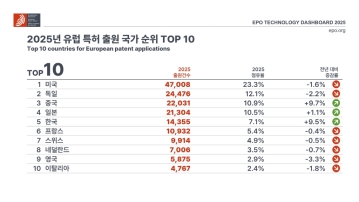
According to the European Patent Office (EPO)'s 'Technology Dashboard 2025', European patent applications last year reached 201,974, surpassing 200,000 for the first time. Korean companies and inventors filed 14,355 applications, representing a 9.5% increase from the previous year and maintaining 5th place by country. Battery, digital communication, and semiconductor technologies led the growth, with Samsung ranking as the top EPO applicant for the second consecutive year and LG reaching 3rd place. The presence of major domestic cities such as Seoul, Suwon, and Yongin was also confirmed. It was also revealed that Korea's European patent strategy is expanding beyond individual technologies to span the entire industry.
2026.03.24by 명세환 기자
SK Telecom First Applies AI-Based Network Operations at Gwanghwamun K-Pop Concert
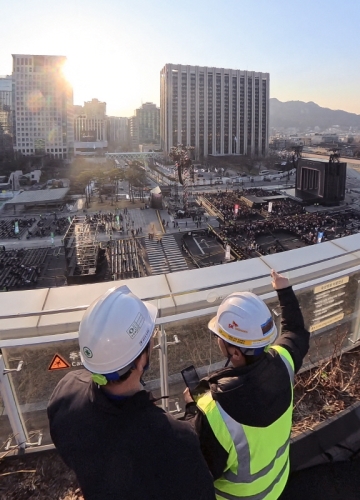
SK Telecom announced that it applied an AI-based network operation system for the first time at a large-scale K-pop concert held in the Gwanghwamun area of Seoul on March 21st, managing communication quality throughout the event. Mobile data usage during the three hours before and after the concert reached 12.15TB, approximately doubling compared to the same time slot the previous weekend. SK Telecom monitored traffic using the AI system 'A-One' in five-minute and 50-meter units to respond to potential overload situations, while also operating temporary communication facilities and on-site personnel in parallel. This case is interpreted as confirmation of the practical applicability of AI-based autonomous network operation in an environment where demand from dense events and foreign users increases simultaneously.
2026.03.23by 명세환 기자











