


Samsung Electronics' first-quarter sales reached KRW 65.3885 trillion, the highest quarterly figure ever.
 Published2021.04.29 10:02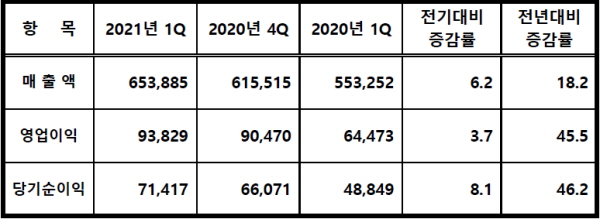
Samsung Electronics Q1 2021 Business Performance (Unit: KRW 100 million, %)
Falling semiconductor NAND prices and a power outage at the Austin plant have led to a decline in profits.
Samsung Electronics' first-quarter 2021 operating results saw profits increase due to robust sales of smartphones and other sets and increased OLED utilization, achieving its highest-ever first-quarter performance.
Samsung Electronics announced its first-quarter 2021 financial results on the 29th. According to the results, consolidated sales reached KRW 65.3885 trillion, an 18.2% increase year-on-year, and operating profit reached KRW 9.3829 trillion, a 45.5% increase year-on-year. Operating profit increased 46.2% year-on-year to KRW 7.1417 trillion.
Despite the impact of the display off-season, sales in the first quarter increased by 6.2% compared to the previous quarter, driven by brisk smartphone sales, recording the highest sales ever for the first quarter.
Compared to the same period last year, sales of set products, including smartphones, TVs, and home appliances, increased by 18.2%.
Operating profit increased compared to the previous quarter, despite the display off-season and a decline in semiconductor performance, driven by improved profitability in smartphones and CE (Consumer Electronics).
Both operating profit and profit margin improved compared to the same period last year.
Semiconductor earnings declined quarter-on-quarter, despite strong memory shipments centered on PCs and mobile devices, due to continued declines in NAND prices and some initial costs for new lines, as well as production disruptions caused by power outages and outages at the Austin line.
Display profits decreased compared to the previous quarter due to slowing demand for small and medium-sized products during the off-season, but profits improved significantly compared to the same period last year due to increased OLED operating rates.
Wireless saw a significant increase in profits compared to the previous quarter and the same period last year, driven by a significant increase in sales of flagship and mid- to low-priced smartphones, as well as an expanded contribution from the Galaxy ecosystem (Device Eco) product line, including tablets, PCs, and wearables.
The network also maintained solid performance thanks to the continued expansion of 5G overseas.
CE's profits increased compared to the previous quarter and the same period last year, driven by continued pent-up demand for home appliances and increased sales of premium TV products.
In terms of the first quarter welcome sentiment, the US dollar weakened against the Korean won, while the euro and major emerging market currencies strengthened.
This had a positive impact on the set business, but the dollar The negative impact on the parts business due to weakness was offset by a minimal positive impact on overall operating profit.
In the second quarter, semiconductor performance is expected to grow due to improved memory market conditions, but IM (IT & Mobile Communications) performance is expected to slow down due to factors such as a decline in the impact of new wireless product launches.
Memory performance is expected to improve due to strong server demand.
The foundry's Austin line is operating normally, but System LSI is expected to continue to experience some of the impact of the foundry production disruption from the previous quarter.
Display sales of small and medium-sized panels are expected to decline due to factors such as the seasonal off-season for smartphones and component shortages.
Wireless is expected to see a decline in sales and profitability due to declining flagship sales and issues with parts supply, but the company plans to minimize the impact by actively leveraging its global supply chain management (SCM) capabilities.
For TVs, CE will focus on expanding sales of new products such as 'Neo QLED' and securing demand for sports events, while for home appliances, it will pursue continued growth through the global expansion of BESPOKE.
In the second half of the year, the components business is expected to see an improvement in market conditions, and the company plans to continue to enhance its product and technological leadership, while the set business plans to pursue premium leadership and strengthen its lineup.
However, global macroeconomic risks, such as demand uncertainty related to COVID-19, are expected to persist.
The memory market is expected to continue its favorable business environment, including strong server and mobile demand, and Samsung Electronics plans to enhance its market leadership by accelerating the transition to 15nm DRAM and 6th-generation V-NAND and expanding the application of EUV (Extreme Ultra Violet).
System LSI is supplying through strengthening cooperation with domestic and international foundries. Maximizing and foundry plans to expand supply capacity through full-scale mass production at the Pyeongtaek Line 2.
Displays will continue to expand OLED adoption and build a foundation for entry into large-panel QD displays.
Wireless plans to focus on securing solid profitability through the expansion of foldable devices, strengthening its low- to mid-priced 5G lineup, and growth in tablets, PCs, and wearables.
The network plans to respond to domestic and international 5G commercialization and expand new global businesses.
Amidst ongoing demand uncertainty related to COVID-19, CE plans to focus on securing profitability by expanding sales of premium TVs, such as the Neo QLED and ultra-large-size TVs, and the New Life line of home appliances.
Facility investment in the first quarter was KRW 9.7 trillion, with KRW 8.5 trillion in semiconductors and KRW 700 billion in displays.
In the case of memory, investment was focused on expanding advanced processes and transitioning processes in Pyeongtaek and Xi'an to meet increasing demand, while in the foundry sector, investment was focused on expanding advanced processes such as EUV 5nm.

Comments
Related news
Samsung Electronics announces Q4 2020 earnings, earning more than in 2019
Samsung Electronics announced on the 28th that it achieved consolidated revenue of 61.55 trillion won and operating profit of 9.05 trillion won for the fourth quarter of 2020. In terms of revenue, this represents a decrease of 5.41 trillion won compared to the previous quarter and an increase of 1.67 trillion won compared to the same period of the previous year. Operating profit decreased by 3.3 trillion won compared to the previous quarter and increased by 1.89 trillion won compared to the same period of the previous year.
2021.01.28by 이수민 기자
2020 Semiconductor 184 Companies Sales 268 Trillion... 9% Increase YoY
Based on disclosure data analyzed by e4ds, 184 domestic semiconductor-related companies recorded 2020 sales of 26.7999 trillion won on a separate financial statement basis, up 9% year-over-year. Operating profit increased 50% year-over-year to 3.0053 trillion won, and net income for the period reached 2.32114 trillion won, a 24% increase year-over-year. Despite COVID-19 and declining memory semiconductor prices, both domestic consumption and exports increased, with operating profit surging 50%.
2021.04.20by 배종인 기자
SK Hynix's first-quarter sales reached KRW 8.4942 trillion, up 18% year-over-year.
SK Hynix achieved strong results in the first quarter of 2021, with sales of 8.4942 trillion won and operating profit of 1.3244 trillion won, driven by increased memory demand and improved yields in key products.
2021.04.28by 배종인 기자
ESP32 Development Environment Selection and GPS Application Implementation
The ESP32 is a microcontroller that integrates Wi-Fi, Bluetooth, 12-bit ADC, capacitive touch, PWM, DAC, and UART in a single SoC. However, the abundance of features does not by itself solve the designer's problems. The real challenges lie in selecting the appropriate development environment, determining which pins can be used and which must be avoided, and converting raw data from modules into usable information. This document addresses ESP32 peripheral constraints (ADC2 and Wi-Fi coexistence limitation, UART1 occupancy, ADC non-linear regions), the trade-offs between Arduino IDE and ESP-IDF, and the process from connecting NEO-6M/NEO-M8N GPS modules to UART2, parsing NMEA sentences, and visualizing routes in Google Earth, all organized based on documented references.
2026.10.12by 편집부
MIPI CSI-2, DSI-2, C-PHY, D-PHY Test Solution Technical White Paper
The MIPI interface adopts a burst mode that transitions between low-power (LP) and high-speed (HS) states for low-power consumption, and in return, strict timing rules are imposed on state transitions. Additionally, the high-speed section operates as a packet-based protocol with headers, ECC, and CRC, so verification engineers must handle waveforms and protocols simultaneously. Traditional configurations combining general-purpose oscilloscopes and AWGs reveal limitations in setup complexity, measurement uncertainty, and lack of reproducibility when faced with these requirements. This white paper, based on webinar materials, organizes the structure of this problem and describes how the SV5C-DPTXCPTX generator for receiver testing and SV5C-DPRXCPRX analyzer for transmitter testing integrate state transition testing, stressed eye testing, and protocol analysis into a single bench, along with their application boundaries.
2026.10.12by 편집부











