



ETRI Develops Driver-Informed Guide for Autonomous Vehicle Control Transition
 Published2021.05.12 08:16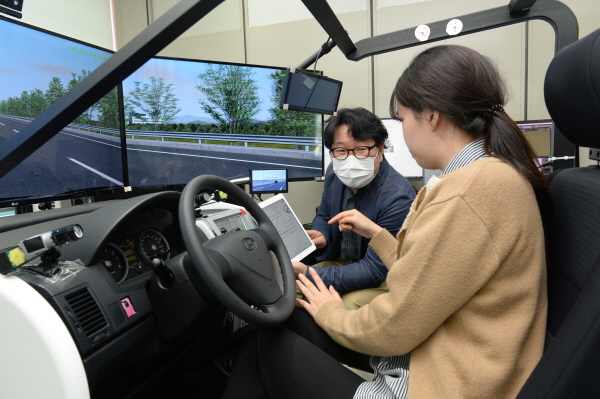
▲ETRI researchers provide situational awareness information to drivers in a virtual car testing environment (from left: Yoon Dae-seop, head of the Cognitive and Transportation ICT Research Lab, and trainee Kim Hye-bin)
The Ministry of Land, Infrastructure and Transport is contributing to the spread of safe autonomous driving technology by distributing it to manufacturers and others.
A domestic research team has developed guidelines to help drivers safely take control of self-driving cars. This will greatly assist government agencies and automakers in establishing standards for autonomous driving control and incorporating safety features.
The Electronics and Telecommunications Research Institute (ETRI) announced on the 6th that it has developed guidelines and three related technologies to guide the safe transfer of control in autonomous vehicles by considering the driver's condition, and released a related dataset.
The Autonomous Vehicle Human Factors Guidelines present scenarios that could arise in various control transfer situations from the driver, vehicle, and environmental perspectives, making them easily understandable for both experts and the general public.
For example, if the car is in autonomous driving mode and is about to switch to manual driving, but an important phone call comes in, a decision must be made about what to do. The guidelines advise that even in situations where a transfer of control is expected, the driver's condition should be monitored and autonomous driving should be maintained through warnings to ensure preparation time.
These guidelines can help automakers and parts suppliers implement features for safe autonomous driving and help users correctly understand the control transfer process.
In particular, government ministries, including the Ministry of Land, Infrastructure and Transport, are expected to play a major role in increasing the acceptance of autonomous vehicles by referring to these guidelines and thereby increasing their utilization and effectiveness.
ETRI stated that it was able to develop detailed and practical guidelines by incorporating a high-quality dataset built through experiments involving 458 participants and over 1,500 control transfers, and also by referencing foreign guidance from the US, Europe, and Japan. Thanks to this research, recommendations developed based on this research were adopted as standards at the ITS General Assembly.
The research team also developed three different technologies to assist in the transfer of control in autonomous vehicles. First, the DVE (Driver, Vehicle, Environment) monitoring system monitors and analyzes driver, vehicle, and driving environment information in real time to predict the driver's readiness to take control.
Additionally, the Co-Pilot Agent (CPA) is a technology that helps drivers and autonomous vehicles communicate by providing biometric information or warnings to enable drivers to quickly and safely take over driving control.
We also developed a system to evaluate the AI control transfer capability of autonomous vehicles. This is a technology that utilizes AI to monitor and analyze driving readiness, driving load, and control transfer reaction time to evaluate the driver's situational awareness, perception, physical response, driving skills, and situational judgment ability in real time.
ETRI Cognitive and Transportation ICT Research Lab Director Dae-Seop Yoon said, “The guidelines, technology, and data developed this time will not only help ensure safe autonomous driving, but will also greatly contribute to increasing trust in autonomous vehicles and revitalizing the related industrial ecosystem.”
The guidelines developed by the research team will be distributed to relevant organizations and manufacturers, and can also be accessed through the ETRI Knowledge Sharing Platform (https://ksp.etri.re.kr/ksp/plan-report/read?id=828). Details on the three developed technologies and datasets can be found on the ETRI Technology Transfer website.
ETRI was able to achieve this result through in-depth research on human factors in the transfer of control of autonomous vehicles over a four-year period as part of a transportation and logistics research project supported by the Ministry of Land, Infrastructure and Transport and the Korea Agency for Infrastructure Technology Advancement (KAIT) since 2017.
Through related research, the research team published 53 papers, including four SCI/SCIE-level papers, and filed 16 patents. Two technology transfers have been completed, and one additional technology transfer is in progress.

Comments
Related news
ETRI: The Era of Tactile Remote Communication Is Just Around the Corner
Domestic researchers have developed a tactile technology that enables remote touching and feeling of objects. They have also succeeded in developing core materials that were previously dependent on foreign technology, demonstrating world-class performance and moving one step closer to leading the next-generation haptic field.
2021.04.23by 배종인 기자
ETRI Lays the Stepping Stone for Global 8K-UHDTV Development
Domestic research teams are hosting a workshop to lead the next-generation 8K-UHD media era, demonstrating ultra-high-definition media transmission technology. Global broadcasting and telecommunications experts are expected to gather together to discuss trends in media services and technology development, laying the groundwork for mutual cooperation and advancement.
2021.04.27by 배종인 기자
.jpg)
ETRI Protects National Infrastructure with Digital Twin Technology
Domestic researchers have developed a system that enables effective management of national infrastructure by utilizing digital twin technology. This is expected to significantly contribute to preventing disasters and maintaining national infrastructure in a smart and safe manner.
2021.04.28by 배종인 기자
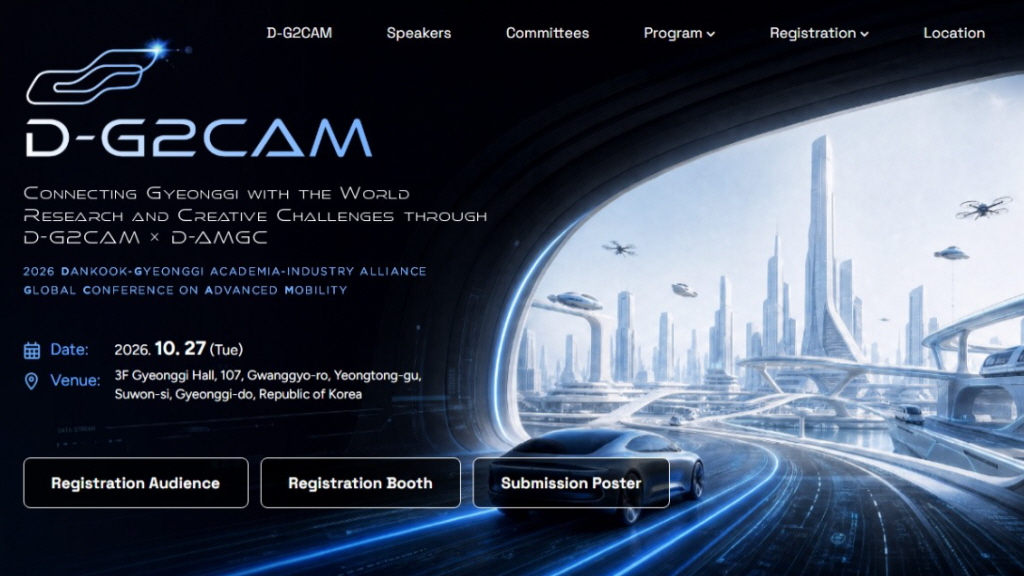
GAIA-Festa 2026, Autonomous Driving, AI, and Aerospace Experts Gather…Discussing Global Cooperation in the 'Silicon Intelligence Era'
GAIA-Festa 2026, which will be held in Suwon on October 27, is an industry-academia-research exchange event that explores the present and future of future mobility and AI technology through the global conference D-G2CAM 2026 and the international contest D-AMGC 2026. Domestic and international experts will share the latest research in autonomous driving, 5G/6G mobility, space technology, and data protection fields, while university students will showcase robots and physical AI prototypes that they have independently developed. Additionally, through poster presentations, corporate exhibitions, international cooperation meetings, and signing ceremonies, a platform will be established to connect the research capabilities and industrial needs of the Gyeonggi region with a global cooperation network.
2026.10.13by 배종인 기자
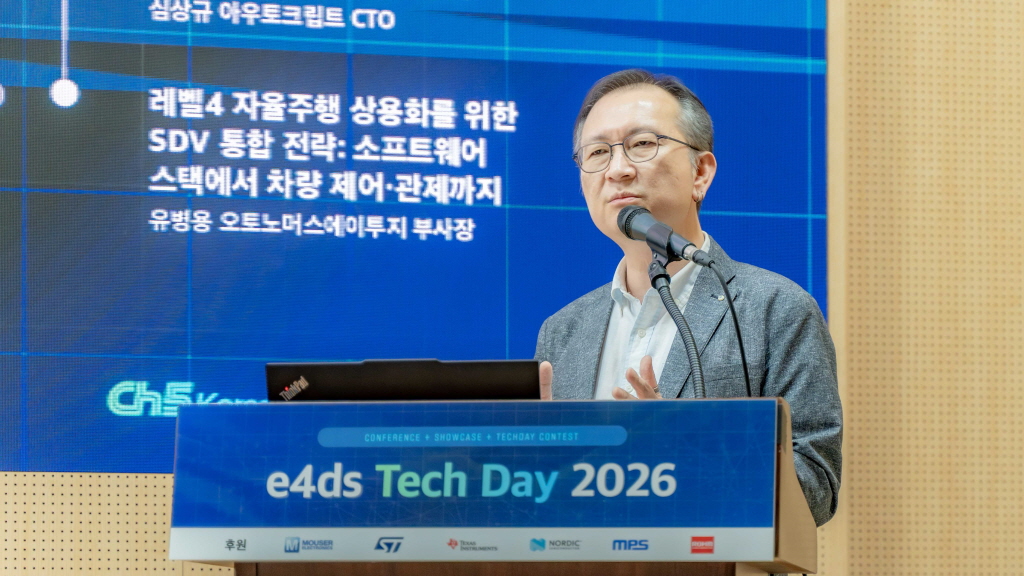
[e4ds Tech Day 2026 ⑨] Sim Sang-gyu, Autocrypt CTO: "In the Physical AI Era, Automotive Security Must Extend Beyond the Vehicle"
At e4ds Tech Day 2026, Sim Sang-gyu, CTO of Autocrypt, explained automotive cybersecurity strategies in the era of Physical AI and SDV (Software-Defined Vehicle). Automobiles are evolving as part of an ecosystem connected to AI, cloud, chargers, IoT, and robots, and he emphasized that the scope of security must expand beyond the vehicle interior to the entire connected environment. In particular, AI model tampering, adversarial attacks, OTA updates, and EV charger hacking were identified as major threats. He explained that response measures require zero trust, AI model integrity protection, intrusion detection, Security by Design and Default, and full lifecycle security management, and that proactive security system establishment beyond regulatory compliance is critical for securing future mobility competitiveness.
2026.10.12by 배종인 기자











