



KAIST Develops Display-Driven OLED Electronic Textiles
 Published2021.05.13 08:02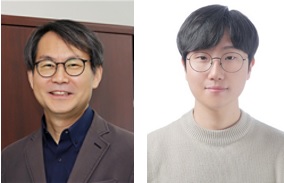
▲(From left) Professor Kyung-Cheol Choi and doctoral candidate Yong-Ha Hwang from the Department of Electrical and Electronic Engineering
Organic light-emitting diode (OLED) electronic textiles capable of driving displays have been developed, raising expectations for their application in fashion and functional clothing.
KAIST announced on the 12th that a research team led by Professor Kyung-Cheol Choi of the Department of Electrical and Electronic Engineering developed an organic light-emitting diode (OLED) electronic fiber capable of outputting information.
Electronic textiles are attracting attention as a next-generation form factor because, unlike existing two-dimensional flat devices, they can adapt to various movements of the human body and provide excellent wearability and portability due to their one-dimensional structure.
In particular, light-emitting electronic textiles are attracting much attention due to their potential applications in various fields such as fashion, functional clothing, medical care, safety, and vehicle design.
On the other hand, previous research on luminescent electronic fibers has shown electro-optical performance that is insufficient for use as displays, or has been conducted only on a device-by-device basis or on a two-dimensional plane with a long aspect ratio, making it difficult to develop application technologies.
Professor Choi Kyung-chul's research team developed an OLED electronic textile display. To achieve this, the research team focused on building an addressing system while achieving high electro-optical performance. First, the research team designed an RGB phosphorescent OLED device structure suitable for a cylindrical fiber structure with a diameter of 300 micrometers (μm). Leveraging their proprietary dip-coating process, they developed an OLED electronic fiber with performance comparable to that of a planar OLED device.
In particular, phosphorescent OLEDs capable of achieving high efficiency were successfully implemented on fiber, demonstrating a luminance of up to 10,000 cd/m2 (candela/square meter) and a high current efficiency of 60 cd/A (candela/ampere). This figure represents a current efficiency approximately five times higher than that of existing technologies.
The research team also designed a contact area on the OLED electronic fiber to establish a woven addressing system for stable display operation based on the OLED electronic fiber. We also verified its wearable functionality by displaying information such as text.
Professor Choi's research team member stated that this electronic fiber has high current efficiency for low power consumption, low operating voltage, and addressability, which are essential for display devices.
“We focused on implementing the essential elements of technology required to implement fiber-based displays,” said Yong-Ha Hwang, a doctoral candidate in Professor Choi’s research team who led this study. “We expect that this will be suitable for various applications, such as fashion and functional clothing, by providing the excellent wearability and portability of electronic textiles while simultaneously implementing display functionality.”
The results of this study, led by Professor Kyung-Cheol Choi's research team and led by doctoral candidate Yong-Ha Hwang as the first author, were published online in the prestigious international academic journal in the field of nanotechnology, 'Advanced Functional Materials', on February 4, and were published as a front cover paper on May 3.
Meanwhile, this research was conducted with the support of the Ministry of Trade, Industry and Energy's Electronic Components Industry Core Technology Development Project and LG Display.
.jpg)
▲Images of RGB OLED electronic textiles woven into actual everyday clothing, a microscope image of RGB OLED electronic textiles (top), and an addressable display system and KAIST character display image (bottom).

Comments
Related news
.jpg)
KAIST Develops Smart Speaker That Initiates Conversations First
Professor Lee Eui-jin's research team at the School of Computing at KAIST announced that they have discovered important user context factors that enable AI assistants in smart speakers to determine optimal timing for initiating speech. While existing smart speakers or those in commercial circulation only provide services upon user request, the smart speaker developed by Professor Lee's team provides proactive services tailored to the user's situation. Professor Lee Eui-jin's research team conducted collaborative research to find the optimal timing for smart speakers to proactively provide voice services. As a result, the team identified important user context factors that determine the optimal speech timing in smart home environments. Reasoning about optimal speech timing is an essential technology for AI assistants to autonomously decide and control the initiation, cessation, or resumption of voice services. Stakeholders anticipate that the important context factors discovered by the research team will enhance accuracy in inferring optimal speech timing.
2020.11.02by 김동우 기자
KAIST Successfully Develops Memory-Centric AI-Accelerated PIM System
AI recommendation system algorithms are AI technologies that serve as the foundation for major tech companies such as Google, Amazon, YouTube, and Facebook to create content recommendations and personalized advertisements. Professor Yu Min-soo's research team at KAIST announced that they have successfully developed an intelligent semiconductor system optimized for accelerating AI recommendation system learning algorithms based on PIM technology.
2020.11.17by 이수민 기자
.jpg)
KAIST Develops AI-Based Gene Transcription Factor Prediction System
A joint research team led by KAIST Distinguished Professor Sang Yup Lee and UC San Diego Professor Bernard Palsson has developed DeepTFactor, a system that uses AI to predict transcription factors that regulate the transcription process of genetic information copying in genes. DeepTFactor employs three parallel CNNs to predict transcription factors from protein sequences. The research team predicted 332 transcription factors in E. coli using DeepTFactor, and validated the system's performance by confirming the genome-wide binding sites of three of those transcription factors.
2021.01.01by 이수민 기자
ESP32 Development Environment Selection and GPS Application Implementation
The ESP32 is a microcontroller that integrates Wi-Fi, Bluetooth, 12-bit ADC, capacitive touch, PWM, DAC, and UART in a single SoC. However, the abundance of features does not by itself solve the designer's problems. The real challenges lie in selecting the appropriate development environment, determining which pins can be used and which must be avoided, and converting raw data from modules into usable information. This document addresses ESP32 peripheral constraints (ADC2 and Wi-Fi coexistence limitation, UART1 occupancy, ADC non-linear regions), the trade-offs between Arduino IDE and ESP-IDF, and the process from connecting NEO-6M/NEO-M8N GPS modules to UART2, parsing NMEA sentences, and visualizing routes in Google Earth, all organized based on documented references.
2026.10.12by 편집부
MIPI CSI-2, DSI-2, C-PHY, D-PHY Test Solution Technical White Paper
The MIPI interface adopts a burst mode that transitions between low-power (LP) and high-speed (HS) states for low-power consumption, and in return, strict timing rules are imposed on state transitions. Additionally, the high-speed section operates as a packet-based protocol with headers, ECC, and CRC, so verification engineers must handle waveforms and protocols simultaneously. Traditional configurations combining general-purpose oscilloscopes and AWGs reveal limitations in setup complexity, measurement uncertainty, and lack of reproducibility when faced with these requirements. This white paper, based on webinar materials, organizes the structure of this problem and describes how the SV5C-DPTXCPTX generator for receiver testing and SV5C-DPRXCPRX analyzer for transmitter testing integrate state transition testing, stressed eye testing, and protocol analysis into a single bench, along with their application boundaries.
2026.10.12by 편집부











