



510 trillion won investment in K-semiconductors by 2030
 Published2021.05.14 08:33
Completing the world's largest and most advanced semiconductor supply chain and expanding the attraction of foreign investment companies.
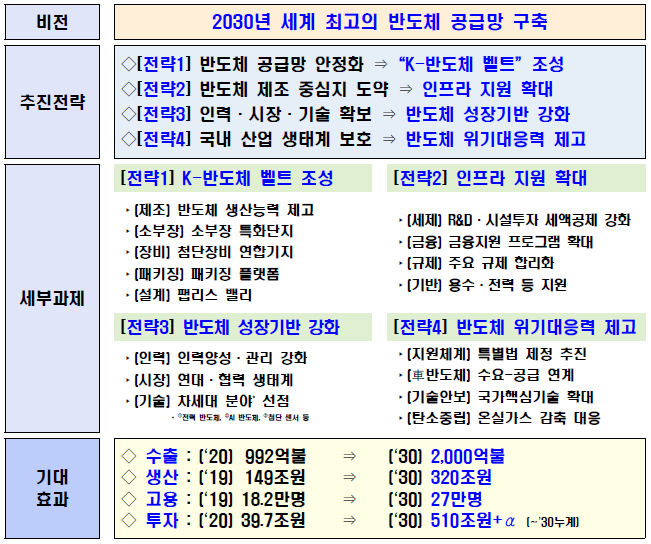
On the 13th, the government held the 'K-Semiconductor Strategy Report Conference' at Samsung Electronics' Pyeongtaek Campus and announced the 'K-Semiconductor Strategy' to realize a comprehensive semiconductor powerhouse.
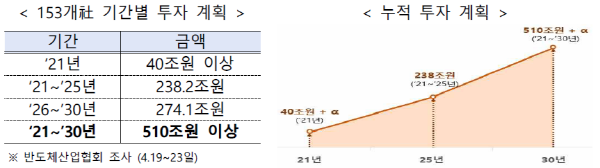
According to the announcement, the government plans to establish a special fund for investment in semiconductors and other equipment worth over 1 trillion won, and significantly expand tax deductions of up to 40-50% for R&D and up to 10-20% for facility investment.
Additionally, it was announced that private investment would amount to over 510 trillion won.
At the event, private companies presented related information on corporate investments in the K-Semiconductor Belt, including Samsung Electronics Vice Chairman Kim Ki-nam's Pyeongtaek Foundry, SK Hynix Vice Chairman Park Jung-ho's Yongin Small and Medium Business Specialized Complex, Nepes Chairman Jeong Chil-hee's Advanced Packaging Platform, and Rebellion CEO Park Sung-hyun's Pangyo Fabless Valley.
The K-Semiconductor Belt connects Pangyo and Giheung-Hwaseong-Pyeongtaek-Onyang in the west and Icheon-Cheongju in the east through Yongin.
Manufacturing plans to maintain the memory gap by expanding and upgrading advanced memory manufacturing facilities and to stabilize the domestic semiconductor supply chain by promoting new and expanded foundries.
SK Hynix is considering securing 8-inch foundry production capacity that is twice the current level.
With regard to small and medium-sized businesses, we will strengthen the competitiveness of small and medium-sized businesses by creating a specialized small and medium-sized business complex by linking and integrating large-scale semiconductor fabs and small and medium-sized business enterprises in the Yongin Semiconductor Cluster.
Regarding cutting-edge equipment, we will expand the attraction of foreign investment in EUV exposure, advanced etching, and materials, areas where short-term technological advancement is difficult for domestic companies, thereby supplementing the domestic semiconductor supply chain.
ASML will invest a total of 240 billion won to establish a training center, and Lam Research will pursue doubling its production capacity.
In terms of packaging, we will establish an advanced packaging production base for implementing single chips with various functions and build an advanced packaging platform through investments in five next-generation packaging technologies.
Fabless is developing Pangyo into a Korean-style fabless valley by establishing a system semiconductor design support center, an AI semiconductor innovation design center, and a next-generation semiconductor complex.
Tax support will be provided to significantly strengthen tax credits for R&D and facility investment by establishing a new (tentatively named) core strategic technology to promote the acquisition of core technologies and expansion of mass production facilities.
In relation to financial support, a 'special fund for investment in semiconductors and other equipment' worth 1 trillion won + α will be newly established to support the expansion of 8-inch foundries, investment in small and medium-sized businesses and advanced packaging facilities, and the support scale for strengthening business competitiveness will be maximized. We are actively supporting expansion and diverse financial programs.
Regarding deregulation, we plan to streamline regulations related to semiconductor manufacturing facilities, including those related to chemicals, high-pressure gases, greenhouse gases, and radio application equipment.
The government and KEPCO will jointly support up to 50% of the cost of establishing the infrastructure for securing 10 years' worth of semiconductor water supply in Yongin, Pyeongtaek, etc. and building power infrastructure for semiconductor manufacturing facilities related to (tentative name) core strategic technologies.
The plan is to train 36,000 semiconductor industry personnel over a 10-year period from 2022 to 2031 by expanding university enrollment, providing full-cycle support for bachelor's, master's, and doctoral degrees, and practical training.
Minister of Trade, Industry and Energy Moon Seung-wook said, “In order to respond to the recent severe semiconductor shortage and the rapidly changing international situation surrounding semiconductors, the public and private sectors have joined forces to create this ‘K-Semiconductor Strategy.’ In response to the large-scale private investment of over 510 trillion won, the government will not spare any support in all areas, including increasing the investment tax credit by more than five times and providing special funds for investment in semiconductors and other facilities worth 1 trillion won.”

Comments
Related news
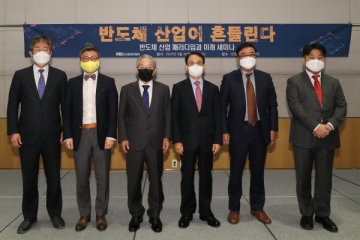
Chairman Jin Dae-je: "National preparation for semiconductor hegemony is essential."
Supply will remain tight relative to semiconductor demand for a considerable period, and opinions have been presented that national-level countermeasures need to be established in preparation for semiconductor hegemony competition. The Federation of Korean Industries (hereinafter referred to as FKI) held a seminar on the 30th at the FKI Hall Conference Center with the theme of "The Semiconductor Industry is Shaken: Semiconductor Industry Paradigm and Future."
2021.03.30by 배종인 기자
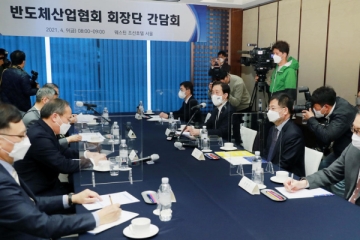
"Expanding semiconductor manufacturing facilities requires tax credits."
The semiconductor industry has requested government support, including tax incentives, to expand semiconductor supply and respond to the global semiconductor market.
2021.04.09by 배종인 기자
The Korea Semiconductor Association (KSA) requests the enactment of a special law to foster the semiconductor industry.
The Korea Semiconductor Industry Association has requested the enactment of a "Special Act for Semiconductor Industry Development" to provide effective support to the semiconductor industry, and stated that support is needed including tax credits of up to 50% of semiconductor manufacturing facility investment costs, as well as support for facility construction, research and development, financial assistance, and talent development.
2021.04.13by 배종인 기자

Intel Unveils Next-Generation 'Core Ultra Series 3' and vPro Platform for Enterprise PCs
Intel has officially unveiled the "Intel Core Ultra Series 3" for next-generation enterprise PCs and the latest vPro platform, addressing a wide range of demands from enterprise notebooks to high-performance workstations.
2026.03.26by 배종인 기자

ROHM Launches ESD Protection Diode Compatible with High-Speed Interfaces of 10Gbps or Higher
Semiconductor specialist ROHM has developed the 'RESDxVx series' of ESD (electrostatic discharge) protection diodes capable of responding to next-generation high-speed data communication environments exceeding 10Gbps, simultaneously enhancing both signal quality maintenance required in high-speed interfaces and IC protection performance.
2026.03.26by 배종인 기자











