



ETRI Develops Novel Hybrid Electrolyte
 Published2021.05.17 15:48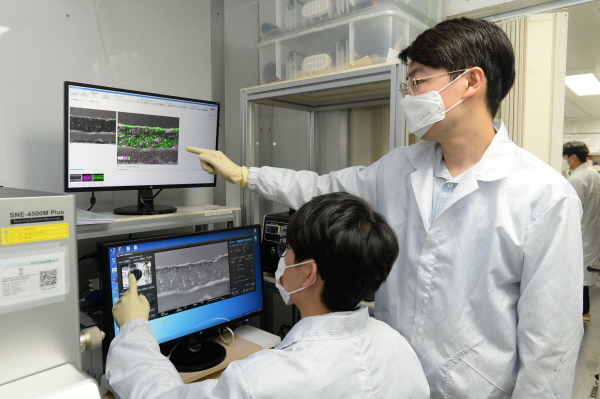
▲ ETRI researchers observing the characteristics of the developed electrolyte with an electron microscope.
Elucidation of the phenomenon of increased interfacial ion concentration, applications in next-generation secondary batteries, etc.
Domestic researchers have developed a new hybrid electrolyte material that can make secondary batteries safer. In particular, the research team's success in designing an electrolyte incorporating a new concept is expected to help further stimulate research on electrolytes for next-generation secondary batteries.
The Electronics and Telecommunications Research Institute (ETRI) announced on the 17th that it has developed a hybrid electrolyte that improves ion conductivity and charge/discharge performance by removing the ion resistance layer at the interface between organic and inorganic electrolytes.
This achievement has proven its excellence by being published online in the latest issue of 'Energy Storage Materials'.
Conventional rechargeable batteries used highly flammable liquid electrolytes, posing a high risk of explosion.
In particular, as the use of secondary batteries increases in mobile phones, wearable devices, and electric vehicles, research on materials to enhance safety is becoming more active.
Changing the electrolyte from liquid to solid reduces the risk of temperature changes or external shocks while also allowing for more freedom in design implementation.
On the other hand, there were still limitations, such as high interfacial resistance or difficult processing depending on the material.
Accordingly, ETRI developed a hybrid electrolyte that is safe and possesses high conductivity by mixing organic and inorganic materials.
It has secured excellent battery performance while overcoming the disadvantages that arise when made using only individual materials.
First, ETRI revealed through experiments that the 'ionic resistance layer' naturally formed on the surface of inorganic solid electrolyte materials during the manufacturing process is the cause of reduced conductivity performance.
On the other hand, inorganic solid electrolyte materials generally have a powder-like form due to their characteristics, making it technically difficult to remove only the surface ion resistance layer without damage.
Accordingly, the research team utilized the 'dry etching method' used in semiconductor processes.
This process is generalUnlike anisotropic etching processes, an isotropic dry etching method can be used to rapidly remove the ion resistance layer up to the side or bottom portion of the solid electrolyte.
In fact, the research team manufactured a hybrid electrolyte based on solid electrolyte particles having an interface with the ion resistance layer removed, and confirmed that the ion conductivity was improved by twofold compared to the existing electrolyte and that the efficiency characteristics of the battery manufactured based on this also increased by threefold.
The research team stated that they were able to achieve this result by focusing on the ion resistance layer, which is easily overlooked, through experiments to identify its cause, and by applying a process to effectively remove it.
The method devised by the research team has the advantage of being suitable for mass production because the manufacturing process is simple and existing secondary battery facilities can be utilized as is.
Above all, it is evaluated as having opened a new chapter in hybrid electrolyte research by overcoming the limitations of existing concepts, which were developed primarily based on single electrolyte materials.
Dr. Shin Dong-ok of ETRI’s Intelligent Sensor Research Lab, who led this research, said, “Designing the electrolyte with a new concept has made it possible to conduct broader research on secondary batteries.” "We will develop safe and high-performance secondary batteries through further research on a wider variety of organic-inorganic hybrid electrolytes," they stated.
While this study focused on the interface within the electrolyte, the research team plans to conduct follow-up research from a battery design perspective, such as controlling the interface between the electrode and the electrolyte to improve charge-discharge efficiency and increasing energy density through the optimization of electrolyte thickness.
This research was conducted under the supervision of ETRI as a joint study with Professor Sang-Wook Kim's team at KAIST.
Dr. Shin Dong-ok of ETRI and Lee Myung-ju, a doctoral student at UST, participated as co-first authors, and the study was conducted with support from the Climate Change Response Technology Development Project of the National Research Foundation of Korea under the Ministry of Science and ICT.
.jpg)
▲ Schematic diagram comparing the existing organic-inorganic hybrid electrolyte with the electrolyte developed by ETRI

Comments
Related news
ETRI Lays the Stepping Stone for Global 8K-UHDTV Development
Domestic research teams are hosting a workshop to lead the next-generation 8K-UHD media era, demonstrating ultra-high-definition media transmission technology. Global broadcasting and telecommunications experts are expected to gather together to discuss trends in media services and technology development, laying the groundwork for mutual cooperation and advancement.
2021.04.27by 배종인 기자
.jpg)
ETRI Protects National Infrastructure with Digital Twin Technology
Domestic researchers have developed a system that enables effective management of national infrastructure by utilizing digital twin technology. This is expected to significantly contribute to preventing disasters and maintaining national infrastructure in a smart and safe manner.
2021.04.28by 배종인 기자
ETRI Develops Driver-Informed Guide for Autonomous Vehicle Control Transition
Domestic researchers have developed guidelines to help drivers safely regain control from autonomous vehicles. This is expected to provide significant assistance to government agencies and automotive manufacturers in establishing standards related to autonomous vehicle control and implementing safety functions.
2021.05.12by 배종인 기자
Schneider Aims for Building Energy Savings and Operational Stability with Next-Generation HVAC Drives
Schneider Electric has unveiled its next-generation HVAC drive product line 'Altivar HVAC'. The new product line's key features center on enhanced energy savings, system operational stability, and building management system integration. The products are divided into 'ATH200' for OEM and small equipment applications, and 'ATH600' for environments requiring continuous operation and advanced control. The company plans to expand the application scope from commercial buildings to facilities where HVAC system stability is critical, such as hospitals, airports, and data centers. The announcement includes over 30% energy savings, operation from -10°C to +60°C, Modbus and BACnet support, and compatibility with low global warming potential refrigerants.
2026.03.26by 명세환 기자
Ecolab Expands AI Data Center Cooling Business Through Acquisition of CoolIT
Ecolab has agreed to acquire CoolIT Systems, a liquid cooling company for AI data centers, for approximately $4.75 billion. The transaction is expected to close by Q3 2026, subject to regulatory approvals. CoolIT has been supplying direct-to-chip cooling-based coolant distribution units, cold plates, and manifolds, serving hyperscale data centers and colocation operators as customers. This acquisition is a measure to address the high-heat and high-density server environments created by AI proliferation. Ecolab plans to combine its water management and digital monitoring capabilities with CoolIT's hardware technology to expand its data center cooling business.
2026.03.26by 명세환 기자











