


Crypton's price hits all-time high, increasing the burden of NAND costs.
 Published2021.05.18 10:50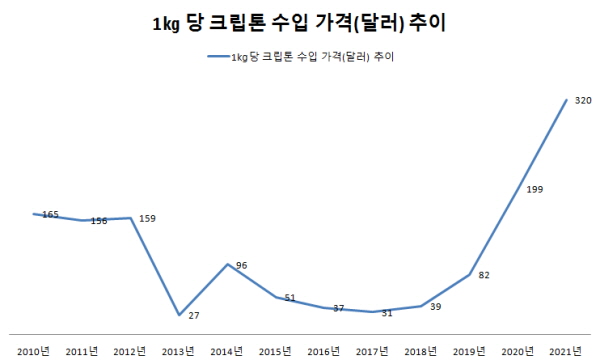
▲Trends in krypton import price (dollars) per kilogram
Demand for key materials for 3D NAND production continues to grow.
Krypton import prices have reached an all-time high. As it accounts for the majority of global NAND flash memory, this is expected to weigh on NAND production costs.
According to import and export statistics from the Korea International Trade Association, as of April 2021, the average import price of krypton this year was $320 per kilogram, a 61% increase from the previous year. This is the highest price ever recorded.
The price of krypton continues to rise, averaging $38 per kg in 2018, rising 111% year-on-year to $82 per kg in 2019, and 143% year-on-year to $199 per kg in 2020.
Import volumes are also continuing to increase. In 2021, krypton imports amounted to 32,780 kg, a 31.3% increase over the same period last year.
This is equivalent to 43.6% of the 69,476 kg in 2020, and the total import volume this year is expected to increase significantly compared to last year.
This price increase is analyzed to be due to the explosive increase in demand while production is limited.
Krypton, which is only about one millionth of the atmosphere, is produced through fractional distillation in an air separation unit (ASU), just like other rare gases such as xenon and neon. However, as the lighting industry, the main consumer, switched to LEDs, demand and prices plummeted for a while, leading producers to reduce production.
Krypton is generally produced by concentrating oxygen in an ASU with a capacity of more than 50,000㎥ per hour, but this is because there is a risk of explosion and the profitability has been low due to the decline in krypton prices.
This led to a continuous decline in the price of krypton from 2010 to 2017.
Meanwhile, as usage in semiconductor 3D NAND has rapidly increased since 2017, the price of krypton has also risen.
3D NAND is a circuitry that stacks dozens of layers of planar (2D) NAND, and requires an etching process to drill holes to create channels that connect each layer.
At this time, Xe and Kr are used as auxiliary propulsion gases (Momentum Gas) to inject etching gas into deep holes.
Toshiba Memory of Japan (now Kioxia) is known to have first developed this method, initially using Xe but giving up because it was too expensive, then using Ar, and recently replacing it with Kr.
Companies currently using Krypton include SK Hynix, Kioxia, and Micron.
These companies are not stacking high-density 3D NAND at once.It is taking the approach of stacking two stacks like assembling NIN blocks. For example, the 96-layer 3D NAND commercialized by SK Hynix is two 48-layer 3D NANDs stacked.
Krypton, which is cheaper than xenon, is mainly used for etching 48-layer 3D NAND, but to produce 96 layers, twice as much krypton is needed as before.
Micron's 176-layer 3D NAND, announced in the second half of 2020, also uses 88-layer double stacking technology.
This is how krypton began to be used for semiconductor NAND, and it is known that more than 76% of the world's krypton is used for semiconductors.
Accordingly, as NAND production increases, demand for krypton is also rapidly increasing, and its price is also rising.
In particular, the production of krypton is limited, but demand continues to increase, so prices are expected to rise. Accordingly, the burden of krypton prices on the proportion of NAND production costs is expected to continue to increase.
In addition, Krypton distributors are spending more than in the past to secure inventory, making them more sensitive to the NAND flash market outlook as more accurate demand forecasts become necessary.
Domestic krypton distributors include Linde Korea, SK Materials, Daedeok Gas, TEMC, and Puem.
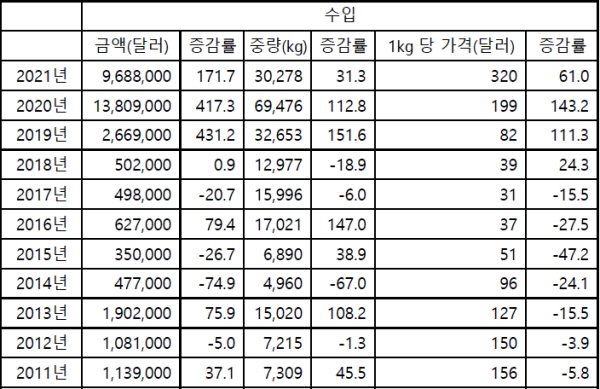
▲ Trends in krypton imports from 2011 to April 2021 (unit: kg, dollar; source: Trade Association export and import statistics)

Comments
Related news
SK Hynix to mass produce 1a DRAM and 176-layer NAND within this year.
SK Hynix announced that it recorded annual revenue of KRW 31.9 trillion, operating profit of KRW 5.0126 trillion, and an operating profit margin of 16% in 2020. This year, the company plans to enhance cost competitiveness by producing fourth-generation 10-nanometer-class (1a) DRAM with improved productivity compared to existing products and 176-layer 4D NAND flash within the year. The company will also accelerate the acquisition of Intel's NAND business division and commence full-scale operations of the M16 new fab.
2021.01.31by 이수민 기자
Kioxia-WD, 162-Layer NAND Development "Stacking Competition Heats Up"
Kioxia and WD have developed sixth-generation 162-layer 3D flash memory technology. The sixth-generation 3D flash memory announced this time is characterized by an advanced architecture compared to the existing 8-stagger structure memory hole array and a 10% increase in lateral cell array density compared to the fifth generation. Through the combination of advanced lateral scaling technology and 162-layer vertical stacking memory, die size has been reduced by 40% compared to 112-layer vertical stacking memory.
2021.02.25by 이수민 기자
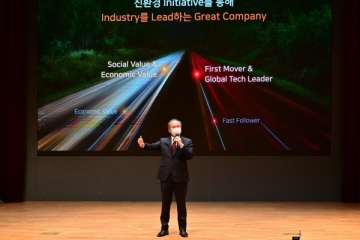
SK Hynix CEO Lee Seok-hee: "We will strengthen our DRAM and NAND competitiveness."
SK Hynix President and CEO Lee Seok-hee announced that he will actively work to strengthen competitiveness in DRAM and NAND, and focus on ESG management to enhance corporate value. During the regular shareholders' meeting held at the company's headquarters in Icheon, Gyeonggi Province on the 30th, SK Hynix President and CEO Lee Seok-hee presented the company's future vision through a 'Financial Story.'
2021.03.30by 배종인 기자
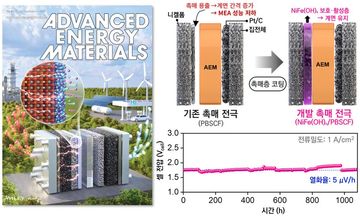
Materials Research Institute Develops Ultra-thin Coating Water Electrolysis Catalyst Technology
The Korea Institute of Materials Science has simultaneously resolved the performance and durability trade-off problem in water electrolysis catalysts by applying ultra-thin surface coating technology. Achieving 1.9 times higher performance compared to conventional catalysts while demonstrating 1,000-hour long-term stability, the institute has developed technology scalable to industrial water electrolysis systems through a simple process.
2026.10.07by 배종인 기자
Gigaphoton Develops Neon Gas Recycling System for ArF Excimer Lasers...Achieves 50% Recycling Rate
Gigaphoton announced that it has developed a gas recycling system for ArF excimer lasers and achieved a 50% neon gas recycling rate.
2026.10.02by 배종인 기자











