



ETRI to Develop Human-Safe THz Wave Security Checkpoints
 Published2021.05.20 14:55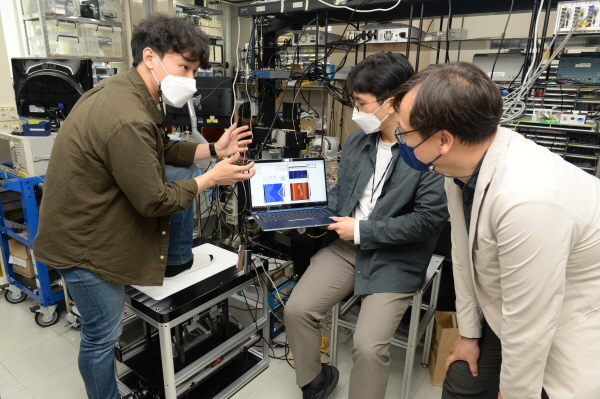
ETRI researchers are using terahertz (THz) waves to penetrate and inspect shoes.
Development of smart security screening technology, which incorporates advanced technology using harmless terahertz waves (THz), has begun, and upon completion of the project, a screening technology capable of capturing both safety and convenience is expected to be created.
The Electronics and Telecommunications Research Institute (ETRI) announced on the 20th that it is developing next-generation security screening technology through joint research with Daemyung TS that can detect dangerous substances, such as weapons and explosives, without removing one's shoes.
Major facilities such as airports involve cumbersome procedures for terror prevention and security, such as removing shoes and hats and taking out various personal belongings separately.
Accordingly, the research team set out to develop advanced security screening technology using terahertz waves to create a safe environment while promoting convenience.
Terahertz waves (THz) are electromagnetic waves that vibrate one trillion times per second.
Terahertz waves are called the "dream frequency" and are being actively researched worldwide due to their characteristics of penetrating clothing and shoes while being harmless to the human body because of their low electromagnetic energy.
ETRI has a frequency higher than the radio waves used in full-body scanners at airports.The plan is to utilize the characteristics of terahertz waves to inspect for the concealment of hazardous materials at a higher resolution.
The research team integrates terahertz band devices to acquire 3D security scan images, performing security scans more precisely and quickly than existing technologies.
It can search for hazardous materials made of non-metals as well as metals.
This security screening system is planned to be built by applying artificial intelligence image recognition technology, enabling it to quickly determine whether hazardous materials are possessed without human verification.
The research team also stated that advanced data processing and reading technologies will be applied to ensure that individual privacy is not infringed upon.
Therefore, it is expected that boarding procedures can be processed with high accuracy and speed in a non-face-to-face and contactless manner, and the detection of risk factors will be possible, contributing to ensuring the safety of air passengers and maintaining the security system.
The research team expects to develop a prototype in 2024, undergo demonstration operations at Incheon International Airport Corporation, obtain domestic certification in 2025, and then introduce it to the general public.
Moving forward, the research team plans to expand into a walk-through system through the development of core technology, where a full-body scan is automatically completed as a person passes through a tunnel.
Park Kyung-hyun, Head of the Future Source Research Division at ETRI, said, “By successfully developing a security screening system that integrates the achievements of ETRI’s terahertz technology research and development over the past 10 years, we will proudly establish Korea as an exporter of advanced aviation security screening equipment.”
ETRI opened a terahertz joint laboratory within the institute together with Daemyung TS Co., Ltd., a participating joint research and development organization, to successfully carry out this next-generation personal security screening technology development project.
Daemyung TS Co., Ltd. develops a non-destructive inspection system using terahertz wavesAs a company with the technology closest to commercialization in Korea, it will be responsible for the demonstration, domestic and international certification, and commercialization of security screening systems to be developed in the future.
This research project is being carried out as part of the 'Development of Human Security Screening Technology for Generations' project, a land and transport R&D initiative supported by the Ministry of Land, Infrastructure and Transport and the Korea Institute of Land, Infrastructure and Transport Technology. Led by ETRI, a total of 11 domestic industry, academia, and research institutions are participating, including companies such as Daemyung TS Co., Ltd., Incheon International Airport Corporation, and QSI Co., Ltd.
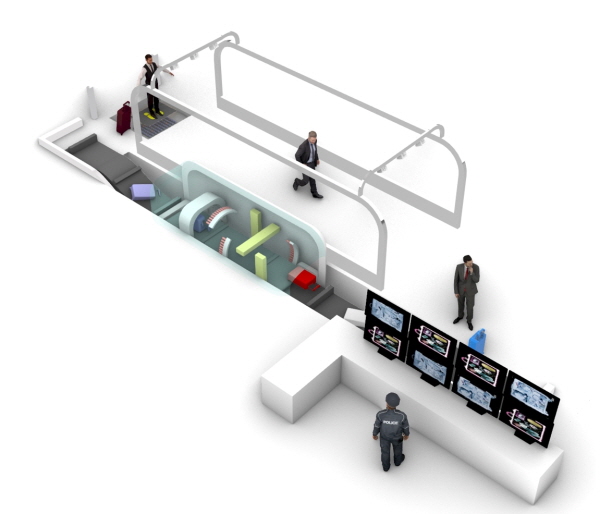
▲ Expected technological utilization upon completion

Comments
Related news
.jpg)
ETRI Protects National Infrastructure with Digital Twin Technology
Domestic researchers have developed a system that enables effective management of national infrastructure by utilizing digital twin technology. This is expected to significantly contribute to preventing disasters and maintaining national infrastructure in a smart and safe manner.
2021.04.28by 배종인 기자
ETRI Develops Driver-Informed Guide for Autonomous Vehicle Control Transition
Domestic researchers have developed guidelines to help drivers safely regain control from autonomous vehicles. This is expected to provide significant assistance to government agencies and automotive manufacturers in establishing standards related to autonomous vehicle control and implementing safety functions.
2021.05.12by 배종인 기자
ETRI Develops Novel Hybrid Electrolyte
Domestic researchers have developed a new hybrid electrolyte material that can make secondary batteries even safer. In particular, the research team has succeeded in electrolyte design applying a new concept, and is expected to help further invigorate research on next-generation secondary battery electrolytes going forward.
2021.05.17by 배종인 기자
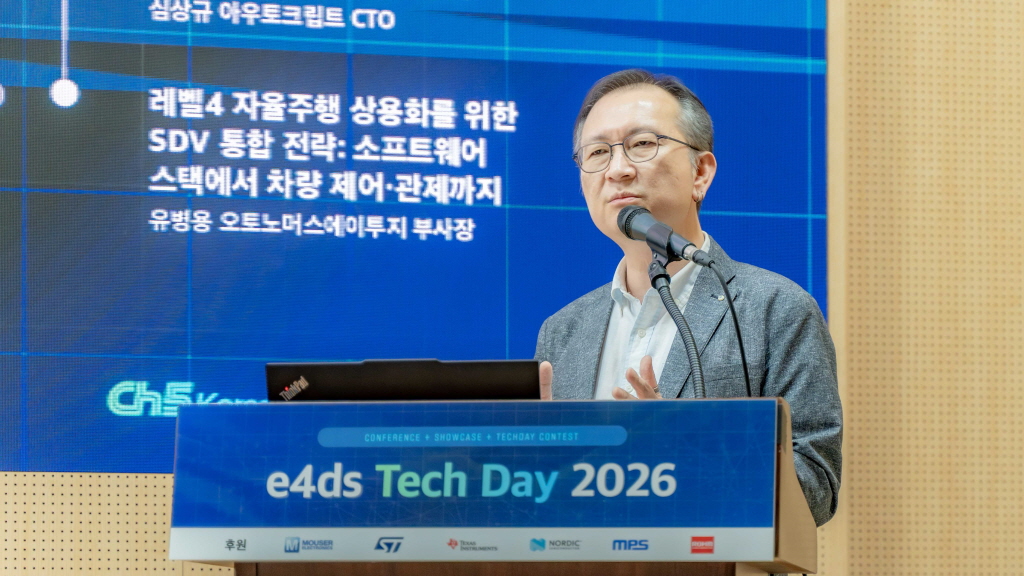
[e4ds Tech Day 2026 ⑨] Sim Sang-gyu, Autocrypt CTO: "In the Physical AI Era, Automotive Security Must Extend Beyond the Vehicle"
At e4ds Tech Day 2026, Sim Sang-gyu, CTO of Autocrypt, explained automotive cybersecurity strategies in the era of Physical AI and SDV (Software-Defined Vehicle). Automobiles are evolving as part of an ecosystem connected to AI, cloud, chargers, IoT, and robots, and he emphasized that the scope of security must expand beyond the vehicle interior to the entire connected environment. In particular, AI model tampering, adversarial attacks, OTA updates, and EV charger hacking were identified as major threats. He explained that response measures require zero trust, AI model integrity protection, intrusion detection, Security by Design and Default, and full lifecycle security management, and that proactive security system establishment beyond regulatory compliance is critical for securing future mobility competitiveness.
2026.10.12by 배종인 기자
NVIDIA to Invest $1 Billion in U.S. Science Over Next Five Years
NVIDIA has announced plans to invest $1 billion over the next five years to strengthen U.S. scientific and technological competitiveness. The company will enhance cutting-edge artificial intelligence research and development capabilities in key areas including quantum computing, healthcare, and energy security, while expanding support for higher education research institutions and cloud service providers. NVIDIA is participating as a major industry partner in the White House Office of Science and Technology Policy's Genesis Mission, and is promoting supercomputer construction in collaboration with national laboratories including Argonne and Los Alamos.
2026.10.12by 배종인 기자











