


Korea Institute of Machinery and Materials (KIMM) develops metamaterials, increasing infrared spectroscopy detection signal by 100 times.
 Published2021.06.01 14:23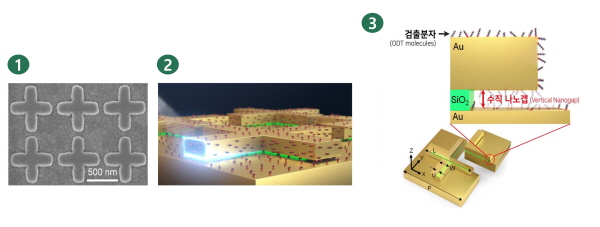
▲Electron microscope images and ultrafine structures of metamaterials
A metamaterial that increases the detection signal of infrared spectroscopy by 100 times has been developed, which is expected to improve the economic efficiency of the process of detecting hazardous substances and biomolecules.
Researchers at the Korea Institute of Machinery and Materials (President Park Sang-jin), under the Ministry of Science and ICT, and UNIST (President Lee Yong-hoon) announced on May 31st that they have developed a metamaterial that could dramatically improve the detection process of hazardous substances and biomolecules. The research results were published in the journal "Small Methods."
A joint research team led by Principal Researcher Jooyeon Jeong of the Nano Process Equipment Laboratory at the Korea Institute of Machinery and Materials and Professor Jongwon Lee of the Department of Electrical and Electronic Engineering at UNIST has developed a metamaterial that amplifies the infrared spectroscopy detection signal, which analyzes the components of a target by irradiating it with infrared light, by more than 100 times. Metamaterials are special functional materials with ultrafine structures arranged on their surfaces, each shorter than the wavelength of light.
Infrared spectroscopy detection is a technique that uses the characteristic of molecules of a substance to absorb infrared rays of a specific frequency to identify the components through the pattern of reflected light. At this time, if the substance to be detected is contained in only a very small amount, it is difficult to read because the difference in intensity of the light, which is the detection signal, is almost nonexistent.
In contrast, utilizing the newly developed metamaterial, the microscopic structures on its surface collect light energy and then direct it directly at the molecules, increasing the intensity of light absorbed by the molecules. This amplifies the detection signal, enabling clear results even with small amounts.
The metamaterial is constructed by sequentially stacking metal, insulator, and metal in a cross shape. The central insulator is thinned to 10 nanometers and cut horizontally to create a vertical gap, maximizing the exposure of molecules to the near field and enhancing their light absorption.
“The newly developed metamaterial achieved a record-breaking detection signal of 36% reflection difference in a single-molecule layer detection experiment with a thickness of 2.8 nanometers,” said Hwang In-yong, a researcher at UNIST’s Department of Electrical Engineering. “We experimentally demonstrated the highest record in a single-molecule layer detection experiment.”
In particular, the metamaterial developed this time is easy to mass-produce and the manufacturing process is economical. Previously, expensive, high-resolution beam lithography processes were required to create microstructures on the surface of metamaterials, but the newly developed metamaterial can be easily manufactured using only nanoimprinting and dry etching processes.
Jeong Ju-yeon, a senior researcher at the Korea Institute of Machinery and Materials, said, “Using the nanoimprinting method, we can thinly layer metal-insulator-metal in that order, and then process the metal and insulator into the desired shape.” She added, “By adding a dry etching process, we can mass-produce metamaterials arranged in microstructures.”
Professor Jong-Won Lee of UNIST said, “This is the first study to simultaneously solve the problem of near-field strength enhancement and near-field exposure through a vertical gap structure,” and added, “It is expected to be widely applied in sensor technology that detects biomolecules, hazardous substances, and gases using infrared.”
The results of this study were published on May 13th in Small Methods, a leading international nanoscience journal published by Wiley. The research was supported by the Ministry of Science and ICT's Global Frontier Wave Energy Extreme Control Research Group and the National Research Foundation of Korea's Nanomaterials Technology Development and Civilian-Military Dual-Use Technology Development Program.

Comments
Related news
Korea Institute of Machinery and Materials (KIMM) is producing large, affordable transparent displays and semiconductors.
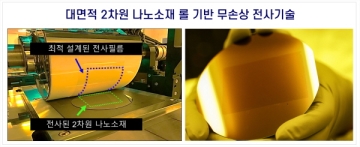
The Korea Institute of Machinery and Materials (KIMM, Director Park Sang-jin) under the Ministry of Science and ICT has developed "large-area 2D nanomaterial damage-free roll transfer technology" that enables the transfer of atomic layer-thick 2D nanomaterials at wafer scale without damage. This breakthrough improvement in the nanomaterial transfer process, which can be applied to various fields including transparent displays, transparent semiconductors, and displays for autonomous vehicles, is expected to accelerate technology commercialization.
2021.05.12by 배종인 기자
Korea Institute of Machinery and Materials, a gathering of laser processing technology experts
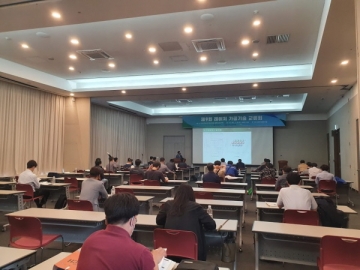
The Korea Institute of Machinery and Materials (President Park Sang-jin) held a "Laser Processing Technology Exchange Meeting," introducing the institute's corporate support programs, the Korea Industrial Complex Corporation's business support initiatives, Korea Maritime and Ocean University's laser workforce development project, and laser application technologies applicable to electric vehicles.
2021.05.26by 배종인 기자

KIMM Accelerates Commercialization of Nano-Micro DNA Needle Patches
The Korea Institute of Machinery and Materials (Director Park Sang-jin), under the Ministry of Science and ICT, is attracting attention by successfully driving technology commercialization from the establishment of a research institute venture company to commercialization based on advanced nanotechnology research achievements.
2021.05.31by 배종인 기자
Schneider Aims for Building Energy Savings and Operational Stability with Next-Generation HVAC Drives
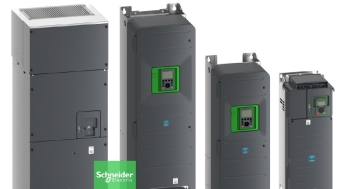
Schneider Electric has unveiled its next-generation HVAC drive product line 'Altivar HVAC'. The new product line's key features center on enhanced energy savings, system operational stability, and building management system integration. The products are divided into 'ATH200' for OEM and small equipment applications, and 'ATH600' for environments requiring continuous operation and advanced control. The company plans to expand the application scope from commercial buildings to facilities where HVAC system stability is critical, such as hospitals, airports, and data centers. The announcement includes over 30% energy savings, operation from -10°C to +60°C, Modbus and BACnet support, and compatibility with low global warming potential refrigerants.
2026.03.26by 명세환 기자
Ecolab Expands AI Data Center Cooling Business Through Acquisition of CoolIT
Ecolab has agreed to acquire CoolIT Systems, a liquid cooling company for AI data centers, for approximately $4.75 billion. The transaction is expected to close by Q3 2026, subject to regulatory approvals. CoolIT has been supplying direct-to-chip cooling-based coolant distribution units, cold plates, and manifolds, serving hyperscale data centers and colocation operators as customers. This acquisition is a measure to address the high-heat and high-density server environments created by AI proliferation. Ecolab plans to combine its water management and digital monitoring capabilities with CoolIT's hardware technology to expand its data center cooling business.
2026.03.26by 명세환 기자











