


ETRI's Radiation-Immunicable Sensor Replaces Heavy Lead Protective Clothing
 Published2021.06.02 15:46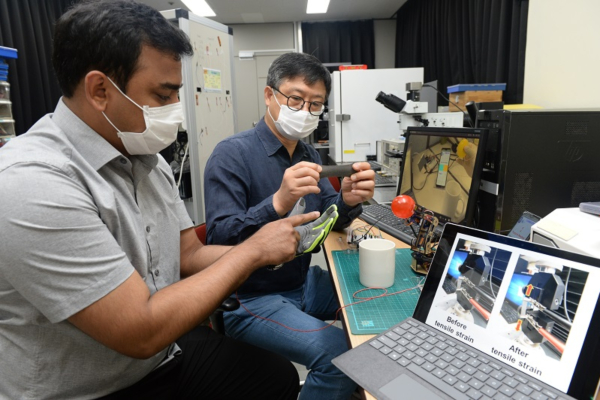
24-hour continuous radiation exposure temperature and pressure measurement possible
Object detection sensors for medical, defense, and extreme environment applications
A domestic research team has developed a flexible composite material-based sensor that can withstand radiation, raising expectations that it will be used in extreme environments such as nuclear power plants or as a replacement for heavy lead protective materials.
The Electronics and Telecommunications Research Institute (ETRI) announced on the 2nd that it has developed a radiation-resistant pressure-temperature composite sensor based on a composite material combining graphene, MXene, and polymer resin (Ecoflex).
The sensor developed by ETRI can measure both pressure and temperature without undergoing any physical or chemical changes even when exposed to high-energy radiation.
The research team also successfully demonstrated the excellence of the developed sensor by testing its performance at the Advanced Radiation Research Institute of the Korea Atomic Energy Research Institute located in Jeongeup.
In the experiment, the material was tested with radiation levels that would be fatal if exposed to a human.
The research team confirmed that there was no change or abnormality in the material even when exposed to 20 kGy of gamma rays from cobalt-60 for a full 24 hours.
The developed sensor is in the form of a flexible film and has a low weight. It is lightweight, can be manufactured over a wide area, and can be made in various shapes.
Thanks to this, it is expected that it will be possible to replace the heavy lead protective clothing used in radiation exposure areas such as nuclear power plants and hospitals by making it into a garment.
It can also be used as a sensor to detect objects.
Through experiments, the research team also confirmed that the sensor's sensitivity was high enough to detect differences in lifting force depending on weight, differences in gripping pressure depending on hardness, and differences in liquid temperature.
Thanks to this, it can be applied to prosthetic limbs as well as robots that perform work in extreme environments with high radiation exposure that humans cannot enter.
The developed material not only blocks radiation but also has excellent high-frequency electromagnetic wave shielding effects, making it highly useful in electronic devices for 5G communications, radar systems for autonomous vehicles, and the aerospace industry.
It is expected to be widely used in home appliances, industrial electronic devices such as medical and defense equipment, electronic components and sensors used in extreme environments, and smart electronic devices.
The research team stated that they were able to develop the sensor based on the technological know-how related to two-dimensional composite materials that they have accumulated over a long period of time.
In particular, he said that the technological prowess to manufacture and combine suitable materials played a key role in achieving this result.
Dr. Choi Chun-ki of the Nanoelectronic Devices Laboratory at ETRI said, “We hope that this technology’s excellent shielding performance will be of great help in making work safe and convenient in environments with high exposure to radiation or electromagnetic waves, or in making it easier to operate electronic devices.”
This study was conducted with support from the Atomic Energy Research and Development Project of the Ministry of Trade, Industry and Energy. The technology developed by the research team is currently in the process of being patented in Korea and the United States.
This technology is so well-developed that it can be immediately transferred to material and sensor companies, and the research team believes that commercialization of related products is possible within two years.
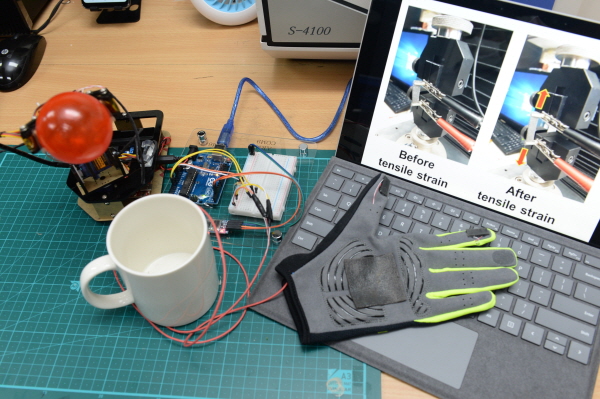
▲A composite material developed by ETRI researchers and a pressure-temperature composite sensor made from it attached to a glove.

Comments
Related news
ETRI Develops Novel Hybrid Electrolyte
Domestic researchers have developed a new hybrid electrolyte material that can make secondary batteries even safer. In particular, the research team has succeeded in electrolyte design applying a new concept, and is expected to help further invigorate research on next-generation secondary battery electrolytes going forward.
2021.05.17by 배종인 기자
ETRI to Develop Human-Safe THz Wave Security Checkpoints
Advanced smart security screening technology utilizing terahertz waves (THz) that are harmless to the human body has begun development, and upon project completion, it is expected that screening technology capable of achieving both safety and convenience will emerge.
2021.05.20by 배종인 기자
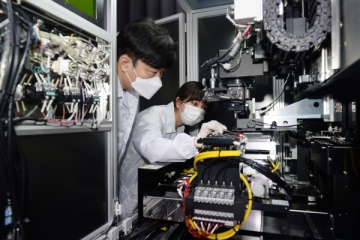
ETRI develops processes and materials that address challenges in micro LED production.
The Micro LED market is projected to grow at a compound annual growth rate of 65% through 2027, reaching a market size of 71 billion dollars. However, high manufacturing difficulty has been a bottleneck to widespread adoption. In response, ETRI announced that it has resolved key challenges in Micro LED display technology by independently developing novel manufacturing processes and new materials.
2021.05.25by 이수민 기자
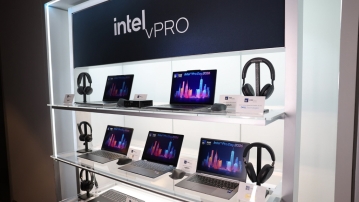
Intel Unveils Next-Generation 'Core Ultra Series 3' and vPro Platform for Enterprise PCs
Intel has officially unveiled the "Intel Core Ultra Series 3" for next-generation enterprise PCs and the latest vPro platform, addressing a wide range of demands from enterprise notebooks to high-performance workstations.
2026.03.26by 배종인 기자
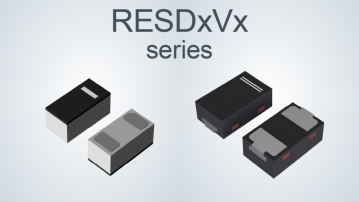
ROHM Launches ESD Protection Diode Compatible with High-Speed Interfaces of 10Gbps or Higher
Semiconductor specialist ROHM has developed the 'RESDxVx series' of ESD (electrostatic discharge) protection diodes capable of responding to next-generation high-speed data communication environments exceeding 10Gbps, simultaneously enhancing both signal quality maintenance required in high-speed interfaces and IC protection performance.
2026.03.26by 배종인 기자











