This page was machine-translated and may differ from the original. View original
The healthcare industry is responding to COVID-19 based on intelligent technology.
MatLib-Simulink provides system-level simulation
Supporting engineers and scientists to focus and collaborate
Today, industries around the world are creating new value through intelligent technologies like AI and data science, such as smart cities, smart factories, and digital healthcare. In particular, the healthcare industry is responding to the pandemic by developing diagnostic and treatment technologies based on individual patient data obtained through data sharing, patient tracking, and non-face-to-face AI medical devices.
On May 26, MathWorks Korea held the 'MATLAB Expo 2021 Korea' online and introduced cases of efficient model development and verification through 'MATLAB and Simulink' in various industries.
Richard Rovner, Vice President of Marketing at MathWorks, who delivered the keynote address, presented a few examples from the approximately 400+ MathWorks solution-based response development cases that took place from late 2019 to the end of 2020. He said engineers and scientists were using MATLAB and Simulink not only to investigate COVID-19 epidemiology and develop containment strategies, but also to develop treatments and vaccines and design and manufacture new medical devices.
.jpg)
Vice President Rovner looked back on the spread of COVID-19 from late 2019 to late 2020, and presented several examples of how engineers and scientists used MATLAB and Simulink to support COVID-19 prevention and treatment, as well as the transition to non-face-to-face work and education environments.
According to him, there were over 400 MathWorks-based response development cases last year. Engineers and scientists used MATLAB and Simulink not only for epidemiological investigations of COVID-19 and the development of containment strategies, but also for the development of treatments and vaccines, and the design and manufacture of new medical devices.
◇ Understanding the characteristics of COVID-19 and responding to the early stages of the pandemic.
Researchers from the Chinese Center for Disease Control and Prevention and the WHO used MATLAB to conduct an epidemiological investigation of the first 425 confirmed cases with scientists across China, and calculated the 'average incubation period (5.2 days)' and 'basic reproduction number (R0, 2.2 people)' related to COVID-19. The results were published in the 'New England Journal of Medicine' in January of this year. This is considered an accurate result given the current situation.
In March of last year, following the WHO's declaration of a pandemic, the British government launched the Ventilator Challenge UK to treat COVID-19 patients. Under this initiative, Cambridge Consultants designed a ventilator for COVID-19 patients in just 47 days, using model-based design using MATLAB and Simulink.
Instead of designing physical components, Cambridge Consultants built models of human lungs and ventilators in a GUI environment using model-based design. By modifying design building blocks and conducting system-level simulations under various conditions, they were able to significantly reduce development time.
“Model-Based Design allows modeling and simulation to be applied to individual parts, entire systems, and all hardware and software,” said Vice President Rovner. “This allows engineers and scientists to rapidly develop innovative solutions.”
◇ Autonomous mobile robots that disinfect public spaces quickly and efficiently.
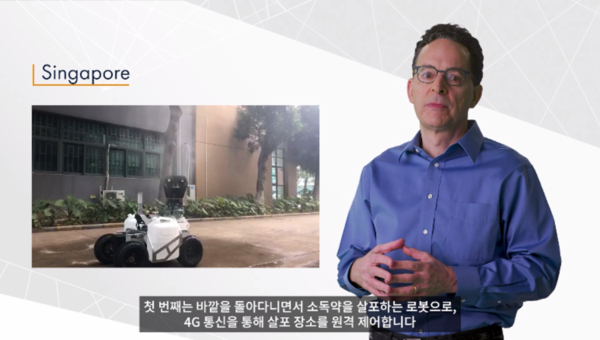
Autonomous and remotely controlled robots can perform disinfection tasks quickly and cost-effectively. Weston Robot, a Singapore-based robot developer and supplier, has designed three autonomous mobile robots (AMRs) using MathWorks Model-Based Design.
We completed the 'outdoor disinfection robot' linked to the LTE-based disinfection zone control function within 10 days, and developed the 'indoor disinfection robot' that utilizes ultraviolet rays and the 'body temperature measurement robot' capable of measuring body temperature in 0.5℃ increments based on a thermal infrared camera in a little over 10 days.

Weston Robotics used model-based design, powered by MathWorks tools, to quickly identify and correct design issues. This accelerated robot prototyping and significantly reduced development time. “Companies that apply model-based design based on MathWorks solutions can easily develop systems with intelligent autonomy,” said Vice President Rovner.
◇ Transition from traditional offline education to online digital education.
The pandemic has brought digital transformation to academia at an unprecedented pace and scale.
Andre Knoesen, a professor of electrical and computer engineering at the University of California, Davis, easily transitioned his engineering problem-solving class to remote learning in a matter of days using MATLAB zyBook, an interactive, web-based MATLAB educational content, ahead of winter semester final exams.
The content helped to quickly progress the class through the 'MATLAB Grader' and MATLAB code automatic grading functions, and in addition, it provided various educational content to students even in non-face-to-face situations by using MATLAB functions such as 'Live Editor', 'MATLAB Mobile', and 'ThingSpeak'.
Professor Christophe Demaziere of Chalmers University of Technology in Sweden is transitioning his course on deterministic modeling of nuclear power systems to online learning using online learning tools like MATLAB, MATLAB Grader, and MATLAB Onramp. He plans to continue teaching online exclusively after the pandemic.
MathWorks is helping more than 2,300 universities worldwide adopt distance learning methods with online learning tools. Over the past year, MATLAB Online's user base has nearly tripled, now reaching 1.5 million.
◇ Development of a COVID-19 diagnosis and spread prevention model
To reduce the time it takes to diagnose COVID-19, researchers in India have developed an AI-driven model that uses MATLAB and the Deep Learning Toolbox to classify chest CT images of COVID-19 patients based on patterns that are difficult to distinguish with the naked eye.
Hadley Sikes, a professor of chemical engineering at the Massachusetts Institute of Technology (MIT), and the SMART Institute, a joint research technology center between Singapore and MIT, have developed a protein-based paper strip test that can diagnose COVID-19 infection in 10 minutes. Dr. Sikes used MATLAB to model the binding proteins and solution channels, key components in the paper strip, which are crucial for COVID-19 diagnosis. The test kit is currently in production.
.jpg)
Researchers from Shanghai Fudan University, GE Healthcare, and King's College are using MRI to study the effects of COVID-19 after recovery. By comparing brain MRI images from 60 recovered COVID-19 patients with a control group of 39 healthy volunteers, researchers were able to detect significant changes in the brain's microstructure, which controls memory and smell. In their study analyzing brain MRI images, researchers accelerated the analysis of brain image data sequences by applying MATLAB.
Researchers from MIT, the University of Toronto, and York University have developed an algorithm that examines sewage discharges from infected individuals to identify and control potential community outbreaks. Developed in MATLAB, the algorithm can identify transmission patterns around hotspots and pinpoint the location of initial cases in uninfected areas.
A research team led by Dr. Mario di Bernardo in Italy used MathWorks solutions to analyze the effectiveness of regional COVID-19 control policies, reflecting the dynamics of six regional variables and the movement of people between regions. The results revealed that local policies were as effective as national approaches in controlling infections.
The Israel Institute of Biological Research (IIBR) is designing a vaccine that replaces the spike protein, the human cell-penetrating substance of COVID-19, with another protein. They demonstrated the effectiveness of the vaccine by determining the percentage of infected cells after vaccination using MATLAB-based analysis.
◇ MathWorks solutions support focus and collaboration, improving production.
MathWorks product marketing manager Kevin Cohan and Simulink product manager Ed Marquez introduced new MATLAB and Simulink capabilities that enable engineers and scientists to focus on their work, collaborate easily when developing complex systems, and bring innovative ideas to production faster.
Simulink has been enhanced to enable extremely fast simulation of even large systems through parallel simulation across multiple threads. The Simulink Cache automatically generates cache files for designs during simulation or code generation, preventing unnecessary model rebuilds and accelerating workflows. Additional speed improvements include parallel array operations and automatic model profiling.
MATLAB speed is also continuously improving. As of R2021a, the average customer workflow is more than twice as fast as it was five to six years ago. MathWorks' own testing shows that R2020a offers a 6x improvement in graphics rendering and a 2-25x improvement in indexing performance compared to the previous version. In the field of deep learning, R2020b through R2021a support 1.6x higher multi-GPU training performance and 2.5x higher CPU inference performance.
It also allows you to work at a higher level of abstraction and minimizes the amount of code you write. The Simulink Data Inspector provides powerful, flexible analysis and exploration without coding when working with map, text, and signal data. It also facilitates simple simulation tuning and monitoring using dashboard blocks. It also supports easy drag-and-drop, click-and-click, and keyboard-based model creation, modification, connection, movement, and documentation.

To support seamless collaboration as projects grow in size, complexity, and number of participants, MathWorks supports integrations with various DevOps framework tools. Continuous interface improvements have also enabled support for various Python-based layers and the ONNX file format. MATLAB interfaces for C and C++ have also been improved.
R2021a adds the Simulink Code Importer, which supports importing custom code into models. MathWorks also offers Projects, a software tool for collaboration in the development of complex systems.
Projects provide a single interface for collaboration across MATLAB and Simulink environments, helping you organize, manage, and share code and models more quickly and conveniently. Key benefits include automating workflows, streamlining file management and work sharing, and facilitating seamless collaboration with a variety of internal and external stakeholders through intellectual property (IP) protection.
Production/ Latest MathWorks solutions support design and testing, automatic code generation, and the integration of automatically generated code with existing software or hardware for implementing ideas in production environments. They can also be deployed to any hardware, regardless of use, including production, prototyping, and data acquisition. They automatically test and verify MATLAB code and Simulink models, enabling early detection of integration issues.
Even if you're not a professional software developer, you can develop custom MATLAB apps with App Designer, sharing and deploying them across enterprise and production systems. Recent updates include automatic generation of MATLAB apps from models and support for co-simulation.
MatLib-Simulink provides system-level simulation
Supporting engineers and scientists to focus and collaborate
Today, industries around the world are creating new value through intelligent technologies like AI and data science, such as smart cities, smart factories, and digital healthcare. In particular, the healthcare industry is responding to the pandemic by developing diagnostic and treatment technologies based on individual patient data obtained through data sharing, patient tracking, and non-face-to-face AI medical devices.
On May 26, MathWorks Korea held the 'MATLAB Expo 2021 Korea' online and introduced cases of efficient model development and verification through 'MATLAB and Simulink' in various industries.
Richard Rovner, Vice President of Marketing at MathWorks, who delivered the keynote address, presented a few examples from the approximately 400+ MathWorks solution-based response development cases that took place from late 2019 to the end of 2020. He said engineers and scientists were using MATLAB and Simulink not only to investigate COVID-19 epidemiology and develop containment strategies, but also to develop treatments and vaccines and design and manufacture new medical devices.
.jpg)
▲ Richard Rovner, Vice President of Marketing [Capture = MathWorks]
Vice President Rovner looked back on the spread of COVID-19 from late 2019 to late 2020, and presented several examples of how engineers and scientists used MATLAB and Simulink to support COVID-19 prevention and treatment, as well as the transition to non-face-to-face work and education environments.
According to him, there were over 400 MathWorks-based response development cases last year. Engineers and scientists used MATLAB and Simulink not only for epidemiological investigations of COVID-19 and the development of containment strategies, but also for the development of treatments and vaccines, and the design and manufacture of new medical devices.
◇ Understanding the characteristics of COVID-19 and responding to the early stages of the pandemic.
Researchers from the Chinese Center for Disease Control and Prevention and the WHO used MATLAB to conduct an epidemiological investigation of the first 425 confirmed cases with scientists across China, and calculated the 'average incubation period (5.2 days)' and 'basic reproduction number (R0, 2.2 people)' related to COVID-19. The results were published in the 'New England Journal of Medicine' in January of this year. This is considered an accurate result given the current situation.
In March of last year, following the WHO's declaration of a pandemic, the British government launched the Ventilator Challenge UK to treat COVID-19 patients. Under this initiative, Cambridge Consultants designed a ventilator for COVID-19 patients in just 47 days, using model-based design using MATLAB and Simulink.
Instead of designing physical components, Cambridge Consultants built models of human lungs and ventilators in a GUI environment using model-based design. By modifying design building blocks and conducting system-level simulations under various conditions, they were able to significantly reduce development time.
“Model-Based Design allows modeling and simulation to be applied to individual parts, entire systems, and all hardware and software,” said Vice President Rovner. “This allows engineers and scientists to rapidly develop innovative solutions.”
◇ Autonomous mobile robots that disinfect public spaces quickly and efficiently.
Autonomous and remotely controlled robots can perform disinfection tasks quickly and cost-effectively. Weston Robot, a Singapore-based robot developer and supplier, has designed three autonomous mobile robots (AMRs) using MathWorks Model-Based Design.
We completed the 'outdoor disinfection robot' linked to the LTE-based disinfection zone control function within 10 days, and developed the 'indoor disinfection robot' that utilizes ultraviolet rays and the 'body temperature measurement robot' capable of measuring body temperature in 0.5℃ increments based on a thermal infrared camera in a little over 10 days.

▲ Weston Robot's outdoor disinfection robot [Capture = MathWorks]
Weston Robotics used model-based design, powered by MathWorks tools, to quickly identify and correct design issues. This accelerated robot prototyping and significantly reduced development time. “Companies that apply model-based design based on MathWorks solutions can easily develop systems with intelligent autonomy,” said Vice President Rovner.
◇ Transition from traditional offline education to online digital education.
The pandemic has brought digital transformation to academia at an unprecedented pace and scale.
Andre Knoesen, a professor of electrical and computer engineering at the University of California, Davis, easily transitioned his engineering problem-solving class to remote learning in a matter of days using MATLAB zyBook, an interactive, web-based MATLAB educational content, ahead of winter semester final exams.
The content helped to quickly progress the class through the 'MATLAB Grader' and MATLAB code automatic grading functions, and in addition, it provided various educational content to students even in non-face-to-face situations by using MATLAB functions such as 'Live Editor', 'MATLAB Mobile', and 'ThingSpeak'.
Professor Christophe Demaziere of Chalmers University of Technology in Sweden is transitioning his course on deterministic modeling of nuclear power systems to online learning using online learning tools like MATLAB, MATLAB Grader, and MATLAB Onramp. He plans to continue teaching online exclusively after the pandemic.
MathWorks is helping more than 2,300 universities worldwide adopt distance learning methods with online learning tools. Over the past year, MATLAB Online's user base has nearly tripled, now reaching 1.5 million.
◇ Development of a COVID-19 diagnosis and spread prevention model
To reduce the time it takes to diagnose COVID-19, researchers in India have developed an AI-driven model that uses MATLAB and the Deep Learning Toolbox to classify chest CT images of COVID-19 patients based on patterns that are difficult to distinguish with the naked eye.
Hadley Sikes, a professor of chemical engineering at the Massachusetts Institute of Technology (MIT), and the SMART Institute, a joint research technology center between Singapore and MIT, have developed a protein-based paper strip test that can diagnose COVID-19 infection in 10 minutes. Dr. Sikes used MATLAB to model the binding proteins and solution channels, key components in the paper strip, which are crucial for COVID-19 diagnosis. The test kit is currently in production.
.jpg)
▲ Jointly developed by MIT Dr. Sykes and SMART Lab
Paper Strip-Based COVID-19 Diagnostic Solution [Capture = MathWorks]
Researchers from Shanghai Fudan University, GE Healthcare, and King's College are using MRI to study the effects of COVID-19 after recovery. By comparing brain MRI images from 60 recovered COVID-19 patients with a control group of 39 healthy volunteers, researchers were able to detect significant changes in the brain's microstructure, which controls memory and smell. In their study analyzing brain MRI images, researchers accelerated the analysis of brain image data sequences by applying MATLAB.
Researchers from MIT, the University of Toronto, and York University have developed an algorithm that examines sewage discharges from infected individuals to identify and control potential community outbreaks. Developed in MATLAB, the algorithm can identify transmission patterns around hotspots and pinpoint the location of initial cases in uninfected areas.
A research team led by Dr. Mario di Bernardo in Italy used MathWorks solutions to analyze the effectiveness of regional COVID-19 control policies, reflecting the dynamics of six regional variables and the movement of people between regions. The results revealed that local policies were as effective as national approaches in controlling infections.
The Israel Institute of Biological Research (IIBR) is designing a vaccine that replaces the spike protein, the human cell-penetrating substance of COVID-19, with another protein. They demonstrated the effectiveness of the vaccine by determining the percentage of infected cells after vaccination using MATLAB-based analysis.
◇ MathWorks solutions support focus and collaboration, improving production.
MathWorks product marketing manager Kevin Cohan and Simulink product manager Ed Marquez introduced new MATLAB and Simulink capabilities that enable engineers and scientists to focus on their work, collaborate easily when developing complex systems, and bring innovative ideas to production faster.
Simulink has been enhanced to enable extremely fast simulation of even large systems through parallel simulation across multiple threads. The Simulink Cache automatically generates cache files for designs during simulation or code generation, preventing unnecessary model rebuilds and accelerating workflows. Additional speed improvements include parallel array operations and automatic model profiling.
MATLAB speed is also continuously improving. As of R2021a, the average customer workflow is more than twice as fast as it was five to six years ago. MathWorks' own testing shows that R2020a offers a 6x improvement in graphics rendering and a 2-25x improvement in indexing performance compared to the previous version. In the field of deep learning, R2020b through R2021a support 1.6x higher multi-GPU training performance and 2.5x higher CPU inference performance.
It also allows you to work at a higher level of abstraction and minimizes the amount of code you write. The Simulink Data Inspector provides powerful, flexible analysis and exploration without coding when working with map, text, and signal data. It also facilitates simple simulation tuning and monitoring using dashboard blocks. It also supports easy drag-and-drop, click-and-click, and keyboard-based model creation, modification, connection, movement, and documentation.

▲ MathWorks is working with various DevOps framework tools.
Supports integration [Capture = MathWorks]
To support seamless collaboration as projects grow in size, complexity, and number of participants, MathWorks supports integrations with various DevOps framework tools. Continuous interface improvements have also enabled support for various Python-based layers and the ONNX file format. MATLAB interfaces for C and C++ have also been improved.
R2021a adds the Simulink Code Importer, which supports importing custom code into models. MathWorks also offers Projects, a software tool for collaboration in the development of complex systems.
Projects provide a single interface for collaboration across MATLAB and Simulink environments, helping you organize, manage, and share code and models more quickly and conveniently. Key benefits include automating workflows, streamlining file management and work sharing, and facilitating seamless collaboration with a variety of internal and external stakeholders through intellectual property (IP) protection.
Production/ Latest MathWorks solutions support design and testing, automatic code generation, and the integration of automatically generated code with existing software or hardware for implementing ideas in production environments. They can also be deployed to any hardware, regardless of use, including production, prototyping, and data acquisition. They automatically test and verify MATLAB code and Simulink models, enabling early detection of integration issues.
Even if you're not a professional software developer, you can develop custom MATLAB apps with App Designer, sharing and deploying them across enterprise and production systems. Recent updates include automatic generation of MATLAB apps from models and support for co-simulation.
본 기사에 대한 정정·반론·추후보도 청구는 보도 청구 안내를, 그간 게재된 보도문은 정정·반론보도 모아보기를 참고해 주세요.