



ETRI to Operate Driverless Autonomous Bus
 Published2021.06.09 08:29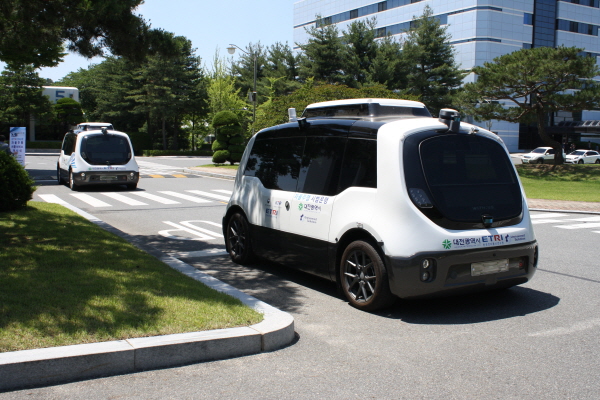
▲The autonomous shuttle bus "Otobi," developed by ETRI researchers, is seen driving along a route within the research center.
Voice control and realistic content provide the foundation for Level 4 autonomous driving.
A domestic research team has successfully developed a steering-less, autonomous vehicle by installing high-performance artificial intelligence software in an electric vehicle manufactured by a small and medium-sized enterprise. This marks the beginning of a full-scale development of autonomous driving technology that requires no driver intervention.
The Electronics and Telecommunications Research Institute (ETRI) announced on the 9th that it has developed an unmanned autonomous driving technology that applies the nation's highest level of artificial intelligence (AI) technology and will provide a pilot shuttle bus service that will circulate around the research center.
Currently commercialized autonomous driving technology is still at levels 2 and 3, where the steering wheel remains in the car or the driver intervenes when necessary.
Meanwhile, ETRI has completed preparations for the era of Level 4 autonomous driving by developing technology to implement a car that does not require a driver's seat.
The name of the autonomous vehicle developed by the research team is AutoVe. The name is a combination of the words “autonomous driving” and “vehicle,” and symbolizes true autonomous driving technology without a driver.
The shuttle service begins when you call a parked Autobee with your mobile device.
When you get on the approaching Autobee and say “Hi Autobee, let’s go to Research Building 7,” it will recognize your voice and take you to your destination. Passengers do not need to drive, so they can freely do whatever they want.
Autobi travels within the research center at a speed limit of 25 km/h, in compliance with safety regulations.
You can make a reservation at the kiosk in the visiting area, and you can check the real-time location of the autobi by scanning the QR code.
The route runs from 10:00 AM to 5:00 PM, passing through the main research buildings.
It drives safely and intelligently even in situations that are always different, such as non-signalized intersections, pedestrian crosswalks, and stopped vehicles.
The high-performance AI algorithm applied to Autobee by the research team processes information obtained from cameras and lidar sensors in real time to recognize the environment, surroundings, and objects, and creates its own driving path.
It is much more efficient than processing sensor information by communicating it remotely.
For user convenience, ETRI has also installed world-class artificial intelligence-based voice conversation interface technology.
Passengers can easily control the car by calling it as if speaking to an AI assistant or by giving commands such as “Let’s go to the destination,” “Stop,” or “Avoid” after getting in.
Ottoby moves forward while constantly conversing with those around him.
The research team uses data distribution infrastructure technology to install multiple sensors throughout the facility and remotely transmit real-time safety information, such as blind spots and construction areas, to Autobee.
The idea is to perform autonomous driving more safely with expanded situational awareness in addition to self-information.
Additionally, the transparent OLED display installed on the window inside the autobi features AR realistic guide technology and 8K VR broadcasting technology developed by ETRI.
Thanks to this, passengers can access vehicle information in real time. You can receive content linked to 3D space or enjoy 8K high-definition 360-degree VR broadcasts while moving around without getting bored.
The technology developed by the research team is expected to be widely utilized as a platform service that provides real-time, hyper-realistic content while comfortably traveling to a destination even when there is no car or the driver is unable to drive.
Since May of last year, the research team has been increasing functionality and perfection through research that integrates ETRI's own technologies in each field, and in February of this year, they became the first in Korea to obtain a temporary autonomous driving operation permit.
This is all the more significant as it is a self-driving service developed by ETRI that integrates its technological capabilities, including artificial intelligence, 5G communications, and media content, without relying on foreign technology.
ETRI's Choi Jeong-dan, head of the Intelligent Robotics Research Center, said, "By integrating ETRI ICT technology, we have developed the first future-oriented autonomous internal circulation shuttle in Korea. “We will strive to establish Autobee as an ETRI landmark and to spread autonomous driving technology to various fields such as logistics, public safety, and national defense,” he said.
For this study, ETRI constructed 100,000 km of domestic road traffic environment data and created 200 terabytes (TB) of 14 million training data.
The research team plans to share relevant data with research institutions and related companies, while continuing research on algorithm performance improvement, stabilization, and optimization, contributing to the development of the domestic artificial intelligence and autonomous driving industry ecosystem.
In addition, ETRI plans to expand the scope of service application to areas such as autonomous driving pilot operation areas while transferring related element technologies.
On the 4th, an autobi demonstration event was successfully held in the hospital for Daejeon Metropolitan City officials.
Through this, the research team plans to provide personalized transportation services (MaaS) for each region and autonomous driving services for the environment and transportation disadvantaged.
This project is being carried out as part of the Ministry of Science and ICT's ICT Convergence Industry Innovation Technology Development Project and the ETRI Research and Development Support Project, and it is being used as the foundation for the autonomous driving technology development innovation project, aiming for the commercialization of fully autonomous vehicles within 27 years.
Comments
Related news
ETRI to Develop Human-Safe THz Wave Security Checkpoints
Advanced smart security screening technology utilizing terahertz waves (THz) that are harmless to the human body has begun development, and upon project completion, it is expected that screening technology capable of achieving both safety and convenience will emerge.
2021.05.20by 배종인 기자
ETRI develops processes and materials that address challenges in micro LED production.
The Micro LED market is projected to grow at a compound annual growth rate of 65% through 2027, reaching a market size of 71 billion dollars. However, high manufacturing difficulty has been a bottleneck to widespread adoption. In response, ETRI announced that it has resolved key challenges in Micro LED display technology by independently developing novel manufacturing processes and new materials.
2021.05.25by 이수민 기자
ETRI's Radiation-Immunicable Sensor Replaces Heavy Lead Protective Clothing
Domestic researchers have developed sensors based on radiation-resistant flexible composite materials, garnering expectations for application in extreme environments such as nuclear power plants or as replacements for heavy lead shielding.
2021.06.02by 배종인 기자
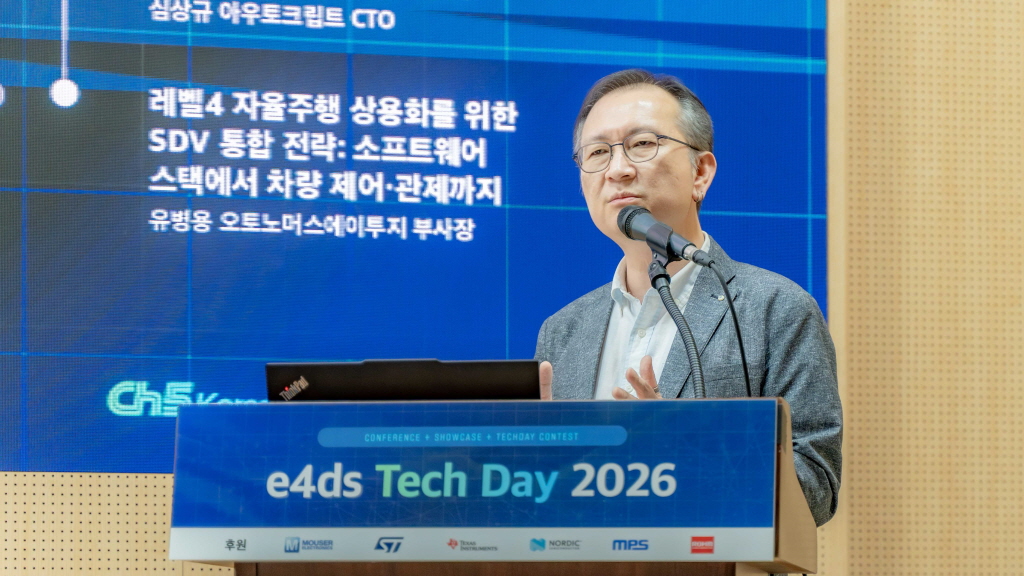
[e4ds Tech Day 2026 ⑨] Sim Sang-gyu, Autocrypt CTO: "In the Physical AI Era, Automotive Security Must Extend Beyond the Vehicle"
At e4ds Tech Day 2026, Sim Sang-gyu, CTO of Autocrypt, explained automotive cybersecurity strategies in the era of Physical AI and SDV (Software-Defined Vehicle). Automobiles are evolving as part of an ecosystem connected to AI, cloud, chargers, IoT, and robots, and he emphasized that the scope of security must expand beyond the vehicle interior to the entire connected environment. In particular, AI model tampering, adversarial attacks, OTA updates, and EV charger hacking were identified as major threats. He explained that response measures require zero trust, AI model integrity protection, intrusion detection, Security by Design and Default, and full lifecycle security management, and that proactive security system establishment beyond regulatory compliance is critical for securing future mobility competitiveness.
2026.10.12by 배종인 기자

Practical HIL Construction Strategy for Automotive and Off-Highway Controller Validation
As vehicle E/E architecture transitions to zonal structures and shifts to software-defined vehicles (SDV), the number of controllers (ECUs) requiring validation and software complexity are surging dramatically. Meanwhile, real vehicle testing cannot provide repeated verification under identical conditions and entails lead time and safety concerns. This white paper explains the principles of HIL (Hardware-in-the-Loop) validation and the structure of the NI platform composed of PXI, SLSC, and VeriStand, and through two actual implementation cases—Camera Record & Replay HIL for In-Cabin Monitoring Controller (ICMU) and Forklift Controller (VCU) HILS—describes how controller-level regression testing becomes possible. Additionally, it explicitly states application boundaries and limitations, such as lack of A2B support.
2026.10.12by 편집부











