



Semiconductor, automobile, and secondary battery exports expected to remain robust until next year.
 Published2021.06.09 08:56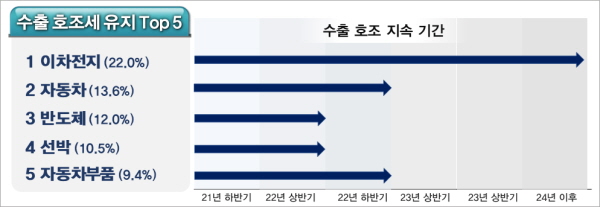
While export performance this year is expected to reach an all-time high, it is expected that exports of secondary batteries, automobiles, semiconductors, ships, and automobile parts will continue to show strong performance until next year, while it is predicted that exports of computers, petrochemicals, displays, bio/health, and home appliances may see a decline in the second half of this year.
The Federation of Korean Industries recently surveyed the heads of research centers at 12 securities firms about their export outlook for 15 major items.
According to the survey, the items expected to maintain their export boom were secondary batteries (22.0%), automobiles (13.6%), semiconductors (12.0%), ships (10.5%), and automobile parts (9.4%), in that order.
Regarding the duration of the export boom among these items, secondary batteries are expected to see the longest export boom, with export boom expected to continue 'after 2024' (40.0%) and 'in the second half of 2023' (30.0%). This indicates that, as the global electric vehicle market is rapidly growing, Korean companies have already secured competitiveness, and despite the increase in overseas expansion by major companies, the export boom is expected to last the longest.
The opinion that automobiles and auto parts will be released by the second half of next year was 62.5% and 57.1%, respectively, in a survey, which appears to be due to the base effect, recovery in demand after COVID-19, and expansion of the electric vehicle market.
Semiconductors, which account for the largest share of our country's exports, are experiencing strong demand centered on DRAM.As the vertical supply situation is tight, export growth is expected to continue until the first half of next year (63.6%), but there are concerns about a decline in unit prices and the growth rate may slow down after the first half of next year.
Opinions were divided on the shipbuilding industry, with 33.3% predicting the first half of next year, 33.3% predicting 2023, and 16.7% predicting 2024. This is likely due to expectations of a global economic recovery and increased demand for eco-friendly ships, which are expected to lead to continued growth in orders until the first half of 2022.
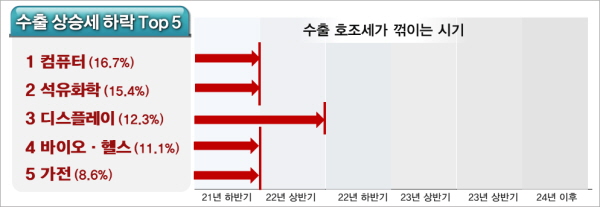
The top five items that are most likely to see a slowdown in the current export boom are computers (16.7%), petrochemicals (15.4%), displays (12.3%), bio/health (11.1%), and home appliances (8.6%).
Among the top 5 items expected to decline, the items expected to decline the fastest starting in the second half of this year include bio and health (60.0%), home appliances (57.1%), computers (50.0%), and petrochemicals (40.0%). Among these, it is particularly noteworthy that the bio and health sector, which has enjoyed a surge in diagnostic kits, is expected to see exports slow down as vaccinations expand.
The display market is also expected to enter a downward trend starting next year (40.0% in the first half, 40.0% in the second half), and sectors that have been performing well so far due to COVID-19 benefits and base effects, such as computers and home appliances, are also expected to see a gradual slowdown in demand.
Experts most frequently cited the decline in global demand (36.0%) as the biggest threat to the domestic export industry, followed by the US-China hegemony conflict (27.7%) and the spread of protectionism (13.9%).
In addition, the most important thing needed to maintain export competitiveness was the government's efforts to improve trade conditions for major exporting countries (38.9%). The most common responses were improvement of the business environment through regulatory reform and tax reduction (33.3%) and expansion of support for R&D investment to strengthen industrial competitiveness (27.8%).
Currently, our exports are mostly booming, especially in key items and new growth items, but many experts believe that the current boom is largely due to the base effect.
Therefore, it was pointed out that in order to sustain the current export boom and maintain export competitiveness even if global demand decreases in the future, it is necessary to improve trade conditions in exporting countries externally and strengthen regulatory reform and various support measures to secure the competitiveness of our companies internally.
Kim Bong-man, director of the International Cooperation Office at the Federation of Korean Industries, said, “Even though the COVID-19 pandemic is not over yet, our export performance is breaking records every day, but we do not know when another crisis will come.” He added, “I hope that our government will actively respond to the US-China hegemony conflict and the spread of protectionism, and support our companies that make a living from exports so that they can conduct business more actively.”

Comments
Related news

April ICT Exports Reach $17.1 Billion… All-Time High for April
In April 2021, ICT exports reached $17.06 billion, representing a 32.6% increase compared to the same month of the previous year, while imports totaled $10.78 billion, up 21.5% year-over-year. The trade balance was provisionally calculated at a surplus of $6.29 billion.
2021.05.20by 배종인 기자

May Semiconductor Exports Break Through 10 Billion Dollars
May semiconductor exports exceeded 10 billion dollars, with semiconductor exports increasing for 11 consecutive months. This export performance is analyzed as resulting from the full rollout of 5G smartphones and expanded investments by data center companies leading to increased orders for mobile and server-use memory, which in turn caused fixed memory prices to rise due to expanded demand across application sectors, as well as favorable notebook sales driven by sustained contactless economy demand.
2021.06.02by 배종인 기자

[Planning] Display outlook for the second half of the year - 'OLED' in the second half of 2021
The second half of 2021 display market is projected to experience continued price increases and sales growth driven by increased consumer electronics demand due to COVID-19, full-scale deployment of 5G smartphones, and expansion of the OLED TV market. Accordingly, we have arranged a forum to provide an outlook on the display market for the second half of the year.
2021.06.08by 배종인 기자
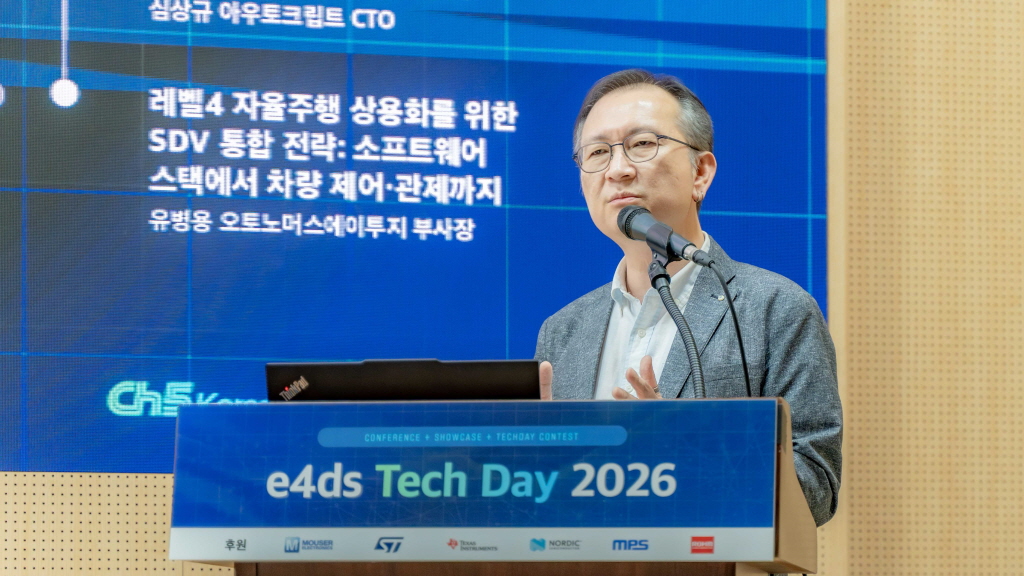
[e4ds Tech Day 2026 ⑨] Sim Sang-gyu, Autocrypt CTO: "In the Physical AI Era, Automotive Security Must Extend Beyond the Vehicle"
At e4ds Tech Day 2026, Sim Sang-gyu, CTO of Autocrypt, explained automotive cybersecurity strategies in the era of Physical AI and SDV (Software-Defined Vehicle). Automobiles are evolving as part of an ecosystem connected to AI, cloud, chargers, IoT, and robots, and he emphasized that the scope of security must expand beyond the vehicle interior to the entire connected environment. In particular, AI model tampering, adversarial attacks, OTA updates, and EV charger hacking were identified as major threats. He explained that response measures require zero trust, AI model integrity protection, intrusion detection, Security by Design and Default, and full lifecycle security management, and that proactive security system establishment beyond regulatory compliance is critical for securing future mobility competitiveness.
2026.10.12by 배종인 기자

Practical HIL Construction Strategy for Automotive and Off-Highway Controller Validation
As vehicle E/E architecture transitions to zonal structures and shifts to software-defined vehicles (SDV), the number of controllers (ECUs) requiring validation and software complexity are surging dramatically. Meanwhile, real vehicle testing cannot provide repeated verification under identical conditions and entails lead time and safety concerns. This white paper explains the principles of HIL (Hardware-in-the-Loop) validation and the structure of the NI platform composed of PXI, SLSC, and VeriStand, and through two actual implementation cases—Camera Record & Replay HIL for In-Cabin Monitoring Controller (ICMU) and Forklift Controller (VCU) HILS—describes how controller-level regression testing becomes possible. Additionally, it explicitly states application boundaries and limitations, such as lack of A2B support.
2026.10.12by 편집부











