



FKI: “Digital Tax Should Be Limited to Revenues Over $20 Billion”
 Published2021.06.09 09:17
Violation of the principle of proportionality in including manufacturing industries with low tax evasion as taxable subjects
The Federation of Korean Industries (Chairman Huh Chang-soo) argued that the digital tax should be limited to digital service companies with sales of over $20 billion.
The Federation of Korean Industries announced that on June 8, representing the Korean business community, it delivered a proposal to OECD Secretary-General Matthias Coleman and BIAC Chairman Charles Rick Johnston, which included proposals such as minimizing the scope of the digital tax, applying the global minimum tax on a limited basis, and granting a grace period before the implementation of the system.
Recently, calls to expand the scope of digital taxation and raise the global minimum tax rate have been raised, primarily in the United States.
In response, the Federation of Korean Industries explained the background of its proposal, stating, “The digital tax is intended to prevent tax evasion by global digital companies,” and adding, “Excessively expanding the scope and raising the tax rate of the digital tax not only runs counter to the purpose of the system but also raises concerns that it could stifle even normal business activities.”
The Federation of Korean Industries expressed concern that if a digital tax were imposed on all industries with sales exceeding $20 billion, as argued by the U.S., 4.7 trillion won—8.5% of annual domestic corporate tax revenue—would fall under the influence of the digital tax, potentially leading to some of this amount being leaked overseas.
According to the plan announced by the OECD in October 2020, the 'market country taxation' target will include not only digital service companies such as Google, but also consumer-facing businesses such as home appliances, mobile phones, and automobiles (excluding B2B, e.g., semiconductors). The United States recently proposed expanding the scope of taxation on the country of origin to all industries.
In response, the Federation of Korean Industries countered that the indiscriminate expansion of the scope of taxation runs counter to the original purpose of introducing the digital tax, which was to prevent tax evasion by global digital companies. This is because the majority of manufacturing companies conduct normal business activities through production and sales subsidiaries in various countries around the world and faithfully pay taxes to tax authorities.
In addition, the Federation of Korean Industries argued that including manufacturing companies with a low likelihood of tax avoidance in the scope of strengthened taxation rights violates the principle of proportionality, and that the application of the digital tax should be limited to digital service companies with sales of over $20 billion.
Furthermore, the Federation of Korean Industries pointed out that the global minimum tax violates the competition principles of a free market economy by restricting healthy tax competition among nations aimed at attracting corporate investment. The Federation of Korean Industries expressed concern that if a global minimum tax is introduced, countries that have attracted corporate investment with low taxes are expected to raise their corporate taxes, leading to a contraction in corporate investment.
Along with this, it was proposed to grant a grace period and establish a dispute mediation body to address the side effects of the introduction of the new tax system.
This is because the introduction of the digital tax will not only cause major changes to the existing tax system but also involve complex detailed taxation standards, so in order to minimize confusion in the early stages of its introduction, preliminary preparations such as concluding tax treaties between countries and amending domestic laws in each country must be carried out with a sufficient grace period.
The Federation of Korean Industries explained that, just as it took about three years from the agreement between countries to the implementation of the system under the Automated Exchange of Financial Information Agreement (MCAA) previously pursued by the OECD, a grace period of at least three years is also required for the introduction of the digital tax.
In addition, given the high likelihood of disputes between countries over taxing rights in the early stages of the system's implementation, it was proposed to establish an independent dispute resolution body led by the OECD to prevent the unilateral reflection of the interests of specific countries.

Comments
Related news
How to Develop High-Efficiency IoT Wearable Devices at Low Cost
IT Conference (Representative: Kim Jung-hee) will hold a "Low-Cost, High-Efficiency Development Technology Seminar" on Friday, August 19th at the Ruby Room on the 2nd floor of the Korea Chamber of Commerce and Industry Building in Yeouido, where it will present various solutions for bill of materials reduction spanning from foundry companies to chip solutions and connector fields. As product competition intensifies in the global market, pressure to reduce time and costs from the initial concept design of IoT and wearable devices through prototype launch is increasing. Accordingly, there is a growing trend toward comprehensive efforts for rapid market entry through cost reduction not only in prototype stages but also in mass production phases.
2016.07.22by 신윤오 기자
Chairman Jin Dae-je: "National preparation for semiconductor hegemony is essential."
Supply will remain tight relative to semiconductor demand for a considerable period, and opinions have been presented that national-level countermeasures need to be established in preparation for semiconductor hegemony competition. The Federation of Korean Industries (hereinafter referred to as FKI) held a seminar on the 30th at the FKI Hall Conference Center with the theme of "The Semiconductor Industry is Shaken: Semiconductor Industry Paradigm and Future."
2021.03.30by 배종인 기자
Semiconductor Industry Issues and Response Strategies Seminar to Be Held
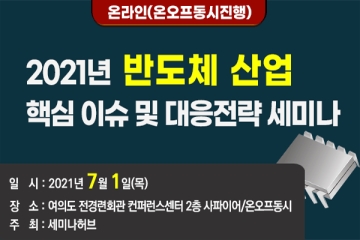
With continued global semiconductor supply instability, interest in semiconductors is at an all-time high. Seminar Hub will hold the "2021 Semiconductor Industry Key Issues and Response Strategies Seminar" both online and offline on July 1st (Thursday) at the Korea Chamber of Commerce and Industry building in Yeouido, Seoul.
2021.06.03by 이수민 기자

Nvidia invests $5 billion in Intel
NVIDIA and Intel, leaders in global AI computing technology, are now forging ahead in providing cutting-edge solutions through NVLink-based architecture integration. NVIDIA and Intel have officially announced a strategic partnership and stated that they will jointly develop customized data center and personal computing products to accelerate diverse applications and workloads ranging from hyperscale to enterprise and consumer markets, thereby laying the foundation for the next generation computing era.
2025.09.22by 배종인 기자
.jpg)
Applied Materials Launches Environmental Protection Campaign to Mark World Cleanup Day
Applied Materials Korea (CEO Park Kwang-seon) is carrying out environmental cleanup activities with employees and their families around the Dongtan Sinricheon area on the occasion of World Cleanup Day, evolving into a company that engages with the local community beyond technological innovation.
2025.09.22by 명세환 기자











