


Nano Convergence 2020 Project Achieves 490% Return on Investment… Contributing to Korea’s Competitiveness in Materials, Parts, and Equipment
 Published2021.06.09 11:18
.jpg)
(From the fifth person from the right) Distinguished guests including Park Jong-gu, Director of the Nano Convergence 2020 Project Group, Park Jin-kyu, Vice Minister of Trade, Industry and Energy, and Hong Yong-taek, Vice Minister of Science and ICT, are posing for a commemorative photo at the final performance report meeting of the Nano Convergence 2020 Project.
Achieved 51 successful commercialization companies, 85 commercialized products, and 740 jobs created.
The Nano Convergence 2020 Project (Project Director Park Jong-gu) invested 143.7 billion won from 2012 to 2020 and recorded commercialization sales of 705 billion won, which is 490% of the investment, contributing to strengthening Korea's competitiveness in materials, parts, and equipment.
The Ministry of Trade, Industry and Energy (Minister Moon Seung-wook) and the Ministry of Science and ICT (Minister Lim Hye-sook) jointly held a "Final Performance Report Meeting" at the Millennium Hilton Hotel on the 8th to successfully conclude the "Nano Convergence 2020 Project (Director Park Jong-gu)," with which they have collaborated for nine years since 2012.
At the event, attended by Vice Minister Park Jin-kyu of the Ministry of Trade, Industry and Energy, Vice Minister Yong Hong-taek of the Ministry of Science and ICT, and about 70 officials from industry, academia, and research institutes in the nano field, presentations were given on the nine-year achievements of the Nano Convergence 2020 project and representative successful commercialization cases, and 10 excellent commercialized products were exhibited.
The 'Nano Convergence 2020 Project' involves the Ministry of Trade, Industry and Energy and the Ministry of Science and ICT jointly establishing a single project team to bring the achievements of nanotechnology held by the public sector to the industrial sector.This is a project that supported early commercialization by connecting it with new product ideas.
From 2012 to 2020, 143.7 billion won was invested, and achievements were made, including commercialization sales of 705 billion won (amount reflecting business contribution rate, as of March 2021), which is 490% of the government investment, 51 successful commercialization companies, 85 commercialized products, 426 patent applications and 191 registrations, and the creation of 740 jobs.
In addition, it was assessed that it generated 1.05 trillion won in production across all industries (including 350 billion won in production inducement in other industries), 400 billion won in value-added inducement, and an increase of 2,750 employed people.
As nanotechnology (NT) is a core foundational technology that enhances the performance of materials, components, and equipment, this project has contributed to strengthening the competitiveness of these sectors and has produced results linked to government policies such as the BIG3 (system semiconductors, future vehicles, and biotechnology), the Korean New Deal, and carbon neutrality through the convergence of NT-IT, NT-BT, and NT-ET.
According to the results of a survey of companies supported by the Nano Convergence 2020 project, the commercialization period was drastically shortened from 56 months to 26 months through the project, and the Nano Convergence 2020 Project Group, which serves as the project's corporate support platform, was evaluated in an OECD report (December 2020) as an innovation cooperation platform in the field of advanced materials, particularly as a representative platform in the area of intellectual property leverage.
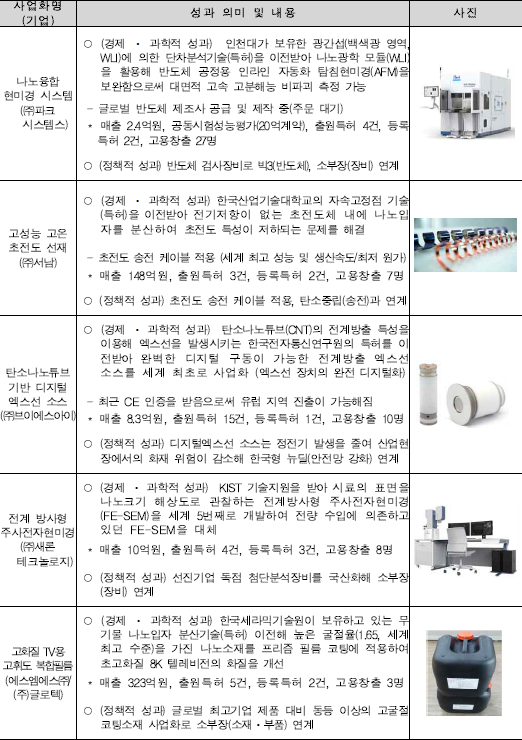
Looking at the major representative achievements, Park Systems Co., Ltd. received the step difference analysis technology (patent) based on optical interference (white light region, WLI) owned by Incheon National University and developed a nano-fusion microscope system capable of large-area, high-speed, high-resolution, non-destructive measurement by utilizing a nano-optical module (WLI) to complement an inline automated probe microscope (AFM) for semiconductor processes, and is currently supplying and manufacturing it to global semiconductor manufacturers.
Seonam Co., Ltd. acquired the magnetic flux fixing point technology (patent) from Korea University of Technology and developed a superconductor with zero electrical resistance By dispersing nanoparticles within it, the problem of degraded superconducting properties was resolved and applied to superconducting transmission cables.
VSI Co., Ltd. acquired a patent from the Korea Electronics and Telecommunications Research Institute that generates X-rays using the field emission characteristics of carbon nanotubes (CNT) and commercialized a field emission X-ray source capable of perfect digital operation for the first time in the world.
Saeron Technology Co., Ltd. developed the world's fifth field emission scanning electron microscope (FE-SEM) capable of observing the surface of samples with nanoscale resolution with technical support from KIST, replacing the FE-SEM that was entirely dependent on imports.
Meanwhile, at this event marking the final conclusion of the Nano Convergence 2020 project, a planning kick-off meeting for the follow-up project, tentatively named the Nano Convergence 2030 project, was held as a preliminary event.
The direction of planning for follow-up projects was discussed in the presence of 25 representatives from industry, academia, and research institutes, including Hong Soon-kook, Chairman of the Nano-Convergence Industry Research Association, who served as co-chair of the planning committee, and Yoo Ji-beom, Chairman of the Nano Technology Research Council.
Park Jin-kyu, Vice Minister of Trade, Industry and Energy, stated, “We have achieved 700 billion won in commercialization sales related to materials, parts, and equipment, and among these achievements are many related to carbon neutrality, the Big 3, and the Korean New Deal.” He added, “In order for the nano-convergence industry ecosystem to further develop in parallel with the growth of materials, parts, and equipment and the Big 3, we will support solidarity and cooperation between nano companies and universities and research institutes, as well as with demand industries.”
Yong Hong-taek, Vice Minister of Science and ICT, stated, “Recent technologies and industries are advancing to new dimensions previously unimaginable through convergence, and nanotechnology, with its general-purpose characteristics, is a representative technology befitting this era of convergence.” He added, “We have prepared a follow-up project that constructively builds upon the Nano Convergence 2020 project, which played a significant role as a support platform for the commercialization of nano-convergence technologies over the past decade, so that R&D technology commercialization through convergence and cooperation can fully flourish. "I hope the Buddha will join hands and run together once again," he said.
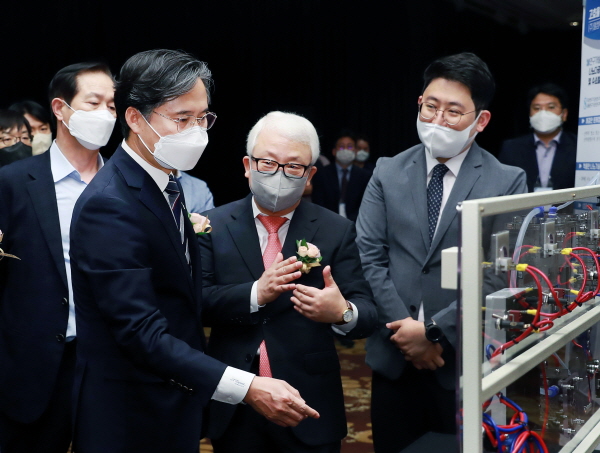
▲ (Second from the left) Vice Minister of Trade, Industry and Energy Park Jin-kyu is being introduced to the project's representative achievements by (third from the left) Director Park Jong-gu of the Nano Convergence 2020 Project Group.
.png)

Comments
Related news

Saenggiwon and Konkuk University reduce hydrogen production catalyst production costs by 50%.
KIST and Konkuk University have developed foundational technology for manufacturing hydrogen generation catalysts through an eco-friendly physical process utilizing pulsed lasers. The method involves irradiating the surface of carbon nanotubes with pulsed lasers without harmful chemical processes, and adding heterogeneous elements in single-atom form other than carbon to create catalysts.
2021.05.07by 이수민 기자

KIMM Accelerates Commercialization of Nano-Micro DNA Needle Patches
The Korea Institute of Machinery and Materials (Director Park Sang-jin), under the Ministry of Science and ICT, is attracting attention by successfully driving technology commercialization from the establishment of a research institute venture company to commercialization based on advanced nanotechnology research achievements.
2021.05.31by 배종인 기자
.jpg)
Samsung Electronics Develops 8-Nan RF Process Technology
Samsung Electronics is aggressively pursuing the 5G communication semiconductor market from sub-6GHz to millimeter wave (mmWave) by providing RF chips for 5G communication supporting multi-channel and multi-antenna as a single-chip solution through its 8-nano RF foundry process.
2021.06.09by 배종인 기자
Schneider Aims for Building Energy Savings and Operational Stability with Next-Generation HVAC Drives
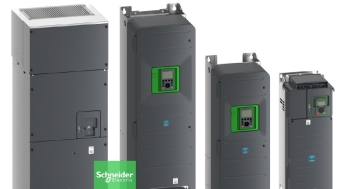
Schneider Electric has unveiled its next-generation HVAC drive product line 'Altivar HVAC'. The new product line's key features center on enhanced energy savings, system operational stability, and building management system integration. The products are divided into 'ATH200' for OEM and small equipment applications, and 'ATH600' for environments requiring continuous operation and advanced control. The company plans to expand the application scope from commercial buildings to facilities where HVAC system stability is critical, such as hospitals, airports, and data centers. The announcement includes over 30% energy savings, operation from -10°C to +60°C, Modbus and BACnet support, and compatibility with low global warming potential refrigerants.
2026.03.26by 명세환 기자
Ecolab Expands AI Data Center Cooling Business Through Acquisition of CoolIT
Ecolab has agreed to acquire CoolIT Systems, a liquid cooling company for AI data centers, for approximately $4.75 billion. The transaction is expected to close by Q3 2026, subject to regulatory approvals. CoolIT has been supplying direct-to-chip cooling-based coolant distribution units, cold plates, and manifolds, serving hyperscale data centers and colocation operators as customers. This acquisition is a measure to address the high-heat and high-density server environments created by AI proliferation. Ecolab plans to combine its water management and digital monitoring capabilities with CoolIT's hardware technology to expand its data center cooling business.
2026.03.26by 명세환 기자











