


[Planning] Smartphone Outlook for the Second Half of the Year: Sharp Rebound in Q3, Continued Growth in Q4
 Published2021.06.15 14:10
.jpg)
반도체 공급부족완화·코로나 정상화·피크 시즌 돌입
중저가 스마트폰 출하량 확대·폴더블 스마트폰 출시
5G 침투율 느리지만 지속 증가, 2022년 51% 전망
[편집자주]
지난해 코로나19 영향으로 피해가 컸던 스마트폰 시장은 지난해 하반기 IT 지출이 늘며 회복을 시도하며, 올해 상반기 비수기에도 불구하고 수출과 판매가 증가하며, 본격적인 회복세로 돌아섰다. 이런 스마트폰 시장은 하반기 애플의 아이폰13 출시 및 삼성전자의 새로운 폴더블 폰 출시, 5G폰 시장 확대에 힘입어 그동안 부진했던 시장을 극복하며, 본격적인 성장세로 돌아설 것으로 전망되고 있다. 또한 상반기 지속적으로 시장의 어려움을 가져왔던 반도체 공급부족도 정상화로 돌아서며, 스마트폰 생산량 확대에도 힘을 실을 것으로 기대되고 있다. 이에 본지는 2021년 하반기 스마트폰 시장 동향을 살펴보는 자리를 마련했다.
■ 2021년 상반기 코로나·비수기 불구 회복
코로나 영향으로 급감했던 스마트폰 수요는 2020년 하반기 이미 회복을 완료했다. 2021년 1분기 스마트폰 출하량은 3억4,500만대를 기록해 전년동기대비 25% 증가했다.
화웨이는 1분기 1,491만대를 기록하며, 전년동기대비 69% 감소하며 출하량 감소세가 지속됐으나 1분기에는 삼성, 애플, 샤오미, 오포, 비보, 화웨이 등 Top 6업체의 지배력이 2019년 1분기 58%에서 2020년 1분기 62%, 2021년 1분기 72%로 강화되는 모습을 보였다.
4월 스마트폰 시장도 신흥국 코로나 재확산, 중국 수요 약세, 비수기 영향에도 불구하고 전년동월대비 56% 성장했다.
4월 주요 지역별 시장 상황을 살펴보면 미국은 전년동월대비 99% 성장했다. 중저가폰으로 수요가 전이됐고, 아이폰SE, 갤럭시A 시리즈 판매 증가, 아이폰 12 pro Max 등이 베스트셀러를 유지했다. 중국은 전년동월대비 10% 감소했다. 중국은 5G 업그레이드 수요 둔화, 화웨이 프리미엄폰 사용자들이 오포, 비보, 샤오미 제품으로 교체가 되지 않았다. 인도는 재봉쇄 조치에 따라 오프라인 판매가 큰 폭으로 감소했다.
지난 2021년 5월 우리나라 휴대폰 수출은 반도체 공급 부족 영향과 코로나19 재확산에도 불구하고 완제품, 부분품 동시 수출 호조로 전년동월대비 43% 증가한 10억4,000만달러를 기록했다. 휴대폰 완제품은 미국 및 유럽연합 등 프리미엄 스마트폰 수요 확대로 2개월 연속 수출이 증가했고, 휴대폰 부분품은 해외 고부가가치 부분품 수요 확대로 7개월 연속 수출이 증가했다.
■ 3Q 글로벌 스마트폰 시장 성장
이러한 가운데 3분기부터 글로벌 스마트폰 출하량은 반도체 공급부족완화, 코로나19 정상화, 피크 시즌 돌입 등에 힘입어 성장할 것으로 예상된다.
NH투자증권에 따르면 올해 스마트폰 출하량은 반도체 공급 부족 영향과 코로나19 재확산의 여향으로 전년대비 6.6% 증가한 약 14억2,000만대를 기록하며 당초 기대보다는 소폭 낮은 수준으로 전망된다.
반면에 3분기에는 반도체 공급부족완화, 코로나19 정상화 및 피크 시즌 돌입 등에 글로벌 스마트폰 출하량이 전분기 대비 35.1% 증가한 3억7,820만대를 기록할 것으로 예상되고 있으며, 4분기에도 아이폰 13 시리즈 출시 및 글로벌 쇼핑 피크시즌 돌입으로 전분기대비 2.9% 증가한 4억610만대 수준이 예상되고 있다.
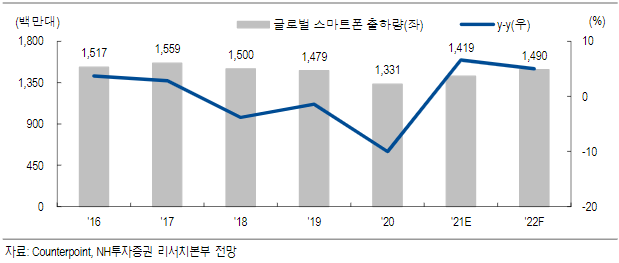
▲연간 글로벌 스마트폰 출하량 추이 및 전망(자료 : Counterpoint, NH투자증권 리서치본부 전망)
업체별로는 화웨이(Huawei)의 미국 제재 영향으로 중화권 업체들이 자국 및 이머징 마켓에서 수혜를 입어 전년비 큰 폭의 판매 증가세를 달성할 것으로 예상되며 애플(Apple)도 화웨이(Huawei) 수혜 및 글로벌 5G 침투율 증가의 수혜를 입을 것으로 전망된다.
삼성전자는 2021년 전년대비 13.6% 증가한 총 2억9,040만대의 스마트폰 출하량을 기록할 것으로 전망되고 있다. 2분기 반도체 공급 부족 및 인도 코로나19 확산 영향으로 부진한 출하량이 예상되지만 3분기부터 중저가 스마트폰 출하량 확대 및 폴더블 스마트폰 출시로 회복세 전망되고 있다.
애플(Apple)은 iPhone 12 시리즈와 iPhone 13 판매량 호조세로 2021년 약 2억2,800만대를 기록하며 2015년 이후 스마트폰 출하량이 가장 높을 것으로 예상되고 있다.
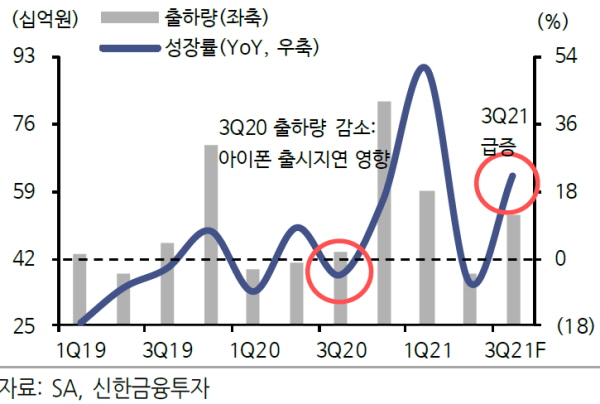
▲애플 아이폰 출하량 성장률(자료 : SA, 신한금융투자)
중화권 업체들도 2021년 약 20%의 이상의 스마트폰 출하량 증가세를 기록할 것으로 기대되고 있다.
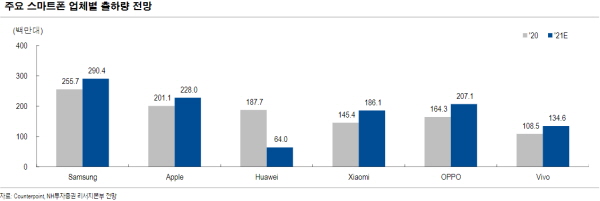
▲주요 스마트폰 업체별 출하량 전망(자료 : Counterpoint, NH투자증권리서치본부전망)
글로벌 스마트폰 출하량은 중장기적으로는 낮은 한자리 수 이상의 성장률을 기대하기는 어렵다고 판단되고 있다. 따라서 기존의 세트 업체들은 교체수요를 이끌어내기 위해 폴더블, 슬라이더블, 롤러블 스마트폰 등 다양한 폼팩터를 가진 스마트폰을 출시할 것으로 전망된다.
폴더블 스마트폰 시장을 선도하고 있는 업체는 삼성전자로 동사는 2021년 8월경 갤럭시Z폴드3, 갤럭시Z플립3 시리즈 두 모델을 신규로 출시할 것으로 전망된다.
삼성전자는 갤럭시Z폴드3의 하드웨어 스펙 상향, 갤럭시Z플립3의 가격 인하, 갤럭시 노트 시리즈의 부재로 삼성전자가 2021년 약700∼800만대 수준의 폴더블 스마트폰 출하량을 기록할 것으로 예상하며 2022년에는 약 1,400만대까지 확대될 것으로 전망되고 있다.
■ 5G 침투율 꾸준히 상승 중
2019년 2분기 5G 스마트폰 상용화 이후 침투율은 꾸준히 상승 중이다.
5G 스마트폰 침투율은 1Q20 7% → 2Q20 18% → 3Q20 18% → 4Q20 32% → 1Q21 36%를 기록했다.
2021년 5억7,000만대로 침투율 38%를 기록할 것으로 보이며, 2022년 7억8,000만대로 침투율 51%가 전망된다.
2Q19∼1Q21 누적 5G 스마트폰 출하대수는 Apple, 화웨이, 삼성전자, 오포, 비보 순으로 기록했다.
다만 소비자들의 5G 서비스 만족도 높지 않고, 5G 망 투자 역시 당초 예상대비 느리게 진행되고 있기 때문에 4G 스마트폰이 3G 스마트폰을 대체하던 당시보다 속도는 더딜 전망이다.
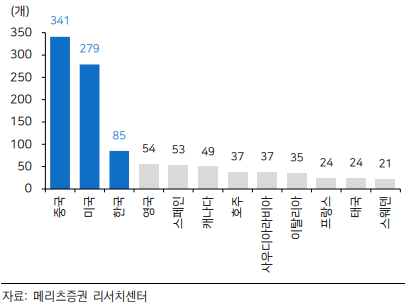
▲주요 국가 내 5G 네트워크 작동 도시 수(자료 : 메리츠증권 리서치센터)
■ 화웨이 약세·LG전자 철수, 업체 간 지각 변동
LG전자의 스마트폰 시장 철수로 인해 2020년 기준 2,400만대의 신규 고객 쟁탈 경쟁이 치열하게 펼쳐질 것으로 보인다. 한국, 미국, 중남미 시장에서 강세를 보이고 있고, 100∼300달러 가격대에 미국 선불제 시장에서 입지를 보유하고 있다. 삼성전자가 LG전자 프리미엄폰 수요를 대부분 흡수할 것으로 예상되고, 미국 선불제 시장에서는 삼성 A시리즈, 모토롤라, ZTE, TCL, 노키아 HMD등이 수혜를 볼 것으로 예상된다.
화웨이는 2019년 2억4,000만대에서 2021년 4,600만대로 출하가 급감했다. 중국 내에서는 오포, 비보, 중국 밖에서는 샤오미가 반사이익을 볼 것으로 예상된다.
특히 샤오미는 2021년 4월 점유율 14.3%로 역대 최고치를 기록하며, 글로벌 Top 3로 도약했다.
주력 시장인 인도가 코로나 재확산에 따른 수요 급감에도 불구하고, 유럽, 중남미, 중동, 아프리카, 신흥 아시아에서 선전하고 있다. 신흥아시아에서는 동남아 지역에서 선전을 바탕으로, 오포, 비보에 이어 3위를 차지하고, 삼성전자를 추월, 동유럽 점유율 25%를 돌파했다. 플래그십 모델 Mi 11 울트라를 앞세워 800달러이상 초프리미엄 영역에서 3% 점유율을 차지하고 있다.

Comments
Related news
Galaxy S21 Ultra equipped with 108-megapixel image sensor
Samsung Electronics has launched a new 108-megapixel image sensor product, the ISOCELL HM3. The ISOCELL HM3 is Samsung Electronics' third-generation 0.8-micrometer image sensor following the HMX and HM1, integrating 108 million pixels in a 1/1.33-inch form factor. Additionally, it incorporates Samsung Electronics' proprietary camera technologies including Smart ISO Pro and Super PD Plus.
2021.01.16by 강정규 기자
.jpg)
LG Electronics Withdraws from Mobile Business, Who Will Fill the Void?
LG Electronics, which dominated the mobile market for nearly 26 years, has exited the market. LG Electronics plans to redirect its mobile capabilities toward home appliances and automotive electronics to prepare for the future. Meanwhile, Samsung Electronics is expected to fill the void left by LG Electronics domestically, with active reinforcement of its mid-to-low-end smartphone lineup. On the other hand, fierce competition with Apple and other Chinese manufacturers is anticipated in overseas markets.
2021.04.12by 이수민 기자
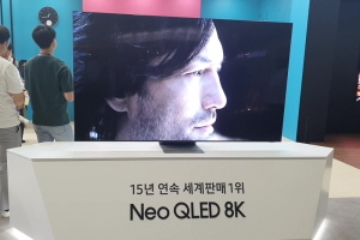
[Planning] Display outlook for the second half of the year - 'OLED' in the second half of 2021
The second half of 2021 display market is projected to experience continued price increases and sales growth driven by increased consumer electronics demand due to COVID-19, full-scale deployment of 5G smartphones, and expansion of the OLED TV market. Accordingly, we have arranged a forum to provide an outlook on the display market for the second half of the year.
2021.06.08by 배종인 기자
ESP32 Development Environment Selection and GPS Application Implementation
The ESP32 is a microcontroller that integrates Wi-Fi, Bluetooth, 12-bit ADC, capacitive touch, PWM, DAC, and UART in a single SoC. However, the abundance of features does not by itself solve the designer's problems. The real challenges lie in selecting the appropriate development environment, determining which pins can be used and which must be avoided, and converting raw data from modules into usable information. This document addresses ESP32 peripheral constraints (ADC2 and Wi-Fi coexistence limitation, UART1 occupancy, ADC non-linear regions), the trade-offs between Arduino IDE and ESP-IDF, and the process from connecting NEO-6M/NEO-M8N GPS modules to UART2, parsing NMEA sentences, and visualizing routes in Google Earth, all organized based on documented references.
2026.10.12by 편집부
MIPI CSI-2, DSI-2, C-PHY, D-PHY Test Solution Technical White Paper
The MIPI interface adopts a burst mode that transitions between low-power (LP) and high-speed (HS) states for low-power consumption, and in return, strict timing rules are imposed on state transitions. Additionally, the high-speed section operates as a packet-based protocol with headers, ECC, and CRC, so verification engineers must handle waveforms and protocols simultaneously. Traditional configurations combining general-purpose oscilloscopes and AWGs reveal limitations in setup complexity, measurement uncertainty, and lack of reproducibility when faced with these requirements. This white paper, based on webinar materials, organizes the structure of this problem and describes how the SV5C-DPTXCPTX generator for receiver testing and SV5C-DPRXCPRX analyzer for transmitter testing integrate state transition testing, stressed eye testing, and protocol analysis into a single bench, along with their application boundaries.
2026.10.12by 편집부











