


Samsung Electronics to Supply Over 4 Million 5G Base Stations Worldwide
 Published2021.06.23 12:10
.jpg)
▲ At the 'Samsung Network: Redefining Communications' event, Samsung Electronics Network Business Division President Kyunghoon Jeon introduces a new 5G solution.
Three core communications chips, built on 20 years of chip development expertise, are scheduled to be released next year.
Samsung Electronics showed confidence in the communications chip market, saying that it is leading the acceleration of the hyper-connected era that seamlessly connects all things and people by supplying more than 4 million 5G base stations worldwide.
Samsung Electronics held a global virtual event on the 22nd and unveiled a number of new 5G network solutions.
The event, hosted by President and Head of Network Business Division Jeon Kyung-hoon, was broadcast live worldwide through Samsung Electronics Newsroom and YouTube channels under the theme of “Samsung Networks: Redefined.”
Samsung Electronics is expanding its next-generation mobile communications business by signing 5G equipment supply contracts with Verizon, the leading mobile carrier in the U.S. last year, and NTT Docomo and Vodafone, the leading carriers in Japan and Europe, this year.
At this event, President Jeon Kyung-hoon said, “Samsung Electronics proactively began research on 5G in 2009, before 4G mobile communication was even widespread, and became the first company in the world to commercialize 5G.He evaluated that “the company is leading the global 5G market by succeeding in this area.”
He explained, “In the rapidly growing 5G market, we have already secured more business contracts than the number of 4G business contracts,” and “We have supplied more than 4 million 5G base stations worldwide.”
He continued, “Based on our 20+ years of experience in designing our own chips and our unrivaled software capabilities, we are growing faster than ever in the 5G market,” adding, “We will continue to take the lead in accelerating our entry into the hyper-connected era that seamlessly connects all things and people through partnerships with leading companies and differentiated solutions.”
■ Presenting a vision to expand the role of personal and industrial networks, three next-generation core chips
At the event, Samsung Electronics introduced ▷ next-generation core chips for base stations, ▷ next-generation high-performance base station lineup, ▷ One Antenna Radio solution, ▷ 5G virtualized base station (vRAN) solution, and ▷ Private Network solution, and revealed its vision to expand and redefine the role of networks in individuals' daily lives and various industrial sites with innovative technologies.
The next-generation core chips for base stations unveiled that day are three types: △2nd generation 5G modem chip (5G Modem SoC), △3rd generation millimeter wave wireless communication chip (mmWave RFIC), and △wireless communication digital-to-analog conversion integrated chip (DFE-RFIC Integrated Chip). Their common feature is that they can reduce the size of base stations while increasing performance and power efficiency.
These three core base station chips, designed based on over 20 years of know-how, are scheduled to be installed in the next-generation high-performance base station lineup to be released next year (2022).
2nd generation 5G modem chip ’ is characterized by doubling the data processing capacity compared to existing ones while reducing power consumption per cell by half, and also supports beamforming operations, which are essential functions for 5G communications.
The '3rd generation millimeter wave wireless communication chip' supports both high-frequency bands (mmWave) of 28 GHz and 39 GHz, and is equipped with advanced technology that can reduce antenna size by about 50%.
The 'digital-to-analog conversion integrated chip for wireless communication' is a chip that converts digital and analog signals used in low-frequency and ultra-high-frequency communications. It is a chip that can be miniaturized while increasing the supported frequency range by up to two times and increasing the wireless signal output of the base station.
■ High-performance base station lineup revealed
Samsung Electronics also unveiled a lineup of high-performance mobile communication base stations, including the '3rd generation Dualband Compact Macro' base station and the 'Massive MIMO Radio' base station.
The '3rd generation dual-band compact macro base station' is the first in the industry to support two ultra-high frequency bands simultaneously, and features a bandwidth of 2,400 MHz, the largest among products released to date.
The next-generation 'multi-input/output base station' that supports the most widely deployed mid-band 5G frequency in the world supports a wide bandwidth of 400MHz and applies new heat dissipation technology to increase the maximum communication speed while reducing power consumption by 20% and reducing the size by 30% for easy installation.
The 'One Antenna Radio' solution was also unveiled.
A large-capacity MIMO base station supporting the 3.5GHz band and 7It integrates a passive antenna that supports the 00MHz to 2.6GHz bands, minimizing antenna installation space and supporting easy installation, thereby drastically reducing network operating costs.
Samsung Electronics also unveiled a commercial-grade '5G virtualized RAN (vRAN)' solution, once again proving its leadership in the virtualized base station and core sectors.
The '5G virtualized base station' is a general-purpose server with dedicated software installed. It is connected to a 'multi-input/output base station' and supports multi-gigabit data speeds, demonstrating that it is an option that can be applied to ultra-high-speed 5G commercial networks.
■ Preemptive investment in 6G technology
At the event, Samsung Electronics unveiled solutions specialized for "private networks," a new area in mobile communications, while also sharing its vision for 6G technology.
He emphasized that he can propose a customized 'private network' according to business size and industry group by utilizing a portfolio of communication equipment, management and operation systems, terminals, and applications, and introduced the '5G Smart Factory' operated in Suwon Digital City and the domestic National Public Safety LTE (PS-LTE) project.
In addition, he emphasized that just as the company has led the new era of mobile communications through active investment in next-generation technologies, including the recent success of terahertz data communications, it is also proactively investing in 6G technology.
Samsung Electronics said that when the 6G era arrives beyond 5G, an era will come in which everything will be at the user's fingertips, overcoming the physical and technological limitations of the industry, such as XR (extended reality), mobile holograms, and digital replication, and that it will build on its technological innovations to create cutting-edge technologies. They announced that they would provide technology and solutions.

Comments
Related news
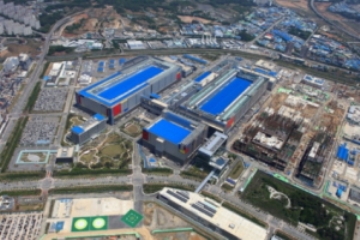
Samsung Electronics to Invest KRW 171 Trillion in System Semiconductors
Samsung Electronics will invest a total of 171 trillion won by 2030, adding 38 trillion won to the original 133 trillion won investment plan established when announcing its 'System Semiconductor Vision 2030' to secure system semiconductor leadership early. The company will further accelerate research and development of advanced foundry processes and construction of production lines.
2021.05.14by 배종인 기자
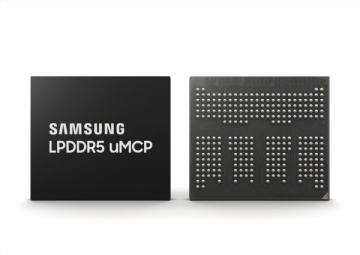
Samsung Electronics Launches New uMCP Products, Incorporating DRAM and NAND in a Single Chip
Samsung Electronics has enhanced design convenience and space utilization for smartphone manufacturers through the launch of a high-performance uMCP new product that integrates DRAM and NAND flash memory on a single chip.
2021.06.15by 배종인 기자
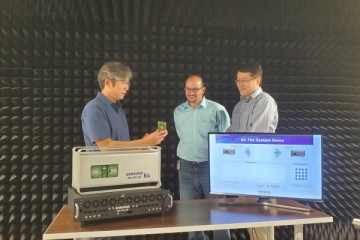
Samsung Electronics successfully demonstrates 6G THz wireless communication, putting 6G development on the horizon.
Samsung Electronics has successfully demonstrated 6G communications in the terahertz band, which is expected to be utilized as a key frequency band for 6G, raising expectations for commercialization realization.
2021.06.16by 배종인 기자
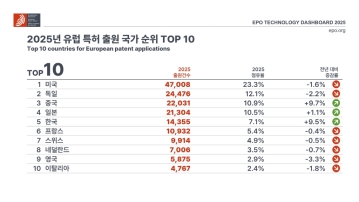
European Patent Applications Surpass 200,000 for the First Time… South Korea Maintains 5th Place, Led by Batteries and Telecommunications
According to the European Patent Office (EPO)'s 'Technology Dashboard 2025', European patent applications last year reached 201,974, surpassing 200,000 for the first time. Korean companies and inventors filed 14,355 applications, representing a 9.5% increase from the previous year and maintaining 5th place by country. Battery, digital communication, and semiconductor technologies led the growth, with Samsung ranking as the top EPO applicant for the second consecutive year and LG reaching 3rd place. The presence of major domestic cities such as Seoul, Suwon, and Yongin was also confirmed. It was also revealed that Korea's European patent strategy is expanding beyond individual technologies to span the entire industry.
2026.03.24by 명세환 기자

SK Telecom First Applies AI-Based Network Operations at Gwanghwamun K-Pop Concert
SK Telecom announced that it applied an AI-based network operation system for the first time at a large-scale K-pop concert held in the Gwanghwamun area of Seoul on March 21st, managing communication quality throughout the event. Mobile data usage during the three hours before and after the concert reached 12.15TB, approximately doubling compared to the same time slot the previous weekend. SK Telecom monitored traffic using the AI system 'A-One' in five-minute and 50-meter units to respond to potential overload situations, while also operating temporary communication facilities and on-site personnel in parallel. This case is interpreted as confirmation of the practical applicability of AI-based autonomous network operation in an environment where demand from dense events and foreign users increases simultaneously.
2026.03.23by 명세환 기자











