


UNIST Develops Solar Cells Using AI
 Published2021.06.25 09:47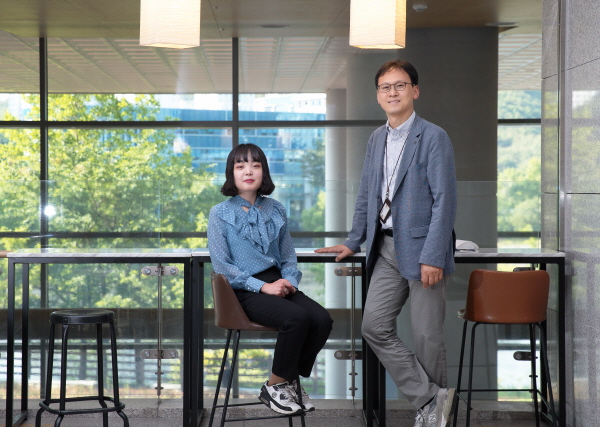
▲Dr. Anna Kyung and Professor Jinyoung Kim (right)
A technology has been introduced that can develop organic solar cells using artificial intelligence (AI), raising expectations that it will be applied to the development of electronic materials in the future.
Researchers at UNIST and the Commonwealth Research Institute of Australia recently presented a technology that applies artificial intelligence to the development of organic solar cells.
This technology is attracting attention as a new research methodology that will accelerate the development of various printable photovoltaic devices, including organic solar cells. The journal Energy & Environmental Science, a prestigious academic journal in the field of energy science, published this research on its June 17th Outside Front Cover. It was also selected as a "Hot Article" by the journal editors and others.
A research team led by Professor Jinyoung Kim of the Department of Energy and Chemical Engineering at UNIST and Dr. Dujin Park of the Federal Institute of Science and Technology (Fed) have developed a model to predict the material composition ratio and layer thickness required for producing high-performance organic solar cells.
The predictive model was created using machine learning technology, a branch of artificial intelligence. The data set required for artificial intelligence (machine learning) learning could be easily secured by mass-producing organic solar cells using a roll-to-roll (R2R) process.
Organic solar cells are made by coating a substrate with a solution containing organic substances and additives. They can be produced in a lightweight, flexible film form and are inexpensive, making them a promising next-generation solar cell. While lower efficiency compared to commercial solar cells remains a concern, the recent development of multi-component organic solar cells has led to increased efficiency.
On the other hand, with the development of multi-component organic solar cells, optimization has become more challenging. Organic solar cells exhibit varying performance depending on the material mixing ratio and layer thickness, requiring optimization to find conditions that maximize the performance of the developed cell. This is because the number of components has increased, leading to a wider range of scenarios.
The research team developed a machine learning-based model that easily predicts optimal performance conditions. Machine learning is more accurate with more training data, and the data needed for training was obtained by manufacturing devices with over 2,000 combinations of organic solar cells using a roll-to-roll process. Roll-to-roll is a process that prints organic solar cell materials on a substrate that is unwound from a cylindrical rod (roll) and then wound around another cylindrical rod (roll). The composition ratios and laminate thicknesses, among other combinations, are designed to vary depending on the substrate location.
“We devised a new value called ‘deposition density’ to digitize the data of various combinations of organic solar cells produced through the roll-to-roll process into a form that machine learning can recognize,” said Dr. Anna Kyung Ahn of UNIST, the first author of the study. “It also makes experiments more accessible, as anyone with roll-to-roll equipment can create a predictive model using a publicly available machine learning library.”
Additionally, roll-to-roll has the advantage of being a commercialized process that can be directly applied to the mass production of organic solar cells. In this experiment, a cell was manufactured with a 10.2% efficiency in converting sunlight into electricity, which is the highest efficiency record for a printed organic solar cell manufactured using a roll-to-roll process.
Dr. Park Du-jin of the Commonwealth Science and Research Organization (CSIRO) of Australia conducted a machine learning model training and optimization condition prediction. The task was to simultaneously identify conditions that yield the highest efficiency and minimize efficiency variation across film thicknesses.
Dr. Park Du-jin explained, “For commercialization, it is important to find conditions that maintain consistently high performance regardless of changes in the thickness of the thin film, as well as high performance conditions.” He added, “This study provides a methodology that can accelerate the commercialization of organic solar cells by predicting both conditions and experimentally verifying them.”
Professor Kim Jin-young said, “There is no precedent for creating and analyzing organic solar cells with 2,000 material combinations in a single study,” and expressed his expectations, saying, “If we increase the learning data and develop a model with excellent accuracy, it can also be used to develop printable electronic device materials such as light-emitting diodes and photodetectors using perovskites.”
This research was supported by the National Research Foundation of Korea and the Australian Renewable Energy Agency.
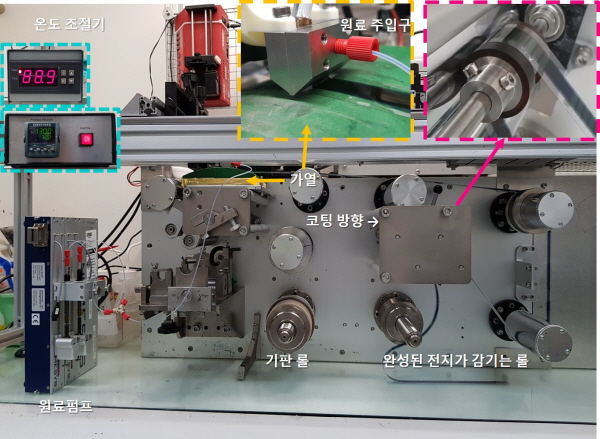
▲Organic solar cell manufacturing process using roll-to-roll process

Comments
Related news
UNIST Dino Team Wins Hackathon
A zombie game created by UNIST students with their distinctive ideas and technical skills was selected as the best work at the hackathon.
2021.06.08by 강정규 기자
UNIST, Durability and Efficiency of Honeycomb-Type Thermoelectric Generators ↑
A research team at UNIST (President Lee Yong-hoon) comprising Professors Son Jae-sung and Chae Han-ki from the Department of Materials Science and Engineering, along with Professor Kwon Beom-jin from Arizona State University, has developed a technology to enhance thermoelectric generator durability and efficiency by 3D printing copper-selenide (Cu2Se), a thermoelectric material, into a honeycomb structure. The ability to produce complex honeycomb structures through 3D printing was made possible by newly developing an ink composed of thermoelectric material.
2021.06.16by 강정규 기자
UNIST Integrates Adaptive Optics Technology with Scanning-Enhanced Nanoscopy
Professor Park Kyung-deok's team in the Department of Physics at UNIST has developed a new optical analysis technique that integrates adaptive optics technology into tip-enhanced nano-microscopy. Like a chameleon that can freely adapt its observation method depending on the target being observed, it is garnering expectations that it will enable analysis of characteristics of various types of ultra-fine particles—such as biological viruses, chemical single molecules, and semiconductor particles—using a single microscope.
2021.06.17by 배종인 기자
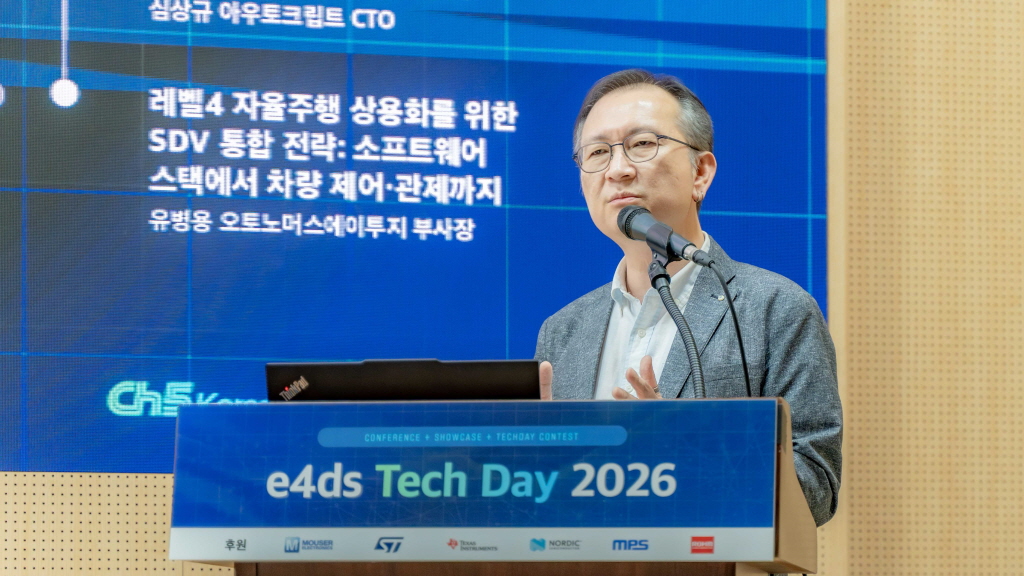
[e4ds Tech Day 2026 ⑨] Sim Sang-gyu, Autocrypt CTO: "In the Physical AI Era, Automotive Security Must Extend Beyond the Vehicle"
At e4ds Tech Day 2026, Sim Sang-gyu, CTO of Autocrypt, explained automotive cybersecurity strategies in the era of Physical AI and SDV (Software-Defined Vehicle). Automobiles are evolving as part of an ecosystem connected to AI, cloud, chargers, IoT, and robots, and he emphasized that the scope of security must expand beyond the vehicle interior to the entire connected environment. In particular, AI model tampering, adversarial attacks, OTA updates, and EV charger hacking were identified as major threats. He explained that response measures require zero trust, AI model integrity protection, intrusion detection, Security by Design and Default, and full lifecycle security management, and that proactive security system establishment beyond regulatory compliance is critical for securing future mobility competitiveness.
2026.10.12by 배종인 기자

NVIDIA to Invest $1 Billion in U.S. Science Over Next Five Years
NVIDIA has announced plans to invest $1 billion over the next five years to strengthen U.S. scientific and technological competitiveness. The company will enhance cutting-edge artificial intelligence research and development capabilities in key areas including quantum computing, healthcare, and energy security, while expanding support for higher education research institutions and cloud service providers. NVIDIA is participating as a major industry partner in the White House Office of Science and Technology Policy's Genesis Mission, and is promoting supercomputer construction in collaboration with national laboratories including Argonne and Los Alamos.
2026.10.12by 배종인 기자











