



The autonomous driving division launches a 1.1 trillion won Level 4+ project.
 Published2021.06.29 08:46
.jpg)
▲Stage-by-stage classification of driving automation
The government will invest 1.974 trillion won over seven years to develop technology for commercializing Level 4+ autonomous vehicles.
The Autonomous Driving Technology Development Innovation Center (Director Jinwoo Choi) completed the commencement report on 53 detailed tasks (2021 government budget of 85.04 billion won) on June 17 and began full-scale development of Level 4+ autonomous driving technology that enables safe and perfect autonomous driving.
The Autonomous Driving Technology Development Innovation Project is a multi-ministerial collaborative project promoted by four ministries: the Ministry of Trade, Industry and Energy, the Ministry of Science and ICT, the Ministry of Land, Infrastructure and Transport, and the National Police Agency. It will be carried out over seven years with a total project cost of KRW 1.0974 trillion.
The project is jointly managed by the business unit and each ministry's R&D specialized institute (Korea Industrial Technology Evaluation and Planning Institute, National IT Industry Promotion Agency, Korea Agency for Infrastructure Technology Advancement, and Science and Security Promotion Center), and supports 88 detailed tasks centered on five major strategic areas, including new vehicle convergence technology, new ICT convergence technology, new road traffic convergence technology, service creation, and ecosystem construction, with the goal of completing the foundation for commercialization of convergence-type Lv. 4+ autonomous driving.
A total of 3,474 people, including 1,524 master's and doctoral students from 373 autonomous driving-related institutions, participated in the 53 sub-projects selected this year.Research personnel will participate in level 4+ commercialization research and development.
The Ministry of Trade, Industry and Energy will lead the development of autonomous vehicle components for recognition, judgment and control of autonomous vehicles with the participation of 799 researchers from 104 institutions, including 54 small and medium-sized enterprises (SMEs), 8 large corporations, 21 national research institutes and 11 universities, including Hyundai Mobis Co., Ltd., Mando Co., Ltd., Seoul Robotics Co., Ltd., Korea Automotive Research Institute, Korea Standards Association and KAIST.
The Ministry of Science and ICT will participate in 3 strategic areas and 15 detailed tasks including new ICT convergence technology, new vehicle convergence technology, and establishment of an autonomous driving ecosystem. A total of 903 researchers, including 316 master's and doctoral degree holders, from 92 institutions including KT Corporation, Morai Corporation, Stris Corporation, the Electronics and Telecommunications Research Institute, the Korea Institute of Industrial Technology, and Seoul National University, 6 large corporations, 21 national research institutes, and 18 universities will participate to promote data collection and processing automation technology, vehicle communication and security, cloud and edge-linked autonomous driving AI SW, and simulator development.
The Ministry of Land, Infrastructure and Transport will lead road and traffic technology, dynamic maps, law/system improvement, and mobility service verification in 13 sub-tasks across 3 strategic areas: development of new road and traffic convergence technologies, autonomous driving services, and autonomous driving ecosystems. A total of 103 institutions, including 40 small and medium-sized enterprises (SMEs), 12 large corporations, 26 national research institutes, and 18 universities, will participate with a total of 1,085 researchers, including 540 master's and doctoral degree holders.
The National Police Agency is cooperating with LG Uplus, Naver Systems, Chajin, Korea Road Traffic Authority, and Korea Electric Power Corporation in two strategic areas and nine sub-tasks: road traffic convergence new technology and autonomous driving ecosystem.A total of 687 researchers, including 327 master's and doctoral degree holders from 74 institutions including the Korea Institute of Magnetics and Technology, Hanyang University, 32 small and medium-sized enterprises, 1 large corporation, 8 national research institutes, and 17 universities, will participate in the research. They will review the Road Traffic Act and other legal systems to ensure traffic safety and communication, and promote the development of pre-verification of autonomous vehicle driving capabilities, an operation support system, and traffic accident analysis technology.
Choi Jin-woo, head of the project division, said, “Since this project is being promoted as a single multi-ministry project, we will establish specific linkage and cooperation plans between sub-tasks without establishing boundaries between ministries to achieve the integrated goal,” adding, “The project division will serve as an all-round mediator to ensure the success of the project.”
Meanwhile, the business unit plans to visit seven autonomous driving pilot operation zones in Korea (Sangam, Seoul; Pangyo, Gyeonggi; Chungbuk; Sejong; Gwangju; Daegu; and Jeju) and automakers to discuss cooperation measures for the successful development of autonomous driving level 4+ technology.

Comments
Related news

Creating a Level 4 Autonomous Driving Ecosystem, to be Completed by 2027
The implementation of Level 4 fully autonomous driving, where vehicles independently assess situations and require no driver intervention even in emergencies, demands changes not only to vehicles and components but also to infrastructure. Four government agencies—the Ministry of Land, Infrastructure and Transport, the Ministry of Trade, Industry and Energy, the Ministry of Science and ICT, and the National Police Agency—announced 53 new projects for the 2021 'Autonomous Driving Technology Development Innovation Project' with an investment of 85.04 billion won. The project will receive a total investment of 1.0974 trillion won from this year through 2027.
2021.01.16by 명세환 기자
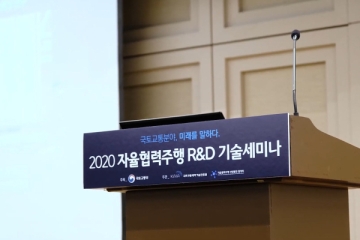
Seminar and briefing session held to promote R&D for autonomous driving SMEs.
The Ministry of Land, Infrastructure and Transport and the Autonomous Cooperative Driving Industry Development Council held a seminar and business meeting to support small and medium-sized enterprises in the autonomous driving sector at The K Hotel Seoul. The first part of the seminar shared information on various government support programs for autonomous cooperative driving, and the second part of the business meeting provided competitive small and medium-sized enterprises with new investment attraction opportunities.
2021.06.03by 이수민 기자
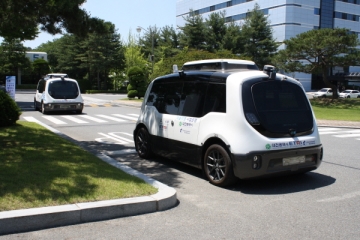
ETRI to Operate Driverless Autonomous Bus
The Electronics and Telecommunications Research Institute (ETRI) has developed unmanned autonomous driving technology applying Korea's highest-level artificial intelligence (AI) technology and is providing a pilot shuttle bus service circulating throughout the research institute.
2021.06.09by 강정규 기자
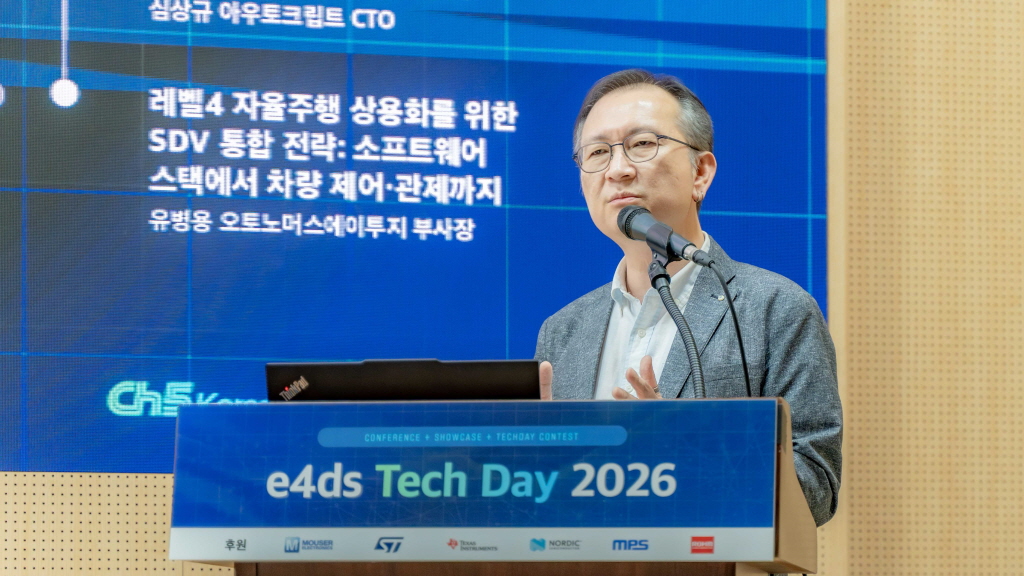
[e4ds Tech Day 2026 ⑨] Sim Sang-gyu, Autocrypt CTO: "In the Physical AI Era, Automotive Security Must Extend Beyond the Vehicle"
At e4ds Tech Day 2026, Sim Sang-gyu, CTO of Autocrypt, explained automotive cybersecurity strategies in the era of Physical AI and SDV (Software-Defined Vehicle). Automobiles are evolving as part of an ecosystem connected to AI, cloud, chargers, IoT, and robots, and he emphasized that the scope of security must expand beyond the vehicle interior to the entire connected environment. In particular, AI model tampering, adversarial attacks, OTA updates, and EV charger hacking were identified as major threats. He explained that response measures require zero trust, AI model integrity protection, intrusion detection, Security by Design and Default, and full lifecycle security management, and that proactive security system establishment beyond regulatory compliance is critical for securing future mobility competitiveness.
2026.10.12by 배종인 기자

Practical HIL Construction Strategy for Automotive and Off-Highway Controller Validation
As vehicle E/E architecture transitions to zonal structures and shifts to software-defined vehicles (SDV), the number of controllers (ECUs) requiring validation and software complexity are surging dramatically. Meanwhile, real vehicle testing cannot provide repeated verification under identical conditions and entails lead time and safety concerns. This white paper explains the principles of HIL (Hardware-in-the-Loop) validation and the structure of the NI platform composed of PXI, SLSC, and VeriStand, and through two actual implementation cases—Camera Record & Replay HIL for In-Cabin Monitoring Controller (ICMU) and Forklift Controller (VCU) HILS—describes how controller-level regression testing becomes possible. Additionally, it explicitly states application boundaries and limitations, such as lack of A2B support.
2026.10.12by 편집부











