


Korea Mechanical Engineering & Construction Co., Ltd. Develops Ultra-Low Temperature Cold Chain Core 'Sterling Refrigerator'
 Published2021.06.30 15:58
.jpg)
▲Korea Institute of Machinery and Materials, Energy Machinery Research Center Director Park Seong-je (right) and Senior Researcher Koh Jun-seok (left)
The Korea Institute of Machinery and Materials (President Sang-Jin Park, hereinafter referred to as KIMM) under the Ministry of Science and ICT has developed the Stirling refrigerator, a core technology of the ultra-low temperature cold chain, and has opened the door to new industries from bio to semiconductors through ultra-low temperature source technology.
The Korea Institute of Machinery and Materials announced on the 30th that the research team led by Director Park Seong-je of the Energy Machinery Research Center succeeded in developing a Stirling refrigerator for ultra-low temperature freezers using the Stirling cycle.
A Stirling refrigerator works on the principle that two pistons move and pump heat through repeated compression and expansion processes.
Ultra-low temperature refrigeration technology using the Stirling cycle is more than twice as energy efficient as existing vapor-compression refrigeration technology, allows for more precise temperature control, and reduces the volume of the device by more than half.
This technology can be used to more efficiently build an ultra-low temperature cold chain, which has recently been attracting attention as a technology for transporting COVID-19 vaccines.
Additionally, interest is being drawn to ultra-low temperature cooling technology, which will be in demand in the future due to the advancement of the semiconductor and display industries.
Comparison with conventional vapor-compression refrigeratorsUnlike other refrigerators that have multiple components such as a compressor, heat exchanger, expander, and oil separator connected by piping, the Stirling refrigerator can be miniaturized into a single unit, can be controlled for continuous operation, and has a much wider temperature control range.
In addition, it uses helium (He) as a refrigerant, not a refrigerant gas that has a negative impact on global warming. Helium is a gas with a GWP of 0, and is an absolutely eco-friendly refrigerant that surpasses low GWP refrigerants that are currently being actively considered for application in the refrigerator field.
The Energy Machinery Research Center of the Korea Institute of Machinery and Materials has been researching Stirling refrigeration technology for the past 20 years and has accumulated research capabilities that are unrivaled in Korea.
We have developed a small Stirling cryogenic refrigerator for infrared sensors using Stirling refrigeration technology, a Stirling engine for household combined heat and power generation, and a large Stirling cryogenic refrigerator for liquid nitrogen cooling.
This research result is even more meaningful in that it expands the application area of Stirling cooling technology from ultra-low temperatures to ultra-low temperatures, making it possible to explore the creation of new industries such as the bio industry and semiconductor industry.
Park Sung-jae, head of the Energy Machinery Research Center at the Korea Institute of Machinery and Materials, said, “The ultra-low temperature Stirling refrigerator will serve as a foundation for expanding the scope of Stirling refrigerators’ application and seeking to create new industries,” adding, “We will do our best in additional research and development, such as enlarging the cooling capacity for ultra-low temperature chillers for the bio industry as well as semiconductor production processes.”
This study was conducted with the support of the Ministry of Trade, Industry and Energy's Industrial Technology Innovation Project and Energy Technology Development Project.

Comments
Related news
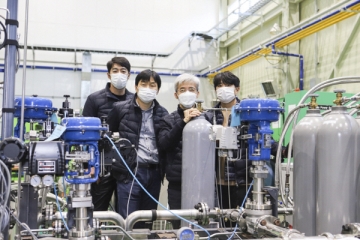
Korea Mechanical Engineering & Construction Co. develops Korea's first 'Neon' Brayton refrigeration system
The Korea Institute of Machinery and Materials (KIMM) has successfully developed Korea's first Brayton cryogenic refrigeration system using neon gas as the working fluid and demonstrated 2kW output at ultra-low temperatures of minus 200°C. With this successful development and demonstration of the ultra-low temperature refrigeration system, a foundation has been established for the localization of ultra-low temperature refrigeration systems, which currently rely entirely on foreign imports.
2020.12.18by 강정규 기자
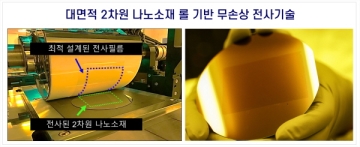
Korea Institute of Machinery and Materials (KIMM) is producing large, affordable transparent displays and semiconductors.
The Korea Institute of Machinery and Materials (KIMM, Director Park Sang-jin) under the Ministry of Science and ICT has developed "large-area 2D nanomaterial damage-free roll transfer technology" that enables the transfer of atomic layer-thick 2D nanomaterials at wafer scale without damage. This breakthrough improvement in the nanomaterial transfer process, which can be applied to various fields including transparent displays, transparent semiconductors, and displays for autonomous vehicles, is expected to accelerate technology commercialization.
2021.05.12by 배종인 기자
.jpg)
KIMM Localizes Large-Area Display Defect Inspection
The Korea Institute of Machinery and Materials (KIMM) under the Ministry of Science and ICT (Director Park Sang-jin) has successfully achieved localization of auto-focus equipment for laser processing machines, which had previously relied entirely on imports from abroad.
2021.06.03by 배종인 기자
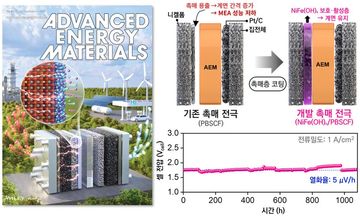
Materials Research Institute Develops Ultra-thin Coating Water Electrolysis Catalyst Technology
The Korea Institute of Materials Science has simultaneously resolved the performance and durability trade-off problem in water electrolysis catalysts by applying ultra-thin surface coating technology. Achieving 1.9 times higher performance compared to conventional catalysts while demonstrating 1,000-hour long-term stability, the institute has developed technology scalable to industrial water electrolysis systems through a simple process.
2026.10.07by 배종인 기자
Gigaphoton Develops Neon Gas Recycling System for ArF Excimer Lasers...Achieves 50% Recycling Rate
Gigaphoton announced that it has developed a gas recycling system for ArF excimer lasers and achieved a 50% neon gas recycling rate.
2026.10.02by 배종인 기자











