



ETRI leads research on machine learning-based frequency standards.
 Published2021.06.30 16:08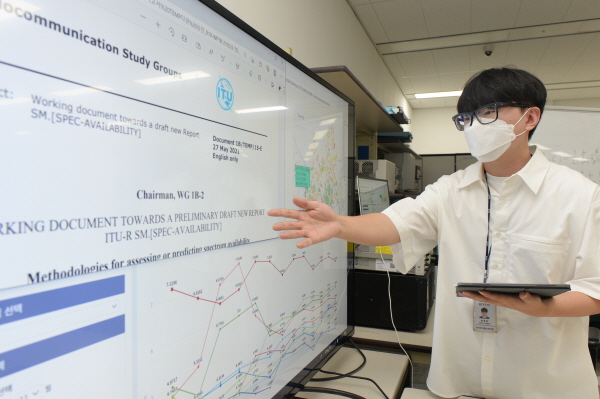
▲ETRI researcher Jong-Hoon Yoon explains a machine learning-based spectrum availability prediction method.
A domestic research team has developed a method for analyzing and predicting frequency usage based on machine learning, which is expected to become an international standard.
The Electronics and Telecommunications Research Institute (ETRI) announced on the 30th that the 'Machine Learning-Based Spectrum Availability Prediction Method' developed by ETRI was adopted as a draft working document for a new report at the 'International Telecommunication Union Radiocommunication Sector Spectrum Management Study Group (ITU-R SG1) Meeting' held for two weeks from the 25th of last month.
'Spectrum availability' is an indicator of the extent to which radio communication services can be used in a specific frequency band.
Accurate analysis of spectrum availability is essential to understanding frequency usage and saturation.
This allows for efficient management of radio resources, such as reclaiming and reallocating unused frequencies.
Until now, spectrum availability has been analyzed through simplified mathematical models, making it difficult to analyze complex radio environments.
In addition, there is no standard document that organizes analysis methods according to various frequency types and usage patterns, so there is no guideline to refer to. It was a situation.
ETRI has systematically organized methods for analyzing spectrum availability by frequency type and usage pattern.
Furthermore, we proposed a methodology for evaluating and predicting spectrum availability using machine learning, reflecting the complex radio environment centered on the most frequently used mobile communication frequencies.
The research team also evaluated and predicted the actual availability of LTE frequency spectrum in Korea using this method.
Based on actual traffic data, the supply-demand balance of LTE frequencies is evaluated and future usage rates are predicted.
This analysis is significant because it is the first of its kind in the world.
Based on this data and methodology, each country will be able to analyze frequencies and efficiently manage radio resources, significantly enhancing the status of ETRI and the Republic of Korea's international standardization activities.
The research team had already proposed a research project related to this working document at the 2019 ITU-R SG1 meeting and received approval as a new SG1 research project through the UN member state circulation process.
This achievement is a culmination of ETRI's leading role throughout the standardization process.
ETRI Radio Resources Research Lab Director Park Seung-geun, who led the standardization effort, said, “Based on the data and machine learning-based spectrum availability assessment and prediction method developed this time, we will continue to strive to secure leadership in next-generation mobile communication frequency research.”
Going forward, the research team plans to actively participate in international standardization work related to radio waves and information and communications, while continuing to research analysis methodologies suited to Korea's radio environment to support the establishment of effective national radio resource management policies.

Comments
Related news
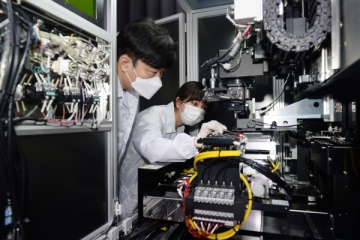
ETRI develops processes and materials that address challenges in micro LED production.
The Micro LED market is projected to grow at a compound annual growth rate of 65% through 2027, reaching a market size of 71 billion dollars. However, high manufacturing difficulty has been a bottleneck to widespread adoption. In response, ETRI announced that it has resolved key challenges in Micro LED display technology by independently developing novel manufacturing processes and new materials.
2021.05.25by 이수민 기자
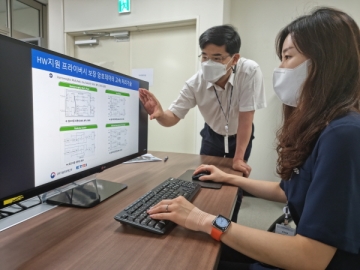
ETRI Opens Era of Secure Data Encryption and Convergence Service Access
The Electronics and Telecommunications Research Institute (ETRI) has developed fully homomorphic encryption (FHE) hardware accelerator technology that enables privacy protection while data remains encrypted and can be applied to machine learning and other applications. This development is expected to open pathways for applying security-sensitive data directly to various converged services in their encrypted state.
2021.06.16by 배종인 기자
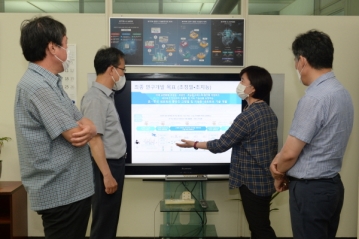
ETRI Selected as Lead Institution for 6G Core Technology Development Project
The Electronics and Telecommunications Research Institute (ETRI) has been selected as the lead organization for the '6G Core Technology Development Project,' which involves 37 collaborative research institutions including mobile communication service operators, Samsung Electronics, and KAIST. The research team has divided the 6G research project into five major focus areas, with institutions collectively undertaking eight strategic tasks across each field.
2021.06.24by 배종인 기자

[e4ds Tech Day 2026 ⑨] Sim Sang-gyu, Autocrypt CTO: "In the Physical AI Era, Automotive Security Must Extend Beyond the Vehicle"
At e4ds Tech Day 2026, Sim Sang-gyu, CTO of Autocrypt, explained automotive cybersecurity strategies in the era of Physical AI and SDV (Software-Defined Vehicle). Automobiles are evolving as part of an ecosystem connected to AI, cloud, chargers, IoT, and robots, and he emphasized that the scope of security must expand beyond the vehicle interior to the entire connected environment. In particular, AI model tampering, adversarial attacks, OTA updates, and EV charger hacking were identified as major threats. He explained that response measures require zero trust, AI model integrity protection, intrusion detection, Security by Design and Default, and full lifecycle security management, and that proactive security system establishment beyond regulatory compliance is critical for securing future mobility competitiveness.
2026.10.12by 배종인 기자
NVIDIA to Invest $1 Billion in U.S. Science Over Next Five Years
NVIDIA has announced plans to invest $1 billion over the next five years to strengthen U.S. scientific and technological competitiveness. The company will enhance cutting-edge artificial intelligence research and development capabilities in key areas including quantum computing, healthcare, and energy security, while expanding support for higher education research institutions and cloud service providers. NVIDIA is participating as a major industry partner in the White House Office of Science and Technology Policy's Genesis Mission, and is promoting supercomputer construction in collaboration with national laboratories including Argonne and Los Alamos.
2026.10.12by 배종인 기자











