


K-semiconductor: Tax, financial, and regulatory support begins in earnest.
 Published2021.07.01 14:51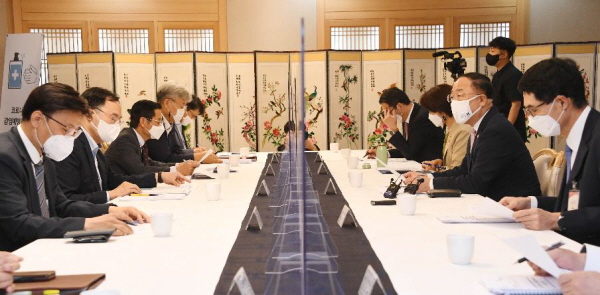
▲A view of the 12th Innovation Growth BIG3 Promotion Meeting.
As a follow-up measure to the K-Semiconductor Strategy, the government is strengthening infrastructure support, including tax deductions, financial assistance, and deregulation, and is moving to establish a foundation for semiconductor growth.
The government held the 12th Innovation Growth BIG3 Promotion Meeting on the 1st and reviewed the progress of follow-up measures and future plans for the 'K-Semiconductor Strategy' jointly announced by relevant ministries on May 13th.
The "K-Semiconductor Strategy" that has been implemented so far has already produced early results in areas such as deregulation and human resource development, and is expected to produce significant results in various areas, including tax support, institutional improvements, and private investment, starting in the second half of 2021.
First, the Ministry of Trade, Industry and Energy and other relevant ministries are smoothly implementing follow-up tasks, including tax and financial support and deregulation, to expand the domestic semiconductor supply infrastructure.
We plan to significantly expand the deduction rate for R&D and facility investments by selecting core semiconductor technologies as national strategic technologies. We are currently discussing the selection of national strategic technologies, focusing on key sectors such as memory, systems, and small and medium-sized equipment.
In the future, the Ministry of Strategy and Finance will announce the National Strategic Technology (draft) through a tax law amendment and the amendment to the 'Tax Special Exceptions and Restrictions Act'It is scheduled to be submitted to the regular National Assembly session in September.
The financial support program (KRW 1 trillion + α) for small and medium-sized enterprises, including semiconductor companies, was established on June 8 and is currently providing financial support to foundries, small and medium-sized enterprises, and packaging companies with investment needs.
Since June 17, we have been exempting from change permits when replacing radio application equipment, and we have formed a dedicated fast-track team for permits and licenses for chemical handling facilities to actively respond to companies' permit and license needs.
In addition, the government plans to initiate the revision process of related laws and notices by the end of the year to ease follow-up regulations, such as △easing the standards for exemption from inspection of imported containers and △granting full approval after inspection of representative facilities for multiple similar chemical substances.
In order to promptly build and operate semiconductor industrial complexes in Yongin and Pyeongtaek, preliminary consulting for river use permits is in progress (Yongin), and measures to preemptively secure the necessary water supply by the end of the year (Yongin and Pyeongtaek) are being reviewed.
Foreign investment in securing a domestic supply chain for advanced equipment is currently underway, including securing a site for an EUV cluster and designing a production line for the construction of advanced equipment manufacturing facilities.
In addition, the public and private sectors are working together to build a foundation for fostering semiconductor talent and expanding technological development.
Samsung Electronics and KAIST have agreed to establish a new semiconductor contract department, and a large-scale public-private joint investment human resource development project is being planned to expand its scale (KRW 300 billion → KRW 350 billion) based on active participation from the private sector.
The 2022 budget is currently being reflected for the PIM and sensor technology development projects, for which a preliminary feasibility study was submitted in the fourth quarter of 2020, and non-preliminary R&D projects in various fields, such as next-generation power semiconductors and artificial intelligence semiconductors, are also being prepared.
Lastly, semiconductors, etc. (In order to foster key national strategic industries, we are preparing to enact the ‘(tentative name) Special Act on Strengthening and Protecting the Competitiveness of Key National Strategic Industries.’
We plan to prepare a draft of the ‘(tentative name) National Core Strategic Industry Special Act’ in conjunction with the main contents to be reflected in the ‘Semiconductor Special Act’ in the future and discuss it with relevant ministries and the National Assembly.
Minister of Trade, Industry and Energy Moon Seung-wook said, “Since the announcement of the ‘K-Semiconductor Strategy’ on May 13, most follow-up tasks have been progressing without a hitch thanks to active efforts by the public and private sectors.” He added, “In particular, it is time to expand support in the areas of taxation and finance so that the semiconductor manufacturing infrastructure that major countries have been competitively supporting can be built or expanded domestically first.” He added, “I ask for the active interest and effort of relevant ministries and the private sector so that we can lay the foundation for mid- to long-term growth of the domestic semiconductor industry through the ‘K-Semiconductor Strategy’ to realize a comprehensive semiconductor powerhouse.”

Comments
Related news
Deputy Prime Minister Hong Nam-ki: "280 billion won in new investment in system semiconductors this year."
The government will actively support the cultivation of system semiconductors through fiscal, tax, financial, and regulatory measures, including an injection of 280 billion won in new funding for system semiconductors this year.
2021.05.06by 배종인 기자
510 trillion won investment in K-semiconductors by 2030
The government will complete the world's largest and most cutting-edge semiconductor supply chain through overwhelming private sector investment of over 510 trillion won by 2030 to realize comprehensive semiconductor superpower status.
2021.05.14by 배종인 기자
Carbon Neutrality in Semiconductors and Displays Requires Solidarity and Cooperation among Device and Material Parts Manufacturers
The semiconductor and display industries reviewed the implementation status of their joint carbon neutrality declaration. At this meeting, executives from semiconductor and display-related companies emphasized that strengthening solidarity and cooperation among device manufacturers and small and medium-sized parts and materials suppliers to activate the industrial ecosystem is more important than anything else for achieving carbon neutrality.
2021.06.29by 배종인 기자

Intel Unveils Next-Generation 'Core Ultra Series 3' and vPro Platform for Enterprise PCs
Intel has officially unveiled the "Intel Core Ultra Series 3" for next-generation enterprise PCs and the latest vPro platform, addressing a wide range of demands from enterprise notebooks to high-performance workstations.
2026.03.26by 배종인 기자

ROHM Launches ESD Protection Diode Compatible with High-Speed Interfaces of 10Gbps or Higher
Semiconductor specialist ROHM has developed the 'RESDxVx series' of ESD (electrostatic discharge) protection diodes capable of responding to next-generation high-speed data communication environments exceeding 10Gbps, simultaneously enhancing both signal quality maintenance required in high-speed interfaces and IC protection performance.
2026.03.26by 배종인 기자











