



Exports hit record highs in 2021, with vehicles and appliances leading the way.
 Published2021.07.05 10:00
Automotive and parts, home appliances, and wireless devices are leading the upward trend.
Economic recovery driven by vaccinations, delta variant a variable
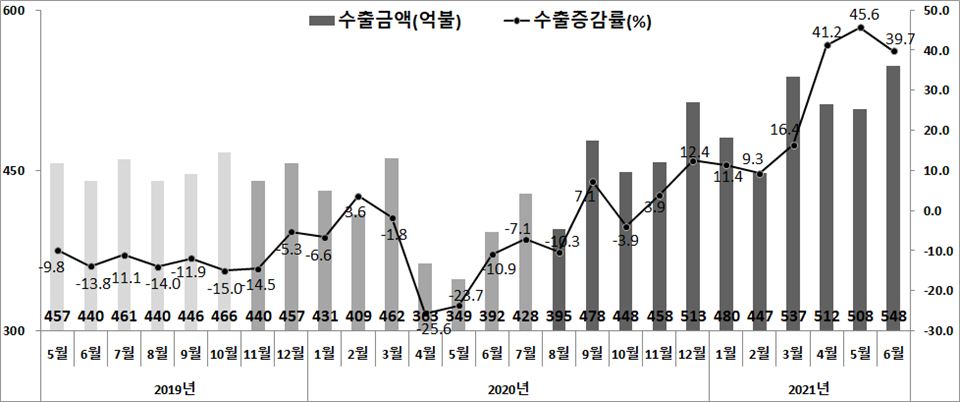
According to the Ministry of Trade, Industry and Energy, exports in the first half of the year reached $303.24 billion, a 26.1% increase from the same period last year. This increase is attributed to improving trade conditions, including the strengthening economic recovery in major trading partners, increased demand for IT and new industries, and rising international oil prices.
Last April, the International Monetary Fund (IMF) raised its global economic growth forecast for this year from 5.5% to 6.0%, and the World Trade Organization (WTO) also raised its trade growth forecast from 7.2% to 8.0%.
According to the WTO, global trade is indeed recovering, with cumulative exports from January to April for all 20 major exporting countries increasing. Following this trend, our exports to all nine regions have increased for three consecutive months, the first time since March to May 2011.
Imports in the first half of the year amounted to $285.11 billion, up 24.0% from last year. Due to the rise in production facility utilization rates following the domestic economic recovery and the improvement in investment/consumption sentiment, imports of primary products (+25.8%), intermediate goods (+22.8%), capital goods (+29.4%), and consumer goods (+21.8%) grew evenly.
Trade increased by 25.1% compared to the same period last year, reaching $588.35 billion, and the trade balance reached $18.12 billion, continuing a surplus for the 13th consecutive year. The volume also increased by $7.49 billion compared to the previous year.
◇ Best first half of export history
This year, exports for every month have been the first or second highest on record. Notably, the past four months have simultaneously achieved monthly exports exceeding $50 billion and the highest monthly exports ever. This continued momentum has surpassed the annual record set in the first half of 2018, with exports exceeding $300 billion for the first half of the year for the first time ever.
The export growth rate (+26.1%) in the first half of this year was the highest in 11 years, since the first half of 2010 (+34.3%). Compared to previous trade crises, such as the IT bubble (2001), the subprime mortgage crisis (2008), and low oil prices (2015), this was the fastest recovery and the largest rebound, significantly exceeding the base effect. This marks the first positive quarter since the second quarter of last year, when COVID-19 had a significant impact on exports.
Of the 15 items, 13, excluding machinery and computers, showed double-digit growth, and 7 (automobiles, auto parts, home appliances, steel, displays, secondary batteries, and textiles) showed a steady upward trend, recording the highest growth rate in the first half of the year in 10 years. Even in terms of absolute size, excluding base effects, both traditional key industries and new industries achieved record-breaking first-half export volumes.
The three major items, semiconductors, general machinery, and petrochemicals, entered the top three in the first half of the year, and new industries, such as bio/health and secondary batteries, also ranked first in the first half of the year.
Regionally, exports increased in eight markets (China, the US, the EU, ASEAN, Japan, Central and South America, India, and the CIS), excluding the Middle East. Exports to China, the US, the EU, and ASEAN recorded the first and second highest figures ever recorded in the first half of the year. Semiconductors drove the growth in China, the US, and ASEAN, while automobiles drove the growth in the EU.
◇ Competitiveness and qualitative growth in export items
In the first half of the year, existing core products such as semiconductors, automobiles, displays, and ships saw qualitative improvements as the proportion of high-value-added products increased. In particular, system semiconductors, eco-friendly vehicles, and OLEDs all achieved record-breaking annual exports last year, and in the first half of this year, exports surpassed the previous first-half figures by 20%, achieving all-time first-half record highs.
In the first half of last year, only two out of 15 major items, computers and bio/health, saw an increase. Even in 2018, which recorded the second-highest first-half exports ever, only eight items saw an increase. However, in the first half of this year, all 15 major items saw an increase. In 2018, semiconductors led the export growth, accounting for 57% of the year-on-year export increase due to the memory super cycle.
◇ Detailed trends in major products such as vehicles, home appliances, and wireless devices
Automobiles , including passenger cars, trucks, and special-purpose vehicles, saw a 49.9% increase in exports in the first half of the year, as the proportion of high-priced eco-friendly cars and SUVs increased despite risks in the automotive semiconductor supply chain, and strategic models from Western countries received positive local responses.
Auto parts , including radiators, batteries, clutches, gear levers, and exhaust pipes, saw a 43.6% increase in exports to regions where our companies have advanced, such as the U.S. and the EU, as consumer sentiment recovered due to economic stimulus measures in major countries and local factory operating rates returned to normal levels.
In the case of home appliances including TVs, speakers, refrigerators, washing machines, air conditioners, and lighting equipment, as time spent at home increased due to restrictions on outdoor activities, alternative consumption expanded, and our company's premium brands received attention, and exports to major markets such as the US, EU, and ASEAN all achieved double-digit growth, with exports increasing by 38.1% in the first half of the year.
In the case of wireless communication devices , including mobile phones, satellite broadcasting receivers, radars, remote controls, antennas, and mobile phone parts, exports increased by 29.4% as demand for smartphone replacement recovered due to improved consumer sentiment in major countries, and our company's low- and mid-priced product lines expanded their market share, and exports of parts to regions such as China also increased significantly.
For displays , including LCD, OLED, and PDP, performance improved despite the reduction in LCD production, as LCD prices rose along with demand for non-face-to-face IT products. Additionally, exports increased by 25.5% as the proportion of high value-added products such as low-power (LPTO) displays expanded amid robust demand for OLEDs for mobile devices.
Secondary batteries, including lithium-ion batteries and lead-acid batteries , are continuing to grow in line with the global eco-friendly car market, with demand for batteries for electric vehicles. As the US expands its eco-friendly policies, exports to the US have more than tripled in size, increasing exports by 24.1%.
Semiconductors , including integrated circuits, discrete components, and silicon wafers, saw increased demand for mobile semiconductors driven by the expansion of 5G smartphones. The adoption of a contactless approach also boosted demand for memory for PCs, including laptops. Furthermore, foundry orders also increased, driving semiconductor exports in the first half of the year to surpass $50 billion, growing 21.9%.
For computers , including SSDs, laptops, desktops, monitors, printers, scanners, and motherboards, demand for enterprise SSDs for data centers has slowed slightly this year, but with the spread of the non-face-to-face economy, new demand for laptops, gaming consoles, etc. has expanded, and despite the high base from last year's significant growth, exports continued to increase by 6.0%.
◇ In the second half of the year, the spread of the delta variant is a variable.
The economic recovery in the first half of the year was driven by a decline in confirmed cases due to expanded vaccinations. However, just two months after the World Health Organization (WHO) warned of the presence of the COVID-19 delta variant in late April, infections spread to 100 countries. The virus is spreading mainly in Turkey and Indonesia, which have been heavily vaccinated with the Chinese Sinopharm vaccine, which is vulnerable to the delta variant, and in the Midwest, which has the lowest vaccination rate in the United States. Taiwan and Vietnam are also struggling.
The transmissibility of the delta variant is known to be 2.7 times stronger than that of the original COVID-19, and an even stronger delta plus variant has also been reported, so caution is needed.
Minister of Trade, Industry and Energy Moon Seung-wook stated, “Threats such as logistics difficulties, disruptions in parts supply, and rising raw material prices persist,” and added, “We will spare no effort in supporting export companies so that exports in 2021 can break the annual record for exports.”
Comments
Related news

Semiconductor, automobile, and secondary battery exports expected to remain robust until next year.
With export performance reaching an all-time high this year, secondary batteries, automobiles, semiconductors, shipbuilding, and automotive parts are projected to maintain favorable export trends through next year, while computers, petrochemicals, displays, bio-health, and home appliances may see their export momentum slow in the second half of this year.
2021.06.09by 명세환 기자

May ICT Exports Reach $17.7 Billion… Second Highest Ever for May Exports
May ICT exports reached $17.73 billion, recording a 27.4% increase compared to the same period last year, achieving the second-highest May export figure on record, driven by strong export performance in semiconductors, displays, and mobile phones.
2021.06.14by 배종인 기자
Hydrogen fluoride imports from Japan account for 1/6th of total imports... Small and medium-sized businesses' reliance on Japan drops to 0.9%.
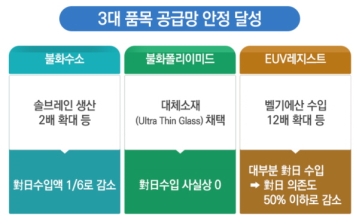
The import value of hydrogen fluoride, which was subject to Japan's export restrictions, has declined to one-sixth of previous levels, and since Japan's export control measures were implemented in July 2019, the rate of decrease in dependence on Japan for ten key strategic materials has accelerated threefold. Additionally, sales of Korean materials, parts, and equipment companies have grown approximately 20.1%, indicating that growth is becoming tangible.
2021.07.01by 배종인 기자

ESP32 Development Environment Selection and GPS Application Implementation
The ESP32 is a microcontroller that integrates Wi-Fi, Bluetooth, 12-bit ADC, capacitive touch, PWM, DAC, and UART in a single SoC. However, the abundance of features does not by itself solve the designer's problems. The real challenges lie in selecting the appropriate development environment, determining which pins can be used and which must be avoided, and converting raw data from modules into usable information. This document addresses ESP32 peripheral constraints (ADC2 and Wi-Fi coexistence limitation, UART1 occupancy, ADC non-linear regions), the trade-offs between Arduino IDE and ESP-IDF, and the process from connecting NEO-6M/NEO-M8N GPS modules to UART2, parsing NMEA sentences, and visualizing routes in Google Earth, all organized based on documented references.
2026.10.12by 편집부

[e4ds Tech Day 2026 ⑨] Sim Sang-gyu, Autocrypt CTO: "In the Physical AI Era, Automotive Security Must Extend Beyond the Vehicle"
At e4ds Tech Day 2026, Sim Sang-gyu, CTO of Autocrypt, explained automotive cybersecurity strategies in the era of Physical AI and SDV (Software-Defined Vehicle). Automobiles are evolving as part of an ecosystem connected to AI, cloud, chargers, IoT, and robots, and he emphasized that the scope of security must expand beyond the vehicle interior to the entire connected environment. In particular, AI model tampering, adversarial attacks, OTA updates, and EV charger hacking were identified as major threats. He explained that response measures require zero trust, AI model integrity protection, intrusion detection, Security by Design and Default, and full lifecycle security management, and that proactive security system establishment beyond regulatory compliance is critical for securing future mobility competitiveness.
2026.10.12by 배종인 기자











