


Xilinx Introduces 'Versal HBM ACAP' Integrated with HBM2E DRAM
 Published2021.07.15 10:20
Implemented Based on Proven 7nm Versal Devices
Sample Shipments Scheduled for First Half of Next Year, Tools Available in Second Half of This Year
Real-time, high-performance applications experience bottlenecks due to memory bandwidth and can operate at the boundary of power and thermal limits. In response, Xilinx announced on the 15th the launch of the latest series of its Versal portfolio, the Versal™ HBM Adaptive Compute Acceleration Platform (ACAP).
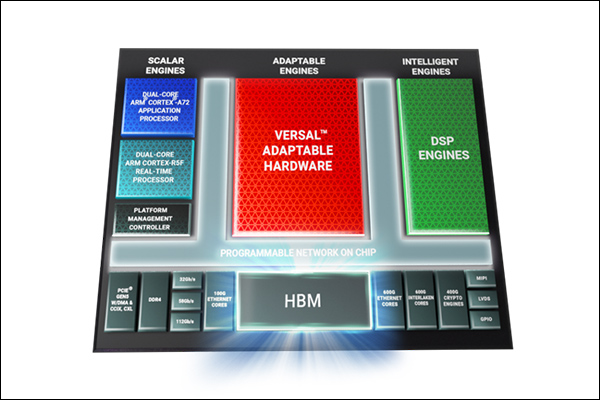
The Versal HBM ACAP integrates HBM2E DRAM offering throughput of 820GB/s and capacity of 32GB, delivering 8x memory bandwidth compared to DDR5 adoption and 63% lower power consumption. The Versal HBM series eliminates memory bottlenecks, enabling data center and network operators to deliver solutions with significantly higher performance while reducing system power consumption, latency, form factor, and total cost of ownership.
Versal HBM devices, implemented based on the Versal Premium series, integrate power-optimized networking cores for high bandwidth and secure connectivity. The Versal HBM series provides 5.6Tb/s serial bandwidth based on 112Gb/s PAM4 transceivers, scalable Ethernet bandwidth of 2.4Tb/s, encryption throughput at 1.2Tb/s line rate, 600Gb/s Interlaken connectivity, and PCIe® Gen5 bandwidth of 1.5Tb/s with embedded DMA supporting both CCIX and CXL.
As an adaptive and heterogeneous platform, the Versal HBM series integrates adaptive engines for low-latency hardware parallel processing, DSP engines for AI inference and signal processing, and scalar engines for embedded computing, platform management, secure boot, and configuration, designed to accelerate a wide range of workloads based on large datasets. Unlike fixed-function accelerators, hardware can be dynamically reconfigured within milliseconds to evolving algorithms and new protocols, eliminating the need for hardware redesign and reconstruction.
Additionally, it delivers high performance and power efficiency for big data workloads including fraud detection, recommendation engines, database acceleration, data analytics, financial modeling, and deep learning inference for natural language processing (NLP). With significantly higher runtime than the latest server-grade CPUs and support for datasets 4x larger, users can build applications with large-scale connected datasets using fewer, lower-cost servers.
It also provides network scalability and performance for 800G routers, switches, and security appliances. Existing 800G next-generation firewalls implemented with NPUs (Network Processing Units) required multiple NPU devices and DDR modules. A single Versal HBM ACAP eliminates external memory and performs packet processing, security processing, and adaptive AI-infused anomaly detection capabilities in a low-power, compact form factor.
Xilinx stated that the Versal HBM ACAP enables customers to implement applications using fewer devices and systems, allowing cloud and network providers to significantly reduce capital expenditures (CapEx) and operating expenses (OpEx).
The Versal HBM ACAP, accessible to both hardware and software developers, is supported by the Vivado® Design Suite for hardware developers, the Vitis™ integrated software platform for software developers, domain-specific frameworks and acceleration libraries, and Vitis AI for data scientists.
The Versal HBM series is implemented based on 7nm Versal devices with completed production validation. Developers can begin prototyping with Versal Premium series devices and evaluation boards and easily migrate to the Versal HBM series. The Versal HBM series is scheduled to begin sample shipments in the first half of 2022. Documentation is currently available, and tools will be accessible through an early access program in the second half of 2021.
Comments
Related news
.jpg)
SK Hynix Begins Mass Production of Next-Generation Memory "HBM2E"
SK Hynix has begun full-scale mass production of HBM2E. This is faster than Samsung Electronics, which announced mass production within this year, as SK Hynix achieved mass production just 10 months after developing HBM2E in August last year. SK Hynix's HBM2E is a product capable of processing 3.6 gigabits of data per second, and can handle 460 gigabytes of data per second through 1,024 I/O ports.
2020.07.03by 강정규 기자
Samsung Electronics Develops Package Technology to "Integrate 4 HBMs into Logic"
Samsung Electronics has developed 'I-Cube4', a 2.5D packaging technology that integrates logic and four HBM units into a single package. The technology is expected to be utilized primarily in HPC, AI/cloud services, and data centers that require high-bandwidth data transmission and high-performance system semiconductors.
2021.05.06by 이수민 기자
.jpg)
Xilinx Announces Vivado FPGA EDA Tool, Powered by Machine Learning
Today's EDA designers are facing challenges with increasing design complexity. In response, Xilinx has launched "Vivado ML Edition," an FPGA EDA tool that reduces design time and cost based on machine learning (ML) optimization algorithms and team-based design flow. Compared to the existing "Vivado HLx Edition," it guarantees 5x faster compilation time on complex designs and average result quality improvements of 10%.
2021.06.25by 이수민 기자

Intel Unveils Next-Generation 'Core Ultra Series 3' and vPro Platform for Enterprise PCs
Intel has officially unveiled the "Intel Core Ultra Series 3" for next-generation enterprise PCs and the latest vPro platform, addressing a wide range of demands from enterprise notebooks to high-performance workstations.
2026.03.26by 배종인 기자

ROHM Launches ESD Protection Diode Compatible with High-Speed Interfaces of 10Gbps or Higher
Semiconductor specialist ROHM has developed the 'RESDxVx series' of ESD (electrostatic discharge) protection diodes capable of responding to next-generation high-speed data communication environments exceeding 10Gbps, simultaneously enhancing both signal quality maintenance required in high-speed interfaces and IC protection performance.
2026.03.26by 배종인 기자











