



Korea Institute of Machinery and Materials (KIMM) excels in AI safety diagnosis
 Published2021.07.19 16:54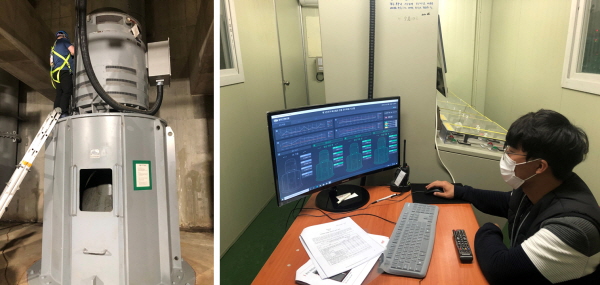
▲(Left) AI-based predictive diagnostic equipment is being attached to a Navy drainage pump. (Right) Status is being monitored based on data obtained using AI-based predictive diagnostic equipment at the Navy maintenance depot.
The Korea Institute of Machinery and Materials (KIMM) is actively utilizing IoT (Internet of Things), big data, and AI-based failure prediction technology to monitor the condition of facilities and structures in various fields, including defense, public service, and industry, and to diagnose and prevent failures in advance.
The Korea Institute of Machinery and Materials (KIMM) recently announced that its System Dynamics Lab's Senior Researcher Seon Kyung-ho has developed AI-based Prognostics and Health Management (PHM) technology, and is taking the lead in commercializing it to make our lives safer by applying it widely in fields ranging from national defense to industry and public safety.
The health management and prediction technology (PHM) developed by the Korea Institute of Machinery and Materials is a technology that monitors the condition of facilities and structures and diagnoses and prevents failures in advance based on the Internet of Things (IoT), big data, and AI.
PHM technology utilizing AI is a technology that can detect and prevent equipment failures in advance by analyzing and learning vibration signals generated in pump and motor systems, which are representative high-consumption equipment. Analyzing the vibration signals generated when a machine is in operation can quickly identify signs of equipment failure.
Moreover, when combined with AI and deep learning technologies, it is possible to accurately and quickly identify faulty parts in complex machines.
Looking at the major achievements, first of all, we supported the rapid combat readiness of our military.
A South Korean Navy vessel arrives at a dry dock for maintenance and drains seawater from the dry dock for onshore maintenance. When unusual vibrations are detected in the drainage pump, AI-based predictive diagnostic technology detects this with sensors and issues an early warning. This allows for efficient management to prevent maintenance delays that could result from breakdowns and to quickly prepare for combat. In April, the Korea Institute of Machinery and Materials (KIMM) supplied software for condition monitoring and diagnosis to four 700kW drainage pumps currently in operation at the maintenance depot of the Republic of Korea Navy's Logistics Command.
Additionally, a stable tap water supply environment was created.
Water pumps, a core component of water purification and sewage treatment plants, are mechanical devices that circulate and supply water. AI-based predictive diagnostic technology identifies abnormal vibrations in water pumps as signs of malfunction and detects them early. This prevents accidents such as supply disruptions in advance, ensuring a stable water supply and sewage treatment. In June, the Korea Institute of Machinery and Materials (KIMM) transferred its "AI-based condition monitoring and predictive diagnostic technology" to AT&T, a facility diagnostics company, and agreed to support its application in water purification and sewage treatment plants and various industrial sites. Applying AI-based predictive diagnostic technology to smarter domestic water facilities is expected to lead to more efficient water management.
It also contributed to ensuring clean subway station air quality.
Air conditioning equipment is a mechanical device responsible for circulating and purifying air within a subway station, and is considered the core of subway station equipment. A malfunction in the motor driving the air conditioner can deteriorate air quality within the station, posing a threat to the health of residents. The Korea Institute of Machinery and Materials (KIMM) installed IoT sensors to measure vibration and current in the motors. The collected big data was then used by AI to develop autonomous diagnostic technology. In February, the KIMM collaborated with Daejeon Metropolitan City and Daejeon Metropolitan Rapid Transit Corporation to apply this AI-based diagnostic technology to Daejeon Station, City Hall Station, and Gapcheon Station on the Daejeon Subway.
Seon Kyung-ho, a senior researcher at the Korea Institute of Machinery and Materials, said, “We expect that the combination of big data and AI technology from numerous mechanical facilities will enable faster, more accurate, and more effective safety diagnosis.” He added, “We will strive to ensure that this technology spreads to actual sites as soon as possible so that we can live a safe life free from the recent spate of accidents involving buildings and plants.”
This research was conducted as part of the basic research project, "Artificial Intelligence-Based Machine System Prediction Diagnosis and Accident Response Technology," supported by the Ministry of Science and ICT.

Comments
Related news
KIMM Takes the Lead in Developing Human-Robot Coexistence Technology
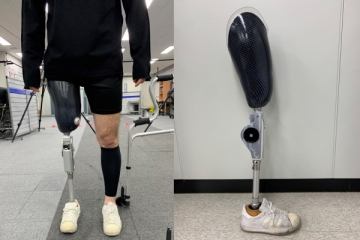
The Korea Institute of Machinery and Materials is leading the development of warm robot technology for a future where humans and robots coexist together, through the establishment of the Innovation Robot Center (Director Park Chan-hoon) for developing next-generation robot technology, along with the latest research achievements including robotic prosthetic limbs and prosthetic arms, wearable robots in clothing form, humanoid hands and universal grippers, and autonomous unmanned tractors.
2021.06.16by 배종인 기자
Korea Institute of Machinery and Materials (KIMM) continues global collaboration through foreign researchers.
The Korea Institute of Machinery and Materials (KIMM), under the Ministry of Science and ICT, headed by President Park Sang-jin, has selected six foreign researchers from the institute as KIMM Ambassadors and is revitalizing global research cooperation that had been constrained by the COVID-19 pandemic.
2021.06.21by 배종인 기자
.jpg)
Korea Mechanical Engineering & Construction Co., Ltd. Develops Ultra-Low Temperature Cold Chain Core 'Sterling Refrigerator'
The Korea Institute of Machinery and Materials (KIMM) under the Ministry of Science and ICT, led by President Park Sang-jin, has developed a Stirling cryogenic refrigerator, a core technology for ultra-low-temperature cold chains, and opened the door to new industries from biotechnology to semiconductors through ultra-low-temperature source technology.
2021.06.30by 배종인 기자

[e4ds Tech Day 2026 ⑨] Sim Sang-gyu, Autocrypt CTO: "In the Physical AI Era, Automotive Security Must Extend Beyond the Vehicle"
At e4ds Tech Day 2026, Sim Sang-gyu, CTO of Autocrypt, explained automotive cybersecurity strategies in the era of Physical AI and SDV (Software-Defined Vehicle). Automobiles are evolving as part of an ecosystem connected to AI, cloud, chargers, IoT, and robots, and he emphasized that the scope of security must expand beyond the vehicle interior to the entire connected environment. In particular, AI model tampering, adversarial attacks, OTA updates, and EV charger hacking were identified as major threats. He explained that response measures require zero trust, AI model integrity protection, intrusion detection, Security by Design and Default, and full lifecycle security management, and that proactive security system establishment beyond regulatory compliance is critical for securing future mobility competitiveness.
2026.10.12by 배종인 기자

NVIDIA to Invest $1 Billion in U.S. Science Over Next Five Years
NVIDIA has announced plans to invest $1 billion over the next five years to strengthen U.S. scientific and technological competitiveness. The company will enhance cutting-edge artificial intelligence research and development capabilities in key areas including quantum computing, healthcare, and energy security, while expanding support for higher education research institutions and cloud service providers. NVIDIA is participating as a major industry partner in the White House Office of Science and Technology Policy's Genesis Mission, and is promoting supercomputer construction in collaboration with national laboratories including Argonne and Los Alamos.
2026.10.12by 배종인 기자











