



Smart Homes Evolve into 'Service Platforms'... Revenue Models Expand
 Published2021.07.20 14:48
e4ds news will host a special webinar on 'Smart Home Industry Outlook' on July 27. In this webinar, Kim Min-young, a senior researcher at LG Economic Research Institute, will give a presentation on the topic of "Smart Home Industry Outlook: Customer Value Beyond Connectivity," while Lee Su-min, a reporter for this publication, will provide commentary on the smart home industry outlook.
Generally, smart homes have been perceived as remote control and home automation through the connection of products, and in fact, various businesses have been working to implement connectivity over the past 10 years.
Thanks to such efforts, the basic costs for implementing IoT technologies, such as smart devices, sensors, integrated chips, and network servers, have rapidly decreased, and many objects have been automatically connected to the platform.
Looking at the current state of the market, the smart home market is growing at an average annual rate of 11%, and interest in smart homes has increased further since COVID-19, with 51% of consumers purchasing one or more smart devices during the pandemic.
On the other hand, it is questionable whether customers purchased smart products because they truly wanted them.
Most manufacturers come with them pre-installed, so the percentage of people who purchase smart appliances without knowing they are smart reaches 50%, and in the case of smart speakers, more than 80% use them only for listening to music.
This is because businesses approached smart homes as an upselling tool and expanded them by incorporating smart features.
In particular, current smart home devices are showing limitations in platform revenue models in addition to the connectivity feature.
Accordingly, leading smart home companies are focusing on qualitative rather than quantitative improvements within connectivity, and are strengthening third-party support to enable customers to use it easily and intuitively.
While existing products were centered on connectivity, we have entered an era where integration with external services, for which customers are increasingly willing to pay, has become crucial.
Smart home leaders such as Amazon, Google, LG, and Samsung It is connecting killer services such as shopping and content to smart homes and expanding into new services such as security and healthcare.
In the future, products and services in wellness, healthcare, beauty/fashion, home testing, entertainment, food/cooking, energy, security, and cleaning will be combined, and it is expected to evolve into a platform that provides end-to-end solutions for each.
Accordingly, an environment is being created where each device is advanced into a computer, and it is expected that this will transition into a computer system where the entire home operates autonomously.
Furthermore, in this environment, it is expected that models for distributing devices at low cost and generating revenue by providing services through the distributed devices will become widespread.
For more information on the future outlook of the smart home industry, you can attend the e4ds webinar on July 27, where Senior Researcher Kim Min-young of LG Economic Research Institute will give a presentation on the topic of 'Smart Home Industry Outlook: Connectivity, and Beyond Customer Value' .

Comments
Related news

LG Electronics sets new record for Q3 results, with operating profit approaching KRW 1 trillion.
With demand for home appliances and TVs recovering in the third quarter after slowing in the first half due to COVID-19, LG Electronics recorded consolidated sales of 16.92 trillion won and operating profit of 959 billion won. This represents a 7.8% increase in sales and a 22.7% increase in operating profit compared to the same period last year. By business division, double-digit growth in home appliances and TV businesses led overall performance improvement compared to the same period last year. The H&A (Home Appliances) division, which handles home appliances, achieved operating profit of 671.5 billion won, accounting for approximately 70% of company-wide operating profit, and cumulative operating profit from the first quarter of this year has already exceeded 2 trillion won. Previously, LG Electronics' home appliance business had never exceeded 2 trillion won in annual operating profit. However, third quarter sales this year reached 6.16 trillion won, marking the highest figure on a quarterly basis.
2020.11.02by 김동우 기자

LG Electronics Seeks Automotive Sales Channels by Establishing Joint Venture with Magna
LG Electronics has decided to establish a joint venture with Magna International, a Canadian automotive parts supplier ranked third globally by revenue, in the electric vehicle (EV) powertrain sector. Considering the rapid advancement of vehicle electrification trends worldwide, both companies are pursuing this partnership to build mass production systems early and enhance business competitiveness and growth potential.
2020.12.25by 명세환 기자
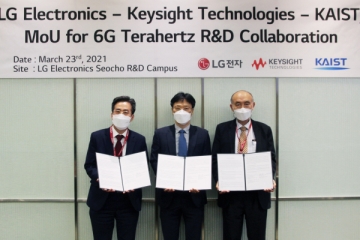
LG Electronics, Keysight, and KAIST to Collaborate on 6G Mobile Communication Technology Development
6G technology is considered a means to enable Ambient Internet of Everything (AIoE) with maximum data transmission of 1Tbps per second. LG Electronics, Keysight Technologies, and Korea Advanced Institute of Science and Technology (KAIST) have signed an MOU for technology development and verification system establishment to secure market dominance in 6G technology, with standardization expected in 2025 and commercialization anticipated in 2029.
2021.03.23by 이수민 기자

ESP32 Development Environment Selection and GPS Application Implementation
The ESP32 is a microcontroller that integrates Wi-Fi, Bluetooth, 12-bit ADC, capacitive touch, PWM, DAC, and UART in a single SoC. However, the abundance of features does not by itself solve the designer's problems. The real challenges lie in selecting the appropriate development environment, determining which pins can be used and which must be avoided, and converting raw data from modules into usable information. This document addresses ESP32 peripheral constraints (ADC2 and Wi-Fi coexistence limitation, UART1 occupancy, ADC non-linear regions), the trade-offs between Arduino IDE and ESP-IDF, and the process from connecting NEO-6M/NEO-M8N GPS modules to UART2, parsing NMEA sentences, and visualizing routes in Google Earth, all organized based on documented references.
2026.10.12by 편집부

[e4ds Tech Day 2026 ⑨] Sim Sang-gyu, Autocrypt CTO: "In the Physical AI Era, Automotive Security Must Extend Beyond the Vehicle"
At e4ds Tech Day 2026, Sim Sang-gyu, CTO of Autocrypt, explained automotive cybersecurity strategies in the era of Physical AI and SDV (Software-Defined Vehicle). Automobiles are evolving as part of an ecosystem connected to AI, cloud, chargers, IoT, and robots, and he emphasized that the scope of security must expand beyond the vehicle interior to the entire connected environment. In particular, AI model tampering, adversarial attacks, OTA updates, and EV charger hacking were identified as major threats. He explained that response measures require zero trust, AI model integrity protection, intrusion detection, Security by Design and Default, and full lifecycle security management, and that proactive security system establishment beyond regulatory compliance is critical for securing future mobility competitiveness.
2026.10.12by 배종인 기자











