



The Korea Electrotechnology Research Institute (KERI) is building an internationally accredited testing infrastructure for HVDC power equipment, worth 18.5 billion won.
 Published2021.07.27 11:16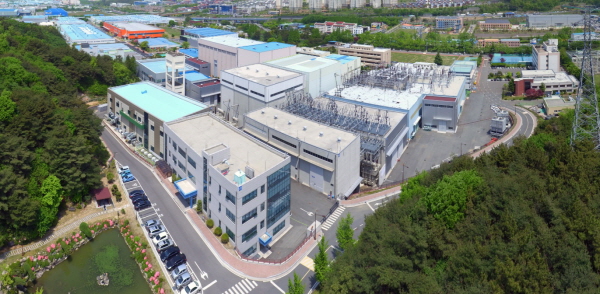
▲A view of the Korea Electrotechnology Research Institute's testing and certification facilities.
Providing effective testing and certification analysis data based on AI and big data.
The Korea Electrotechnology Research Institute (KERI, Acting President Dong-wook Yoo), a government-funded research institute under the National Research Council of Science and Technology of the Ministry of Science and ICT, is building the first large-scale infrastructure in Korea to test and certify power equipment in the field of 'high voltage direct current (HVDC)', which is considered a next-generation power transmission technology, in the Changwon area of Gyeongnam Province. This will contribute to strengthening the export competitiveness of domestic power equipment companies by providing fast and reliable testing and certification services.
On the 27th, the Korea Electric Power Research Institute (KERI) announced that the Ministry of Trade, Industry and Energy, Gyeongnam Province, Changwon City, and KERI will join forces to invest a total of 18.5 billion won to build an 'Internationally Accredited Testing Infrastructure for HVDC Power Equipment' within the premises of the institute's Changwon headquarters. Related projects began in June of last year, and full-scale construction is scheduled to begin in the fourth quarter of this year, with completion targeted for 2023.
Through this infrastructure construction, domestic companies developing HVDC-related technologies and manufacturing power equipment will be able to quickly receive testing and certification at low cost without having to go overseas.
In light of similar testing and certification infrastructure construction projects carried out by KERI, this project is expected to shorten the average product development period by 3.9 months, reduce overseas testing costs by 1.5 billion won per year, and reduce incidental costs (transportation costs, accommodation costs, etc.) by 100 million won. As a result, work efficiency is expected to increase by a whopping 45.3%.
Additionally, it is expected that approximately 2,400 domestic and foreign engineers will visit Gyeongnam and Changwon each year to take the test, and the local economy consumption activation effect is expected to exceed 1 billion won annually.
The comprehensive impact of the 30-year operation of the HVDC test infrastructure to be built this time is estimated to be approximately KRW 157.9 billion in economic ripple effects and approximately 1,000 jobs created.
HVDC (High Voltage Direct Current) is a technology that converts large amounts of electricity produced at power plants into high-voltage direct current and transmits it over long distances.
Direct current transmission maximizes energy efficiency because it has very small line losses compared to alternating current (AC) both underground and overhead during the long-distance power supply process, and because it does not require consideration of phase and frequency, it is easy to transmit power between countries or different power systems.
In particular, it has the advantage of reducing the risk of blackouts by linking with neighboring systems in emergency situations, and since there is no change in current over time, the generation of electromagnetic waves is very small, which can increase social acceptance.
For this reason, the current Experts predict that by 2025, approximately 17 trillion won will be invested in 11 projects, including efforts to secure global leadership in HVDC technology and plans to expand the HVDC power grid in Korea's 8th and 9th Basic Plans for Electricity Supply and Demand.
HVDC requires the transmission of extremely high voltages over long distances, making the reliability and safety of related power equipment and facilities crucial. However, due to the lack of specialized testing infrastructure in Korea to verify the performance of HVDC power equipment, domestic power equipment manufacturers have had no choice but to visit overseas testing labs for testing and certification. This has resulted in financial burdens, delivery delays, and the outflow of core design technology.
Recently, the COVID-19 pandemic has made international travel difficult, making it even more challenging to take tests. To strengthen the export competitiveness of domestic companies in the competitive global market, specialized testing infrastructure for HVDC power equipment is urgently needed.
KERI plans to link the HVDC testing infrastructure being built this time with the 'KERI-University of Waterloo Changwon Artificial Intelligence Research Center' built in July of last year, and provide companies with more effective testing and certification analysis data based on AI and big data technologies.
Kim Jong-wook, head of KERI’s testing department, said, “Our research institute is a regular member of the Short Circuit Testing League (STL), which only has 12 member countries in the world. Test reports with the KERI logo are accepted anywhere in the global power equipment market, giving us a very high brand value.” He added, “We will actively support domestic companies’ product development through our HVDC testing infrastructure so that they can enhance their technological capabilities and strengthen their export competitiveness.”

Comments
Related news
Korea Electric Power Corporation (KEPCO) accelerates development of aerial wind power generation.
The Korea Electrotechnology Research Institute (KERI), representing South Korea's electrical technology and industrial sectors, Korea Electric Power Corporation (KEPCO), and Changwon City in Gyeongnam Province, recognized as a pioneer in the Green New Deal through various eco-friendly policies, are accelerating the localization and development of 'airborne wind power generation,' which is drawing attention as a next-generation renewable energy source.
2021.05.06by 배종인 기자
Electric Research Institute Develops World's 5th 'MW-Class Magnetron'
The Korea Electrotechnology Research Institute (KERI), a specialized electricity research organization under the National Research Council of Science and Technology, Ministry of Science and ICT, with acting president Yoo Dong-wook, announced that a research team led by Dr. Kim Geun-joo and Dr. Kim Jung-il from the Electrical Medical Device Research Center has indigenously developed advanced magnetron technology capable of transmitting high-power megawatt (MW)-class electromagnetic waves used in medical and various industrial fields, achieving the world's fifth such capability.
2021.05.26by 배종인 기자
KERI Ensures Performance and Safety of Electric Ship Batteries
The Korea Electrotechnology Research Institute (hereinafter KERI, Acting Director Yoo Dong-wook) has been designated as Korea's first testing and certification body for eco-friendly electric vessel batteries, and will undertake safety testing of battery cells and modules to prevent explosions and fires, contributing to the realization of carbon neutrality in the marine and fisheries sector.
2021.06.10by 배종인 기자
Schneider Aims for Building Energy Savings and Operational Stability with Next-Generation HVAC Drives
Schneider Electric has unveiled its next-generation HVAC drive product line 'Altivar HVAC'. The new product line's key features center on enhanced energy savings, system operational stability, and building management system integration. The products are divided into 'ATH200' for OEM and small equipment applications, and 'ATH600' for environments requiring continuous operation and advanced control. The company plans to expand the application scope from commercial buildings to facilities where HVAC system stability is critical, such as hospitals, airports, and data centers. The announcement includes over 30% energy savings, operation from -10°C to +60°C, Modbus and BACnet support, and compatibility with low global warming potential refrigerants.
2026.03.26by 명세환 기자
Ecolab Expands AI Data Center Cooling Business Through Acquisition of CoolIT
Ecolab has agreed to acquire CoolIT Systems, a liquid cooling company for AI data centers, for approximately $4.75 billion. The transaction is expected to close by Q3 2026, subject to regulatory approvals. CoolIT has been supplying direct-to-chip cooling-based coolant distribution units, cold plates, and manifolds, serving hyperscale data centers and colocation operators as customers. This acquisition is a measure to address the high-heat and high-density server environments created by AI proliferation. Ecolab plans to combine its water management and digital monitoring capabilities with CoolIT's hardware technology to expand its data center cooling business.
2026.03.26by 명세환 기자











