


Semiconductor, battery, and vaccine tax support begins in earnest.
 Published2021.07.28 08:58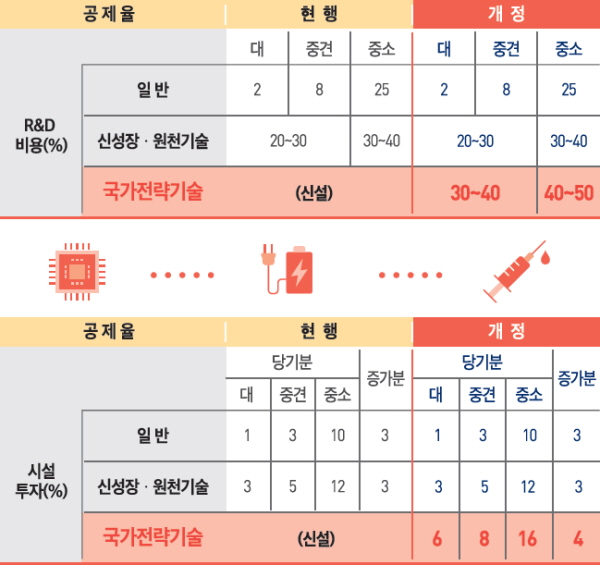
▲Amendment to tax support for national strategic technologies such as semiconductors, batteries, and vaccines
Expanded deduction rates for R&D +10% and facility investment +3-4%
The government will strengthen support for R&D and facility investment in national strategic technologies such as semiconductors, batteries, and vaccines through tax incentives.
The government announced a tax law amendment on the 26th.
Accordingly, it was decided to strengthen tax support for national strategic technology R&D and facility investment to secure next-generation growth engines.
First, the current two-stage structure of general investment and new growth and original technology investment will be reorganized, a third stage, strategic technology, will be established, and the deduction rate will be expanded compared to that for new growth and original technology.
R&D expenses will be increased by +10%p compared to new growth and original technologies, and facility investment will be increased by +3-4%p compared to new growth and original technologies.
In this case, the R&D cost deduction rate is 30-40% for large and medium-sized companies, and 40-50% for small and medium-sized companies. The facility investment deduction rate for the current period is 6% for large corporations, 8% for medium-sized enterprises, and 16% for small and medium-sized enterprises, and the increase is 4%.
The government has selected three fields for national strategic technology support: semiconductors, batteries, and vaccines.
This is because these three fields are experiencing heated competition for global technological hegemony and supply chains, and securing core technologies, production capacity, and supply bases are functioning as diplomatic strategic assets.
In the case of semiconductors, we provide balanced support across sectors to strengthen global competitiveness across the entire industrial ecosystem, including memory, systems, materials, components, and equipment.
Memory includes initial investment in mass production facilities to solidify the gap with overseas competitors, while the system focuses on strengthening global competitiveness in the foundry sector and supporting small and medium-sized fabless companies. The Small Business Administration supports the prevention of recurrence of a material supply crisis and the strengthening of technological competitiveness in parts and equipment.
Specifically, △DRAM design/manufacturing technology and facility investment for 15nm or less, △16nm or less DRAM design/manufacturing technology and facility investment for 170-layer or more NAND flash, △128-layer or more NAND flash, △7nm or less manufacturing technology in the SoC foundry field, △Vehicle/energy efficiency improvement/power semiconductor design/manufacturing technology, etc.
The battery business currently focuses on improving the performance of commercial secondary batteries, securing the lead in next-generation secondary batteries, and supporting the development of four major materials and components.
Vaccines support all stages of development, testing, and production to secure vaccine sovereignty.
The support period is limited to three years, from the second half of 2021 to December 31, 2024.
In addition, tax support for new growth R&D will also be strengthened.
The target technologies include carbon-neutral technologies, biotechnology, and other new industrial technologies, which are eligible for tax credits for new growth and original technology R&D.
The functions of the New Growth and Original Technology Deliberation Committee have been expanded to review existing technology evaluations and the introduction of new technologies, and individual technologies are subject to a sunset provision to periodically evaluate their continued existence.
To expand future growth engines, the application period for the tax credit system for new growth and original technology R&D costs will be extended by three years to December 31, 2024.
Additionally, to support R&D-funded projects, the application period for the R&D government subsidy tax exemption system will be extended by two years to December 31, 2023.
In addition, we are working to support the creation of an intellectual property (IP) market demand and supply ecosystem.
To support the expansion of demand in the oversupplied knowledge goods market, intangible assets Investment tax credits for the acquisition of intellectual property will be permitted, and the scope of eligible assets for the integrated investment tax credit, primarily tangible business assets such as machinery and equipment, will be expanded to include intellectual property acquired by small and medium-sized enterprises. An additional 3% will be added to the basic deduction of 10% for small and medium-sized enterprises and 3% for medium-sized enterprises.
Additionally, the scope of tax reductions for income from the transfer or rental of technology, including patents developed through in-house research and development, will be expanded and extended. The 50% tax reduction on technology transfer income for small and medium-sized enterprises (SMEs) will be extended by two years, until December 31, 2023. The 25% tax reduction on technology rental income for SMEs will also be extended by two years, until December 31, 2023, and SMEs will be added to the exemption starting in 2022.

Comments
Related news
510 trillion won investment in K-semiconductors by 2030
The government will complete the world's largest and most cutting-edge semiconductor supply chain through overwhelming private sector investment of over 510 trillion won by 2030 to realize comprehensive semiconductor superpower status.
2021.05.14by 배종인 기자
K-semiconductor: Tax, financial, and regulatory support begins in earnest.
The government is strengthening infrastructure support through enhanced tax credits, financial assistance, and regulatory relief as follow-up measures to the K-Semiconductor Strategy, thereby establishing a full foundation for semiconductor growth.
2021.07.01by 배종인 기자

K-Semiconductor Strategy: How Possible Is It That 'Korea Becomes a Semiconductor Powerhouse by 2030'?
As the United States has weaponized semiconductor technology against China, China is striking back with massive investments in semiconductor self-sufficiency. Meanwhile, global interest surrounding semiconductors remains intense among Japan, the EU, and Taiwan. In response, the government has been announcing a series of K-Semiconductor strategies since May. This is evaluated as demonstrating the government's commitment to fostering the domestic semiconductor industry in response to major global powers' movements. However, limitations are evident in that the scope of support is broad, differentiation from other countries' policies is limited, and the policies remain not yet concrete.
2021.07.06by 이수민 기자

Intel Unveils Next-Generation 'Core Ultra Series 3' and vPro Platform for Enterprise PCs
Intel has officially unveiled the "Intel Core Ultra Series 3" for next-generation enterprise PCs and the latest vPro platform, addressing a wide range of demands from enterprise notebooks to high-performance workstations.
2026.03.26by 배종인 기자

ROHM Launches ESD Protection Diode Compatible with High-Speed Interfaces of 10Gbps or Higher
Semiconductor specialist ROHM has developed the 'RESDxVx series' of ESD (electrostatic discharge) protection diodes capable of responding to next-generation high-speed data communication environments exceeding 10Gbps, simultaneously enhancing both signal quality maintenance required in high-speed interfaces and IC protection performance.
2026.03.26by 배종인 기자











