


The solution to the mid-term overseas outflow of 'process automation'
 Published2021.08.05 08:54
1 billion won in support for each project over the next two years
The government has begun supporting technology development for 10 urgent tasks that require automation and intelligence of labor-intensive and high-risk processes in manufacturing SMEs that frequently relocate overseas. In the future, 1 billion won will be provided for technology development costs for each task over two years.
The Ministry of SMEs and Startups (Minister Kwon Chil-seung) announced that it has selected 10 "2021 Process and Quality Technology Development" projects to improve manufacturing processes in order to promote the return of overseas factories to Korea and prevent the relocation of domestic factories overseas.
This project supports the development of technologies to convert labor-intensive and high-risk processes into automated and intelligent processes for small and medium-sized manufacturing plants that have already relocated overseas or are likely to do so due to high domestic production costs.
This year's project selection was made after a public announcement in April and an on-site evaluation by external experts, and comprehensively considering the following factors: △Demand for overseas relocation of domestic factories and return of overseas factories to Korea; △Need for process improvement such as labor intensity and industrial accident rate; △Need for government support such as production induction and employment effects.
The 10 projects selected this time are 4 in the automotive sector, 3 in the plastics sector, 2 in the core technology sector (welding and casting), and 1 in the coronavirus diagnostics sector. Each project will receive 1 billion won in technology development costs over 2 years.
Looking at the major selected tasks, first of all, Taem Digitech's wiring harness automation process technology development was selected.
Wiring harnesses are bundles of wires that electrically connect electronic components within a car. Because it is difficult to standardize the various types and lengths of wires, most processes rely on manual labor.
Accordingly, most wiring harness manufacturing plants have been relocated to low-wage countries overseas (China, Vietnam, Mexico), but Hyundai Motor Company's production has been halted due to import disruption caused by COVID-19.
In the future, KMDigtech, a manufacturer of wiring harness equipment, will develop a technology to automate the entire process into a single unit and then supply automation equipment to manufacturers (such as Kyungshin). It is expected to increase productivity (70% reduction in manpower and space) and encourage overseas factories to return to Korea.
Next, Jeonjin Heavy Industries' development of automation and intelligence process technology for large-scale welding structures for construction equipment was selected.
Construction equipment is becoming increasingly large-scale, high-strength structures, but automation is challenging and requires demanding joint and welding performance, leading to a reliance on manual labor and high risks (handling heavy materials and hazardous gases), making it difficult to recruit and retain specialized personnel.
Accordingly, Jeonjin Heavy Industries Co., Ltd., a manufacturer of construction equipment (concrete pump trucks, etc.), is considering outsourcing part of its manufacturing process to Turkey and exporting semi-assembled (CKD) units to India, and additionally relocating its domestic factories overseas (to China, India, etc.).
In the future, through the simplification of the manufacturing process, automation of the welding process, and the development of smart factory technologies for the welding and inspection processes, we plan to improve quality (60%) and reduce costs (30%), localize the entire process, and hire additional facility operation personnel (10 people) without relocating overseas factories.
The Ministry of SMEs and Startups plans to consistently support the development of process improvement technologies on a scale of 10 projects per year. More detailed information can be found on the Ministry of SMEs and Startups website and through the SME Technology Development Project Comprehensive Management System.
Park Jong-chan, head of the Smart Manufacturing Innovation Planning Division at the Ministry of SMEs and Startups, expressed his hope that “this project will contribute to preventing the outflow of manufacturing companies overseas by improving the productivity and cost of small and medium-sized enterprises that are struggling with labor costs and labor shortages.”

Comments
Related news
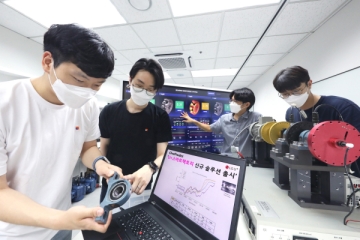
U+ Launches AI-Based Factory Equipment Predictive Maintenance Solution
LG Uplus and OnePredict have launched a new smart factory solution that diagnoses and inspects factory equipment failures and malfunctions in advance. The U+ Smart Factory Equipment Predictive Maintenance Solution performs predictive maintenance on various equipment through AI. It analyzes data on equipment vibration, current, speed and other parameters using AI technology to diagnose condition, and predicts the timing of failure occurrence and remaining service life.
2021.07.29by 이수민 기자
Smart Factory, a Symbol of Manufacturing Innovation: “No Development Without AI Support”
South Korea ranks as one of the world's top five manufacturing countries alongside the United States, China, Germany, and Japan, with manufacturing accounting for 30.4% of total industry—the highest proportion among these nations. Recently, the expansion of smart factories has been identified as a method to enhance manufacturing competitiveness. AI technology serves as a core technology for implementing smart factories, and the development of related technologies and cultivation of talent have emerged as urgent tasks.
2021.08.03by 이수민 기자
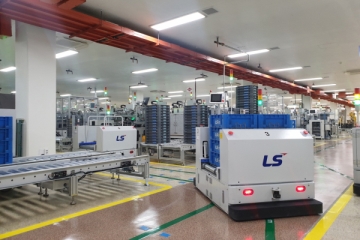
LS Electric Supports Small and Medium-Sized Enterprises to Build Smart Factories
LS Electric is launching its 2021 large and medium-sized enterprise co-prosperity smart factory construction support project in earnest. Through this initiative, LS Electric will provide mentoring, roadmap establishment, and supplier connection support to a total of 18 companies—15 partner companies and 3 domestic general small and medium-sized enterprises—enabling smart factory construction tailored to each company's production conditions.
2021.08.05by 이수민 기자
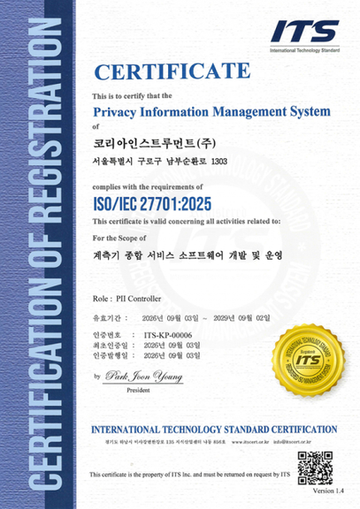
Korea Instrument, KOLAS Accredited Calibration Agency First to Simultaneously Acquire ISO/IEC 27,001·27,701
Korea Instrument has become the first among KOLAS accredited calibration agencies to simultaneously acquire ISO/IEC 27,001 and ISO/IEC 27,701 certifications. Through its proprietary platforms CWIZ Enterprise and CWIZ Partners, the company has embedded information security and personal data protection requirements across all business processes including customer information, equipment data, and calibration reports, with plans to continuously advance its management system through regular audits and security inspections.
2026.10.12by 배종인 기자
TeamViewer One, IT Incident Automation Workflow and Resolution Center Enhanced
TeamViewer has added IT incident automation capabilities and an advanced Resolution Center to its integrated digital workplace management platform 'TeamViewer ONE'. Recurrent service disruptions, configuration errors, and capacity shortages are automatically handled according to preset policies, and device status verification through script deployment can be managed in a unified interface, significantly reducing repetitive tasks for IT teams.
2026.10.12by 배종인 기자











