



ETRI Develops Stretchable Light-Blocking Transparent Film
 Published2021.08.11 11:06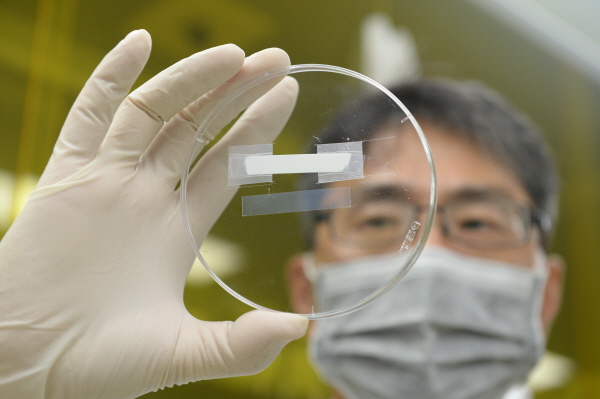
ETRI Principal Researcher Park Seung-gu is adjusting light transmittance by pulling a transparent polymer film.
Applicable to wearables, motion sensors, smart windows, and displays
Domestic researchers have developed a novel material that can block 100% of light by freely stretching a transparent vinyl-like film. With its ability to easily control light transmission and its high elasticity, it is expected to be applicable in various fields such as wearable devices, flexible displays, and smart windows.
The Electronics and Telecommunications Research Institute (ETRI) announced on the 11th that it has developed a transparent polymer film capable of freely controlling light transmittance.
This technology was featured as a cover article in a journal published by the Royal Society of Chemistry (RSC) at the end of last month.
The film developed by ETRI researchers is a film that can expand and contract without adding light intensity control materials or particles, and can block light transmittance up to 100%.
The research team created it using a photocuring method that hardens a polymer solution with light. The polymer and solvent contained in the polymer solution are chemically bonded through light.
The research team identified the relationship between light-reactive polymer materials and solvents, and found the optimal content ratio to naturally disperse the polymers into nanoparticle sizes.
The change in transparency occurring in the film is due to this ratio.
With this, we succeeded in developing a polymer solution capable of blocking light without artificial light intensity control, thereby enabling the implementation of this technology.
The research team explained that the key to this achievement is the change in the refractive index of light due to the spaces between polymers, or pores, created when the polymer film is stretched.
In other words, as the amount of light passing through decreases, the transparent film appears opaque.
The film developed by ETRI researchers is 5cm x 5cm in size and blocks 100% of light even if its length is increased by only about 15–30% depending on the wavelength of visible light.
It is hundreds of times better performance compared to existing films with similar performance.
It is also groundbreaking that light intensity can be controlled using only simple mechanical stimulation without using electricity.
In addition, this technology is identical to the general manufacturing process of domestic polymer film manufacturers, so it can be easily manufactured using existing equipment.
It is advantageous for commercialization as a separate nanoparticle dispersion procedure for controlling light transmittance is eliminated, and large-area fabrication is also easy.
“This achievement allows for easy film manufacturing and easy control depending on the degree to which the film is stretched.” Shin Hyung-cheol, Head of the Human Augmentation Research Lab at ETRI, said, “This achievement makes film manufacturing easy and enables easy control depending on the degree to which the film is stretched.” "Once the application is developed in the future, it can be utilized as a material for conveying information through visual and tactile data by varying the tactile sensations by zone," he said.
In addition, this technology is scheduled to be transferred to polymer film material manufacturers, display manufacturers, and others.
This achievement was researched as part of the Ministry of Science and ICT's 'Research on Source Technologies for Human-Centered Autonomous Intelligent Systems' project.
The research team has filed patents for this technology in five countries, including South Korea, the United States, Germany, Japan, and China.

Comments
Related news
ETRI develops secondary battery cathode structure without solid electrolyte
The cathode of an all-solid-state secondary battery requires a solid electrolyte to form ion transport pathways within the electrode. As the proportion of solid electrolyte increases, the amount of active material decreases relatively, limiting improvements in energy density. In response, ETRI has developed a novel electrode structure in which the cathode is composed solely of titanium disulfide as the active material without a solid electrolyte.
2021.07.14by 이수민 기자
ETRI establishes foundation for verification of anti-hacking encryption algorithms.
Domestic researchers have developed the world's first dedicated cryptanalysis platform. This is expected to accelerate efforts to discover cryptographic algorithms with higher security levels in preparation for the quantum computing era.
2021.07.21by 배종인 기자
ETRI-RFHIC to Localize GaN MMICs for Military Radars
ETRI announced that it is launching a collaborative project to support RFHIC, the only domestic manufacturer producing gallium nitride material-based products, in mass production of gallium nitride MMIC for radar applications, with support from the Ministry of Trade, Industry and Energy and the Ministry of Defense. The two organizations held a joint research laboratory plaque ceremony on the 22nd and signed a memorandum of understanding on business cooperation.
2021.07.22by 이수민 기자
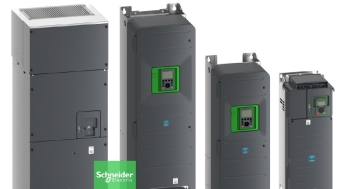
Schneider Aims for Building Energy Savings and Operational Stability with Next-Generation HVAC Drives
Schneider Electric has unveiled its next-generation HVAC drive product line 'Altivar HVAC'. The new product line's key features center on enhanced energy savings, system operational stability, and building management system integration. The products are divided into 'ATH200' for OEM and small equipment applications, and 'ATH600' for environments requiring continuous operation and advanced control. The company plans to expand the application scope from commercial buildings to facilities where HVAC system stability is critical, such as hospitals, airports, and data centers. The announcement includes over 30% energy savings, operation from -10°C to +60°C, Modbus and BACnet support, and compatibility with low global warming potential refrigerants.
2026.03.26by 명세환 기자
Ecolab Expands AI Data Center Cooling Business Through Acquisition of CoolIT
Ecolab has agreed to acquire CoolIT Systems, a liquid cooling company for AI data centers, for approximately $4.75 billion. The transaction is expected to close by Q3 2026, subject to regulatory approvals. CoolIT has been supplying direct-to-chip cooling-based coolant distribution units, cold plates, and manifolds, serving hyperscale data centers and colocation operators as customers. This acquisition is a measure to address the high-heat and high-density server environments created by AI proliferation. Ecolab plans to combine its water management and digital monitoring capabilities with CoolIT's hardware technology to expand its data center cooling business.
2026.03.26by 명세환 기자











