



Expansion of the Autonomous Robot Market Requires the Perfect Match of Sensors, Communications, and Legal Frameworks
 Published2021.08.17 05:00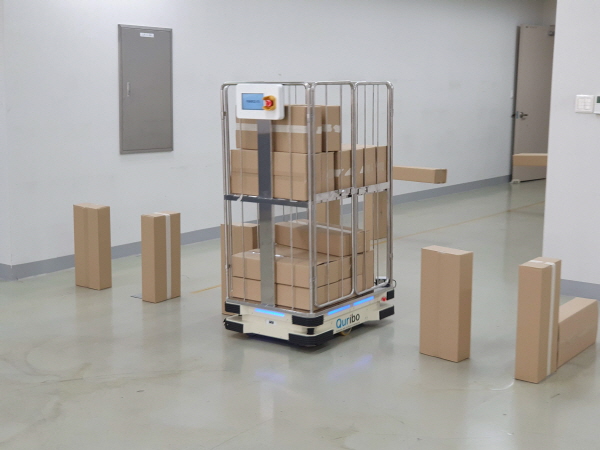
▲ Logistics robot from Curibo, a company specializing in autonomous robots
SLAM implementation of core technologies for sensors such as LiDAR and cameras
Recently, a hamburger brand has been implementing a service that delivers hamburgers to customers using serving robots. In addition, a domestic robotics company is conducting a pilot project to deliver goods to customers using autonomous transport robots, and in state-of-the-art logistics centers recently established, autonomous logistics robots are carrying out sorting and transporting heavy parcels.
These services are emerging as the optimal method for providing contactless services to both customers and field workers in the COVID-19 environment, and are significantly contributing to securing labor and ensuring the safety of workers at various logistics sites.
■ Sensor technology enabling autonomous driving
To enable such services, mechanical engineering elements such as actuators that move the robot are important, but a robot operating system capable of controlling the robot is considered crucial.
Information acquisition is necessary to control robots, and various sensors are being used for this purpose.
A representative sensor is Lidar.
LiDAR sensors are a technology capable of detecting the distance, direction, speed, temperature, material distribution, and concentration characteristics of an object by shining a laser onto it.
Lidar sensors generally utilize the advantages of lasers, which can generate pulse signals with high energy density and short periods, to be used for more precise observation of atmospheric properties and distance measurement.
LiDAR sensors can be classified into time-of-flight (TOF) and phase-shift methods depending on the laser signal modulation method. The TOF method makes it possible to measure distance by emitting a laser pulse signal and measuring the time it takes for reflected pulse signals from objects within the measurement range to arrive at the receiver.
The phase-shift method emits a laser beam that is continuously modulated with a specific frequency and calculates time and distance by measuring the phase change of the signal reflected back from objects within the measurement range.
Image-based sensor sensors utilizing cameras are also used alongside LiDAR. Tesla's autonomous driving system utilizes 2D image sensors based on cameras, excluding LiDAR. Camera-based image-based autonomous driving estimates the robot's position through feature point matching. However, this method has the drawback of requiring the construction of a positioning database using extensive indoor video data for accurate positioning. Additionally, it suffers from the disadvantage that performance decreases if feature points are distorted or insufficient.
■ SLAM, Key to Autonomous Robot Control
Autonomous driving technology is perfected only when the robot can be freely controlled using information collected through sensors. The technology that makes this possible is SALM (Simultaneous Localization And Mapping).
Slam is a map-based technology that essentially explores the surroundings to draw a map and determine one's location.
SLAM technology is fundamentally based on information acquired through sensors such as LiDAR and cameras, and uses the robot's wheel rotation speed to correct position or other auxiliary devices.
Autonomous robots equipped with SLAM technology can independently draw maps and continuously upgrade the map level, enabling them to navigate even narrow paths and reach their destinations accurately using only coordinates.
■ Securing communication networks such as 5G, LTE, and Wi-Fi is essential
Securing communication is essential for controlling autonomous robots. Consequently, telecommunications companies have recently been actively entering the autonomous robot business.
In the past, the range of movement of autonomous robots was limited due to communication limitations, but recently, with reduced communication costs and the spread of 5G, the limitations on the range of movement of autonomous robots are being resolved.
In particular, for autonomous robots, the establishment of 5G mobile communication is essential as there is a lot of long-distance transport such as logistics.
■ Autonomous Robots Must Securing Legal Frameworks
For the widespread adoption of autonomous robots, securing technology and establishing legal frameworks are absolutely necessary.
Currently, acquiring video information by attaching cameras to the exterior of robots for purposes such as generating movement paths and maps is subject to restrictions on the collection and use of identifiable personal information under the Personal Information Protection Act.
In addition, outdoor autonomous robots are classified as 'vehicles' under the current Road Traffic Act, so their passage on sidewalks and crosswalks is restricted.
In addition, it is unclear exactly whether the responsible party should be the robot operator or the robot manufacturer in the event of an accident caused by an autonomous robot.
Accordingly, it is analyzed that for the activation of autonomous robots, the three elements of sensor technology, communication technology, and legal frameworks must be in balance to give momentum to market creation.

Comments
Related news
[Planning] IoT: Transforming Our Lives, Implemented by Cutting-Edge Technology (1) - Sensors
The Internet of Things (IoT) refers to a system in which objects are connected and operate through internet connectivity between things without human intervention. IoT is being applied extensively in our daily lives, often without our awareness, across areas such as health management, power supply, gas, parking facilities, and home appliances. This publication has arranged a series of five sessions to examine the advanced technologies that enable the Internet of Things.
2021.05.17by 배종인 기자
[Interview] STM32 Discovery Day 2021: "Providing Smart IoT and HMI Development Ideas and Insights"
ST Korea will host the 'STM32 Discovery Day Online Track 2021' online over four days from August 17 to 19. The event will introduce the latest solutions and products based on STM32 MCU that enhance wireless communication performance and incorporate improved accessibility and new features. The event will be conducted by ST experts, and demo demonstrations and related videos will be provided to facilitate understanding.
2021.08.09by 이수민 기자
[Interview] Daehyun Kim, CEO of Qribo, “Leading Logistics Robots with Optimized Control Management”
Recently, Curio's CEO Kim Dae-hyun, who was interviewed by this publication, expressed confidence in logistics robot technology and stated his commitment to advancing and expanding the adoption of logistics robot technology going forward.
2021.08.17by 배종인 기자
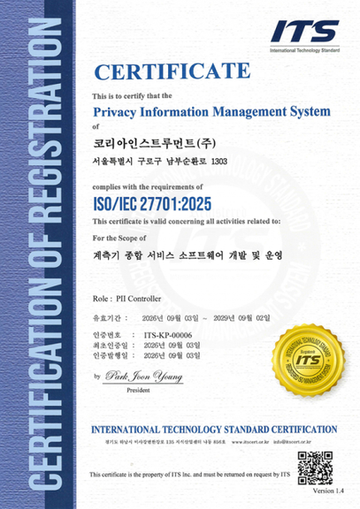
Korea Instrument, KOLAS Accredited Calibration Agency First to Simultaneously Acquire ISO/IEC 27,001·27,701
Korea Instrument has become the first among KOLAS accredited calibration agencies to simultaneously acquire ISO/IEC 27,001 and ISO/IEC 27,701 certifications. Through its proprietary platforms CWIZ Enterprise and CWIZ Partners, the company has embedded information security and personal data protection requirements across all business processes including customer information, equipment data, and calibration reports, with plans to continuously advance its management system through regular audits and security inspections.
2026.10.12by 배종인 기자
TeamViewer One, IT Incident Automation Workflow and Resolution Center Enhanced
TeamViewer has added IT incident automation capabilities and an advanced Resolution Center to its integrated digital workplace management platform 'TeamViewer ONE'. Recurrent service disruptions, configuration errors, and capacity shortages are automatically handled according to preset policies, and device status verification through script deployment can be managed in a unified interface, significantly reducing repetitive tasks for IT teams.
2026.10.12by 배종인 기자











